

GRE Prep Club Daily Prep
Thank you for using the timer - this advanced tool can estimate your performance and suggest more practice questions. We have subscribed you to Daily Prep Questions via email.
Customized
for You
Track
Your Progress
Practice
Pays
Not interested in getting valuable practice questions and articles delivered to your email? No problem, unsubscribe here.
 Sep 28
Live Online Class with Top GRE Expert Mike Butville
08:00 PM EDT
-10:00 PM EDT
Top scores are possible when you enroll in a powerful GRE course, taught live online + 6 months access to TTP GRE OnDemand video courses included! Class starts Mon/Wed Sept. 28, 2026 - Dec. 9, 2026, 8:00pm-10:00pm EST

Efficient quick tests to boost your GRE score
[#permalink]
 Updated on: 05 Jun 2026, 12:38
Updated on: 05 Jun 2026, 12:38
1
Expert Reply
2
Bookmarks
Efficient, quick tests to boost your GRE score
GRE Prep Club – Mini Test Series
Introduction:
Welcome to the GRE Prep Club Mini Test Series, an innovative and streamlined practice platform designed for busy students. This new project offers a series of condensed, high-impact practice sessions tailored to the specific demands of the GRE General Test.
Traditional practice tests are essential, but often require significant, uninterrupted blocks of time. This Mini Test Series addresses this challenge by providing a nimble, modular approach. It allows you to fit effective GRE prep into any window in your schedule—whether it’s twenty minutes on your commute, during a lunch break, or between lectures.
Efficiency and Balance
The Mini Test Series is built on the principle that consistent, focused effort leads to dramatic score improvements.
By distilling the full exam experience into shorter, adaptive segments, we help you avoid fatigue and maintain peak concentration. Each mini-test is carefully balanced, encompassing both core measures of the GRE General Test:
- Quantitative Reasoning: Practice essential problem-solving skills, interpretation of data, and the application of arithmetic, algebra, geometry, and data analysis. Our on-screen calculator interface and geometric visualization tools are designed to simulate the official testing environment.
- Verbal Reasoning: Sharpen your critical thinking, text completion, sentence equivalence, and reading comprehension abilities. Analyze complex discourse, evaluate arguments, and strengthen your vocabulary contextually.
Our Vision
The GRE Prep Club Mini Test Series is your flexible partner on the path to graduate school. Our mission is to provide you with a powerful tool that transforms fragmented moments into a comprehensive, balanced study regimen.
Don't wait for the 'perfect' study block. Use every moment. Start Your Mini Test Now!
Thanks to GeminiHeat for the precious collaboration.
Show: ::
Attachment:
GRE Efficient, quick tests to boost your GRE score.png [ 1.3 MiB | Viewed 3885 times ]
Attachment:
GRE quick tests.png [ 1.75 MiB | Viewed 94542 times ]
Efficient quick tests to boost your GRE score
[#permalink]
Updated on: 06 Jun 2026, 03:12
Updated on: 06 Jun 2026, 03:12
Expert Reply
1
Bookmarks
Mini Test #1
Quantitative
Question #1
In a certain company, \(3\) % of the employees in Department \(\mathrm{X}\) received a promotion. In Department \(\mathrm{Y}, 9\) % of the employees received a promotion.
A. Quantity A is greater.
B. Quantity B is greater.
C. The two quantities are equal.
D. The relationship cannot be determined from the information given.
Question #2
A factory produces 5 batches of light bulbs. The average number of bulbs per batch is 42. Two additional batches are produced, containing \(r\) and \(s\) bulbs, respectively. The new average across all 7 batches is 44.
A. Quantity A is greater.
B. Quantity B is greater.
C. The two quantities are equal.
D. The relationship cannot be determined from the information given.
Question #3
Let y be any real number.
A. Quantity A is greater.
B. Quantity B is greater.
C. The two quantities are equal.
D. The relationship cannot be determined from the information given.
Question #4
Circle O has a radius of 10. Points A, B, and C lie on the circle such that chord A B has length 12 and chord B C has length 12. Point D is the midpoint of chord A B. Point E is the midpoint of chord B C.
Let x be the distance from O to D.
Let y be the distance from O to E.
Let z be the distance from D to E.
A. Quantity A is greater.
B. Quantity B is greater.
C. The two quantities are equal.
D. The relationship cannot be determined from the information given.
Question #5
A digital image is 1200 pixels wide and 800 pixels tall. A graphic designer increases the width by a factor of 1.10 and decreases the height by a factor of 0.90.
What is the percent change in the total number of pixels (area) of the image?
A. The area decreases by 2 percent.
B. The area increases by 1 percent.
C. The area decreases by 1 percent.
D. The area does not change.
E. The area decreases by 10 percent.
Question #6
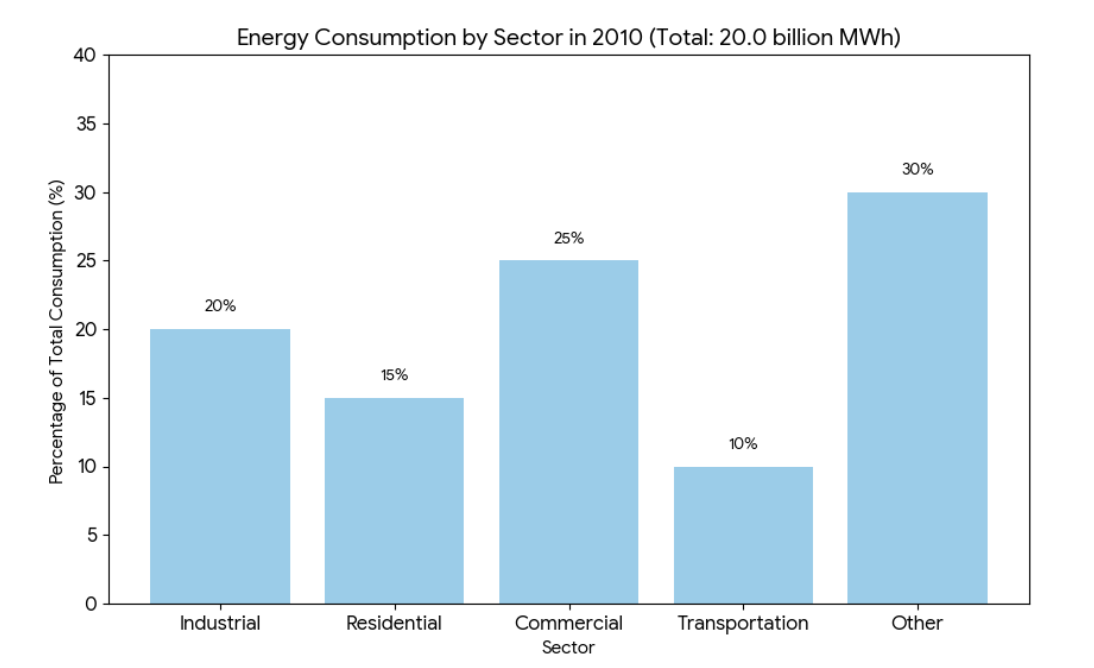
GRE consumption.png [ 71.48 KiB | Viewed 3664 times ]
The total energy consumption for a specific region was 20.0 billion MWh in 2010. Based on the graph provided below, for how many sectors was the energy consumption in 2010 greater than 3.0 billion MWh?
(1 billion = 1,000,000,000)
A. One
B. Two
C. Three
D. Four
E. Five
Question #7
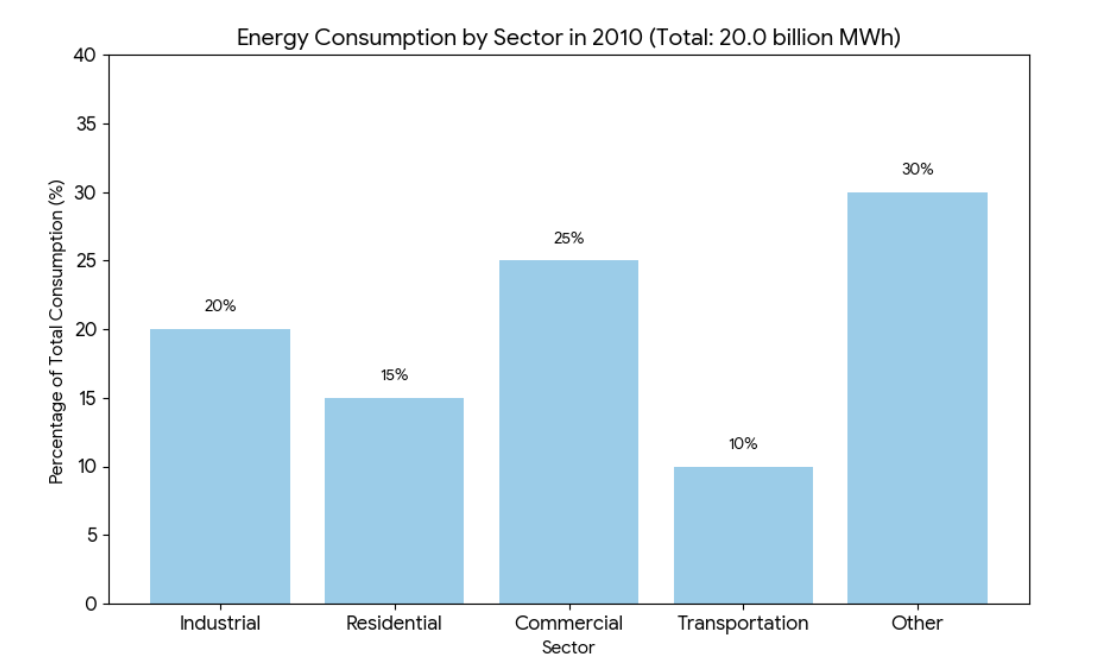
The total energy consumption for a specific region was 20.0 billion MWh in 2010. If the energy consumption for the "Residential" sector is projected to increase by 20 percent from 2010 to 2011, while all other sectors remain constant at their 2010 levels, what will be the total energy consumption for the region in 2011?
A. 20.3 billion MWh
B. 20.6 billion MWh
C. 21.0 billion MWh
D. 23.0 billion MWh
E. 24.0 billion MWh
Question #8
If the "Industrial" sector consumes 4.0 billion MWh in 2010, and this consumption represents a 25 percent decrease from its consumption in 2005, what was the "Industrial" sector's consumption in 2005?
A. 5.0 billion MWh
B. 5.33 billion MWh
C. 6.0 billion MWh
D. 7.5 billion MWh
E. 8.0 billion MWh
Question #9
When the integer \(m\) is divided by 45 , the remainder is 24 . Which of the following must be a divisor of \(m \)?
A. 3
B. 5
C. 6
D. 9
E. 15
Question #10
Suppose \(\frac{x}{y}=0.5\). For which of the following expressions is the value always equal to 0.5 ?
A. \(\frac{x}{x+y}\)
B. \(\frac{y}{x+y}\)
C. \(\frac{y-x}{x}\)
D. \(\frac{y-x}{y}\)
E. \(\frac{x+y}{y}\)
Question #11
A bookstore buys hardcover novels at a wholesale price of $ 25 each and sells most of them at a retail price of $ 40 each. During a clearance event, the remaining novels are sold at a reduced price, lowering the retail price by y dollars per novel. The store's profit from selling each clearance novel is more than 20 percent of its wholesale price.
Which of the following could be the value of y?
Indicate all such values.
□ 6
□ 8
□ 10
□ 12
Question #12
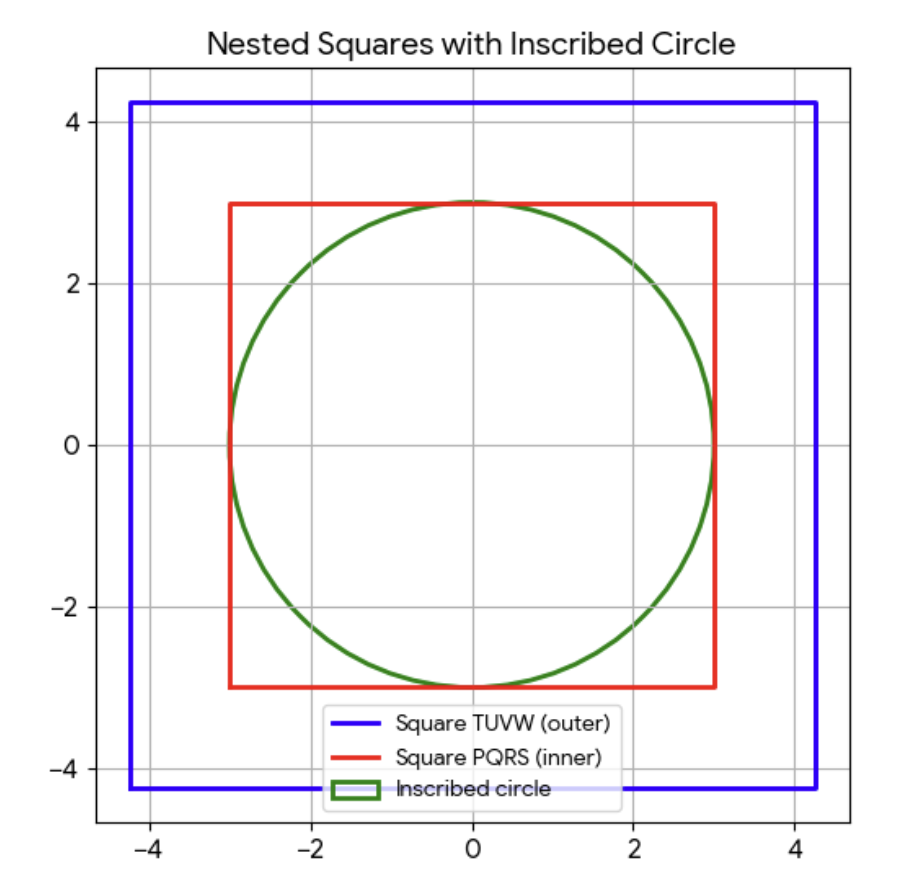
GRe In the figure below, square P Q R S .png [ 111.63 KiB | Viewed 3446 times ]
In the figure below, square P Q R S is centered within square T U V W. The sides of both squares are parallel to the coordinate axes. A circle is inscribed in square P Q R S. The radius of the circle is 3 . If the distance between the parallel sides of the two squares is exactly 1.5 , what is the perimeter of square T U V W ?
Step-by-Step Logic:
1 Analyze the Inner Square ( P Q R S ): The circle is inscribed in P Q R S, and its radius is 3 . Therefore, the side length of P Q R S is \(2 \times 3=6\).
2 Determine the Outer Square ( $T U V W$ ) side length: The problem states there is a gap of 1.5 between the parallel sides of the two squares.
- The side of the outer square extends past the inner square on both sides.
- Side length of $T U V W=($ Side length of P Q R S)+( gap on left )+ (gap on right)
- Side length =6+1.5+1.5=9.
3 Calculate the Perimeter: The perimeter of a square is \(4 \times\) side length.
- Perimeter \(=4 \times 9=36\).
Correct Answer: 36
---------------------------------------------------------------------------------------------
Verbal
Question #1
That the language in which climate scientists frame their predictions of future food system collapse is often dismissed by skeptics as needlessly ________ does not, in the end, diminish the sobering validity of the underlying data: crop yields are already declining, and arable land grows scarcer by the decade.
Question #2
That subterranean termite colonies proliferate most readily in tropical soils is a phenomenon whose explanation cannot be reduced simply to ambient heat; such an account would be not merely (i) ______ , given that regions exist where the climate is scorching yet these insects remain (ii) ________ .
Question #3
For those who maintain that commercial integrity rests upon a foundation of rigorous state (i) ________ the Italian maritime republics of the late Middle Ages must appear as a thoroughgoing (ii) ________ . The statutes governing Genoese and Venetian trade were a tangled thicket of overlapping jurisdictions, riddled with loopholes and enforced only sporadically - conditions that, by any reasonable expectation, ought to have bred endemic corruption. That Genoa nonetheless emerged during precisely this period as a hub of Mediterranean commerce, a city widely regarded as an exceptionally (iii) ________ place in which to conduct business, defies such tidy causal assumptions.
Question #4/5
1) It can be inferred from the passage that proponents of the irrigation-pump explanation assume that any increase in water extraction from the Lake Chad catchment basin would
A. not have been fully compensated for by cooler temperatures during the late 1960s through the 1980s.
B. not have been substantial enough to measurably lower the water table in the early decades of the twentieth century.
C. have been counterbalanced by the moderating influence of increased cloud cover during the period of most acute shrinkage.
D. have been concentrated disproportionately in the Nigerian portion of the basin rather than the Chadian portion during the 1980s.
E. have exerted a more severe impact during the 1980s than during the initial phase of pump introduction in the 1960s.
2) Which of the following best describes the overall organization of the passage?
A. A theory is identified, and its applicability to a specific instance is illustrated.
B. A phenomenon is described, and two alternative explanations for that phenomenon are considered.
C. A hypothesis is presented, its explanatory limitations are noted, and an alternative hypothesis is offered.
D. An observation is noted, two competing theories about it are presented, and one theory is rejected.
E. An anomaly is mentioned, conjectures about its source are advanced, and further investigation is called for.
Question #6
The ________ of the symphony orchestra's cultural authority, though already underway by the late 1960s, was masked for nearly a decade by a surge in government arts funding that gave the impression of an institution still very much in its ascendancy.
Question #7
The reintroduction of captive-bred individuals into dwindling amphibian populations is widely ________ as a conservation strategy, yet a growing body of field research warns that such releases can introduce novel pathogens that devastate the very wild communities they aim to bolster.
Question #8
That the broad contours of the Aksumite kingdom's emergence as a regional power are beyond scholarly dispute does not alter the fact that the particulars of its early royal succession remain shrouded in uncertainty, a consequence of the marked ________ of contemporaneous inscriptions from the formative period.
Question #9
The architectural critic Lewis Mumford was ______ in the view of his detractors, from ranking among the most authoritative voices on urban planning by what they saw as his stubborn romanticism and his refusal to engage with quantitative data, even as his champions placed him at the very pinnacle of the field.
Question #10/11/12
1) According to the passage, the populations inhabiting the Indus periphery before the Mature Harappan phase would most likely have
A. already initiated tentative experimentation with cultivating domesticated cereals other than millet.
B. employed subterranean granaries chiefly to store foraged Chenopodium seeds gathered from the wild.
C. processed whatever millet they may have encountered in ways that did little to augment its nutritional utility.
D. depended on wild game and foraged plant resources to meet a significant share of their caloric requirements.
E. constructed threshing floors that they later repurposed for the large-scale processing of harvested millet grain.
2) The discussion of millet's inherently low bioavailability of niacin and essential amino acids functions in the passage chiefly to
A. document the specific grain-preparation techniques employed by Indus periphery communities during the Mature Harappan phase.
B. account for why these frontier populations exhibited a preference for certain food-processing methods over alternative approaches.
C. lend weight to a claim advanced in the passage about the dietary role millet played among the inhabitants of these frontier settlements.
D. diagnose the reasons that certain researchers have, in the author's view, inflated the importance of millet cultivation at these sites.
E. elucidate the agricultural logic behind the substantial quantities of millet that were evidently cultivated in the Indus periphery.
3) The passage most strongly supports which of the following generalizations about societies that have relied on millet as a dietary staple?
A. Such societies have typically had access to fired clay vessels or dedicated milling installations.
B. Such societies have customarily combined domesticated cereals with wild food sources in their regular diet.
C. Such societies have rarely made use of threshing floors as part of their grain-processing toolkit.
D. Such societies have seldom constructed subterranean granaries for the extended storage of harvested crops.
E. Such societies have infrequently cultivated millet in volumes adequate to generate a meaningful surplus.
Quantitative
Question #1
In a certain company, \(3\) % of the employees in Department \(\mathrm{X}\) received a promotion. In Department \(\mathrm{Y}, 9\) % of the employees received a promotion.
Quantity A |
Quantity B |
The number of employees promoted in Department X |
The number of employees promoted in Department Y |
A. Quantity A is greater.
B. Quantity B is greater.
C. The two quantities are equal.
D. The relationship cannot be determined from the information given.
Show: :: solution
Step 1 - Understand the given information
- Department X promotion rate =3 %
- Department Y promotion rate =9 %
- Actual number of employees in each department is not given
Step 2 - Express Quantities in terms of unknown totals
Let x= total employees in Department X
Let y= total employees in Department Y
Quantity \(\mathrm{A}=0.03 x\)
Quantity \(\mathrm{B}=0.09 y\)
Step 3 - Compare
Without knowing $x$ and $y$, we cannot determine which is larger.
The answer is D
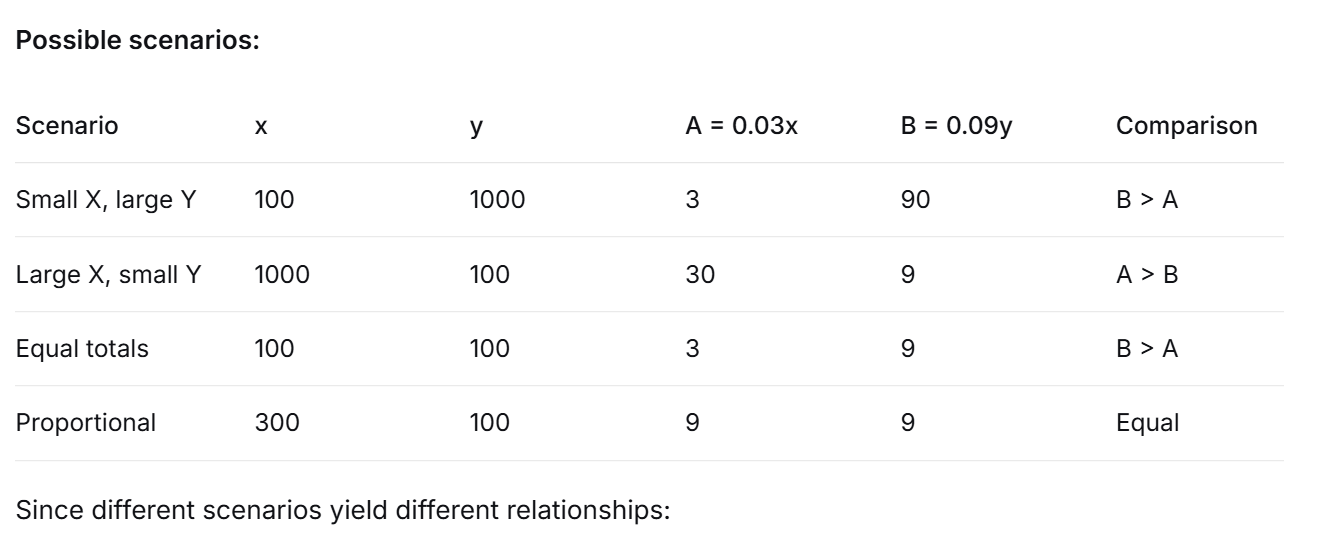
GRE table (2).png [ 63.92 KiB | Viewed 3366 times ]
- Department X promotion rate =3 %
- Department Y promotion rate =9 %
- Actual number of employees in each department is not given
Step 2 - Express Quantities in terms of unknown totals
Let x= total employees in Department X
Let y= total employees in Department Y
Quantity \(\mathrm{A}=0.03 x\)
Quantity \(\mathrm{B}=0.09 y\)
Step 3 - Compare
Without knowing $x$ and $y$, we cannot determine which is larger.
The answer is D
Attachment:
GRE table (2).png [ 63.92 KiB | Viewed 3366 times ]
Question #2
A factory produces 5 batches of light bulbs. The average number of bulbs per batch is 42. Two additional batches are produced, containing \(r\) and \(s\) bulbs, respectively. The new average across all 7 batches is 44.
Quantity A |
Quantity B |
The average (arithmetic mean) of \(r\) and \(s\) |
49 |
A. Quantity A is greater.
B. Quantity B is greater.
C. The two quantities are equal.
D. The relationship cannot be determined from the information given.
Show: :: Solution
Step 1 - Find sum of first 5 batches
\(\text { Sum of } 5 \text { batches }=5 \times 42.0=210\)
Step 2 - Find sum of all 7 batches
\(\text { Sum of } 7 \text { batches }=7 \times 44.0=308\)
Step 3 - Find sum of \(r+s\)
\(r+s=308-210=98\)
Step 4 - Find average (arithmetic mean) of r and s
\(\frac{r+s}{2}=\frac{98}{2}=49.0\)
Step 5 - Compare with Quantity B
Quantity \(\mathrm{A}=49.0, \quad\) Quantity \(\mathrm{B}=49.0\)
The two quantities are equal
The answer is C
\(\text { Sum of } 5 \text { batches }=5 \times 42.0=210\)
Step 2 - Find sum of all 7 batches
\(\text { Sum of } 7 \text { batches }=7 \times 44.0=308\)
Step 3 - Find sum of \(r+s\)
\(r+s=308-210=98\)
Step 4 - Find average (arithmetic mean) of r and s
\(\frac{r+s}{2}=\frac{98}{2}=49.0\)
Step 5 - Compare with Quantity B
Quantity \(\mathrm{A}=49.0, \quad\) Quantity \(\mathrm{B}=49.0\)
The two quantities are equal
The answer is C
Question #3
Let y be any real number.
Quantity A |
Quantity B |
The arithmetic mean of \((y+1)^2\) and \((y-1)^2\) |
\( y \times y\) |
A. Quantity A is greater.
B. Quantity B is greater.
C. The two quantities are equal.
D. The relationship cannot be determined from the information given.
Show: :: Solution
Quantity \(\mathrm{A}=\frac{(y+1)^2+(y-1)^2}{2}=y^2+1\)
Quantity \(\mathrm{B}=y^2\)
\(y^2+1>y^2 \quad\) for all real y
Quantity A is greater
Quantity \(\mathrm{B}=y^2\)
\(y^2+1>y^2 \quad\) for all real y
Quantity A is greater
Question #4
Circle O has a radius of 10. Points A, B, and C lie on the circle such that chord A B has length 12 and chord B C has length 12. Point D is the midpoint of chord A B. Point E is the midpoint of chord B C.
Let x be the distance from O to D.
Let y be the distance from O to E.
Let z be the distance from D to E.
Quantity A |
Quantity B |
x |
y+z |
A. Quantity A is greater.
B. Quantity B is greater.
C. The two quantities are equal.
D. The relationship cannot be determined from the information given.
Show: :: Solution
Step 1 - Find x (distance from center to midpoint of chord $A B$ )
For a chord of length L in a circle of radius R :
\(\begin{aligned}
& \text { Distance from center to chord }=\sqrt{R^2-\left(\frac{L}{2}\right)^2} \\
& x=\sqrt{10^2-\left(\frac{12}{2}\right)^2}=\sqrt{100-36}=\sqrt{64}=8
\end{aligned}\)
Step 2 - Find y
By symmetry, chord $B C$ also has length 12 , so:
\(y=\sqrt{10^2-\left(\frac{12}{2}\right)^2}=8\)
Step 3 - Analyze z=D E
Points D and E are midpoints of chords $A B$ and B C sharing point B. The distance z depends on the angle between the two chords.
- If chords are very close (small angle at $B$ ), z is small (approaches 0 )
- If chords are far apart, $z$ can be large (up to the distance between two points on the circle)
Since $D$ and $E$ are distinct points, z>0.
Step 4 - Compare
Quantity \(\mathrm{A}=8\)
Quantity \(\mathrm{B}=y+z=8+z\)
Because \(z>0 \):
\(8+z>8\)
Quantity B > Quantity A
Step 5 - Conclusion
Quantity B is greater
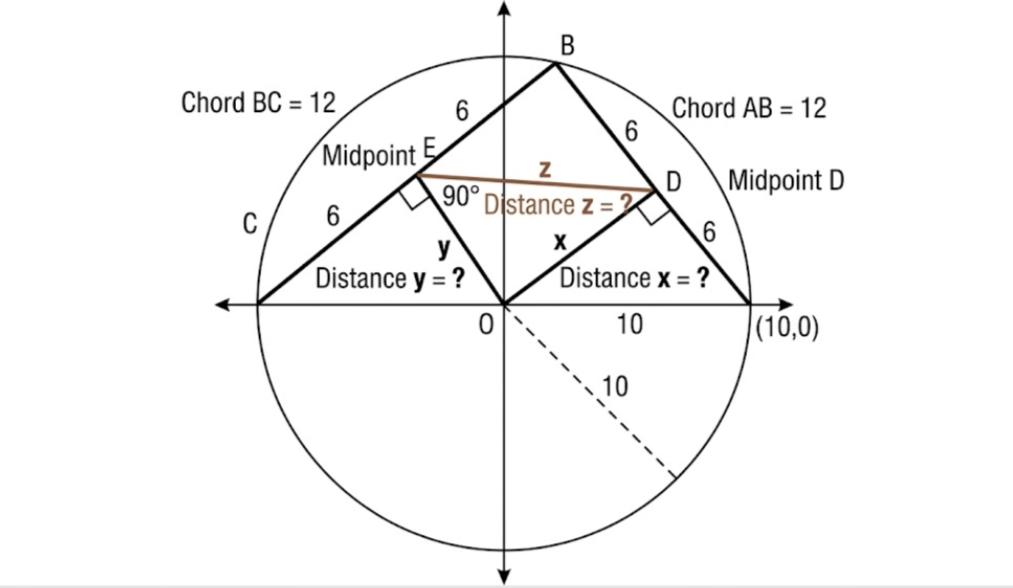
GRE circle (3).png [ 164.57 KiB | Viewed 3370 times ]
For a chord of length L in a circle of radius R :
\(\begin{aligned}
& \text { Distance from center to chord }=\sqrt{R^2-\left(\frac{L}{2}\right)^2} \\
& x=\sqrt{10^2-\left(\frac{12}{2}\right)^2}=\sqrt{100-36}=\sqrt{64}=8
\end{aligned}\)
Step 2 - Find y
By symmetry, chord $B C$ also has length 12 , so:
\(y=\sqrt{10^2-\left(\frac{12}{2}\right)^2}=8\)
Step 3 - Analyze z=D E
Points D and E are midpoints of chords $A B$ and B C sharing point B. The distance z depends on the angle between the two chords.
- If chords are very close (small angle at $B$ ), z is small (approaches 0 )
- If chords are far apart, $z$ can be large (up to the distance between two points on the circle)
Since $D$ and $E$ are distinct points, z>0.
Step 4 - Compare
Quantity \(\mathrm{A}=8\)
Quantity \(\mathrm{B}=y+z=8+z\)
Because \(z>0 \):
\(8+z>8\)
Quantity B > Quantity A
Step 5 - Conclusion
Quantity B is greater
Attachment:
GRE circle (3).png [ 164.57 KiB | Viewed 3370 times ]
Question #5
A digital image is 1200 pixels wide and 800 pixels tall. A graphic designer increases the width by a factor of 1.10 and decreases the height by a factor of 0.90.
What is the percent change in the total number of pixels (area) of the image?
A. The area decreases by 2 percent.
B. The area increases by 1 percent.
C. The area decreases by 1 percent.
D. The area does not change.
E. The area decreases by 10 percent.
Show: :: Solution
Solution
Step 1- Original area
\(\text { Original pixels }=1200 \times 800=960,000\)
Step 2 - New dimensions
\(\begin{aligned}
& \text { New width }=1200 \times 1.10=1320 \\
& \text { New height }=800 \times 0.90=720
\end{aligned}\)
Step 3 - New area
\(
\text { New pixels }=1320 \times 720=950,400\)
Step 4 - Percent change
\(\frac{950,400-960,000}{960,000} \times 100 \%=\frac{-9,600}{960,000} \times 100\) %\(=-1 \)%
Step 5 - Conclusion
The area decreases by 1 percent.
The answer is C
Step 1- Original area
\(\text { Original pixels }=1200 \times 800=960,000\)
Step 2 - New dimensions
\(\begin{aligned}
& \text { New width }=1200 \times 1.10=1320 \\
& \text { New height }=800 \times 0.90=720
\end{aligned}\)
Step 3 - New area
\(
\text { New pixels }=1320 \times 720=950,400\)
Step 4 - Percent change
\(\frac{950,400-960,000}{960,000} \times 100 \%=\frac{-9,600}{960,000} \times 100\) %\(=-1 \)%
Step 5 - Conclusion
The area decreases by 1 percent.
The answer is C
Question #6
Attachment:
GRE consumption.png [ 71.48 KiB | Viewed 3664 times ]
The total energy consumption for a specific region was 20.0 billion MWh in 2010. Based on the graph provided below, for how many sectors was the energy consumption in 2010 greater than 3.0 billion MWh?
(1 billion = 1,000,000,000)
A. One
B. Two
C. Three
D. Four
E. Five
Show: ::
Step 1: Determine the threshold in percentage terms.
The total energy consumption in 2010 was 20.0 billion MWh. To find out how many sectors had consumption greater than 3.0 billion MWh , we calculate the required percentage threshold:
\(\text { Threshold Percentage }=\frac{3.0 \text { billion MWh }}{20.0 \text { billion MWh }} \times 100\) %\(=15\) %
Any sector with more than \(\mathbf{1 5} \boldsymbol{\%}\) of the total consumption exceeds 3.0 billion MWh .
Step 2: Evaluate each sector from the graph.
- Industrial: 20% (Greater than 15%) - Yes
- Residential: 15 % (Equal to 15 %, not greater than) - No
- Commercial: 25 % (Greater than 15 %$) - Yes
- Transportation: 10 % (Less than 15 %$ ) - No
- Other: 30 % (Greater than 15 % ) - Yes
Step 3: Count the sectors.
The sectors that exceed 15\% are Industrial, Commercial, and Other. There are three such sectors.
Correct Answer: C
The total energy consumption in 2010 was 20.0 billion MWh. To find out how many sectors had consumption greater than 3.0 billion MWh , we calculate the required percentage threshold:
\(\text { Threshold Percentage }=\frac{3.0 \text { billion MWh }}{20.0 \text { billion MWh }} \times 100\) %\(=15\) %
Any sector with more than \(\mathbf{1 5} \boldsymbol{\%}\) of the total consumption exceeds 3.0 billion MWh .
Step 2: Evaluate each sector from the graph.
- Industrial: 20% (Greater than 15%) - Yes
- Residential: 15 % (Equal to 15 %, not greater than) - No
- Commercial: 25 % (Greater than 15 %$) - Yes
- Transportation: 10 % (Less than 15 %$ ) - No
- Other: 30 % (Greater than 15 % ) - Yes
Step 3: Count the sectors.
The sectors that exceed 15\% are Industrial, Commercial, and Other. There are three such sectors.
Correct Answer: C
Question #7
The total energy consumption for a specific region was 20.0 billion MWh in 2010. If the energy consumption for the "Residential" sector is projected to increase by 20 percent from 2010 to 2011, while all other sectors remain constant at their 2010 levels, what will be the total energy consumption for the region in 2011?
A. 20.3 billion MWh
B. 20.6 billion MWh
C. 21.0 billion MWh
D. 23.0 billion MWh
E. 24.0 billion MWh
Show: :: solution
Solution and Logic:
1 Find 2010 Residential consumption: The chart shows Residential at 15 % .\(15 \)% \(\times 20.0 billion = 3.0\) billion MWh.
2 Calculate the increase: A 20 percent increase on 3.0 billion is \(3.0 \times 0.20= 0.6\) billion MWh.
3 Calculate new total: The original total was 20.0 billion, and we added 0.6 billion. The new total is \(20.0+0.6=20.6\) billion MWh.
Correct Answer: B
1 Find 2010 Residential consumption: The chart shows Residential at 15 % .\(15 \)% \(\times 20.0 billion = 3.0\) billion MWh.
2 Calculate the increase: A 20 percent increase on 3.0 billion is \(3.0 \times 0.20= 0.6\) billion MWh.
3 Calculate new total: The original total was 20.0 billion, and we added 0.6 billion. The new total is \(20.0+0.6=20.6\) billion MWh.
Correct Answer: B
Question #8
If the "Industrial" sector consumes 4.0 billion MWh in 2010, and this consumption represents a 25 percent decrease from its consumption in 2005, what was the "Industrial" sector's consumption in 2005?
A. 5.0 billion MWh
B. 5.33 billion MWh
C. 6.0 billion MWh
D. 7.5 billion MWh
E. 8.0 billion MWh
Show: :: solution
Solution and Logic:
1 Understand the relationship: Let x be the consumption in 2005. A 25 percent decrease means \(x-0.25 x=4.0\), or \(0.75 x=4.0\).
2 Solve for x :
\(x=\frac{4.0}{0.75}\)
\(x=\frac{4.0}{3 / 4}\)
\(x=4.0 \times \frac{4}{3}=\frac{16}{3} \approx 5.33 \text { billion } \mathrm{MWh}\)
3 Double check: \(5.333-(0.25 \times 5.333)=5.333-1.333=4.0\).
Correct Answer: B
1 Understand the relationship: Let x be the consumption in 2005. A 25 percent decrease means \(x-0.25 x=4.0\), or \(0.75 x=4.0\).
2 Solve for x :
\(x=\frac{4.0}{0.75}\)
\(x=\frac{4.0}{3 / 4}\)
\(x=4.0 \times \frac{4}{3}=\frac{16}{3} \approx 5.33 \text { billion } \mathrm{MWh}\)
3 Double check: \(5.333-(0.25 \times 5.333)=5.333-1.333=4.0\).
Correct Answer: B
Question #9
When the integer \(m\) is divided by 45 , the remainder is 24 . Which of the following must be a divisor of \(m \)?
A. 3
B. 5
C. 6
D. 9
E. 15
Show: ::
Step 1- Write the general form
\(m=45 k+24\)
where $k$ is a non-negative integer.
Step 2 - Factor the expression
\(m=45 k+24=3 \times(15 k+8)\)
So \(m\) is always divisible by 3 .
The answer is A
\(m=45 k+24\)
where $k$ is a non-negative integer.
Step 2 - Factor the expression
\(m=45 k+24=3 \times(15 k+8)\)
So \(m\) is always divisible by 3 .
The answer is A
Question #10
Suppose \(\frac{x}{y}=0.5\). For which of the following expressions is the value always equal to 0.5 ?
A. \(\frac{x}{x+y}\)
B. \(\frac{y}{x+y}\)
C. \(\frac{y-x}{x}\)
D. \(\frac{y-x}{y}\)
E. \(\frac{x+y}{y}\)
Show: ::
Solution
Given: \(\frac{x}{y}=0.5=\frac{1}{2} \Rightarrow y=2 x\)
Let \(x=k, y=2 k\).
Test each:
A: \(\frac{x}{x+y}=\frac{k}{k+2 k}=\frac{k}{3 k}=\frac{1}{3} \approx 0.333\)
B: \(\frac{y}{x+y}=\frac{2 k}{3 k}=\frac{2}{3} \approx 0.667\)
C: \(\frac{y-x}{x}=\frac{2 k-k}{k}=\frac{k}{k}=1\)
D: \(\frac{y-x}{y}=\frac{2 k-k}{2 k}=\frac{k}{2 k}=\frac{1}{2}=0.5\)
E: \(\frac{x+y}{y}=\frac{k+2 k}{2 k}=\frac{3 k}{2 k}=\frac{3}{2}=1.5\)
D is the answer \(\frac{y-x}{y}\)
Given: \(\frac{x}{y}=0.5=\frac{1}{2} \Rightarrow y=2 x\)
Let \(x=k, y=2 k\).
Test each:
A: \(\frac{x}{x+y}=\frac{k}{k+2 k}=\frac{k}{3 k}=\frac{1}{3} \approx 0.333\)
B: \(\frac{y}{x+y}=\frac{2 k}{3 k}=\frac{2}{3} \approx 0.667\)
C: \(\frac{y-x}{x}=\frac{2 k-k}{k}=\frac{k}{k}=1\)
D: \(\frac{y-x}{y}=\frac{2 k-k}{2 k}=\frac{k}{2 k}=\frac{1}{2}=0.5\)
E: \(\frac{x+y}{y}=\frac{k+2 k}{2 k}=\frac{3 k}{2 k}=\frac{3}{2}=1.5\)
D is the answer \(\frac{y-x}{y}\)
Question #11
A bookstore buys hardcover novels at a wholesale price of $ 25 each and sells most of them at a retail price of $ 40 each. During a clearance event, the remaining novels are sold at a reduced price, lowering the retail price by y dollars per novel. The store's profit from selling each clearance novel is more than 20 percent of its wholesale price.
Which of the following could be the value of y?
Indicate all such values.
□ 6
□ 8
□ 10
□ 12
Show: ::
Step 1 - Understand the given values
- Wholesale price =$ 25
- Original retail price =$ 40
- Clearance retail price =40-y
- Profit (clearance) =(40-y)-25=15-y
- Profit must be more than 20 % of wholesale price
Step 2 - Write the inequality
20 % of wholesale price \(=0.20 \times 25=5\)
\(15-y>5\)
Step 3 - Solve
\(\begin{gathered}
15-y>5 \\
-y>5-15 \\
-y>-10 \\
y<10
\end{gathered}\)
Step 4 - Apply logical constraints
- $y$ is a discount amount, so \(y \geq 0\)
- Clearance price must be $\geq$ wholesale price? No - profit can be small but positive? Wait: Profit > 5 means \(15-y>5 \rightarrow y<10\).
Also, clearance price could be below wholesale? Profit could be negative? The problem says "profit ... was more than 15 % of wholesale" - that is positive profit. So \(15-y>0 \rightarrow y<15\). But the tighter condition is y<10.
Also, clearance price should be \(\geq 0\) (trivial). So possible y :
\(0 \leq y<10\)
From the options: 6, 8, 10, 12
- y=6 (since 6 < 10)
- y=8 ( since 8<10)
- y=10 (not greater than 5 , profit $=5 \rightarrow$ not more than 5 )
- y=12 (profit =3, not >5 )
Step 5 - Conclusion
The answers are
6,8
The answer is A,B
- Wholesale price =$ 25
- Original retail price =$ 40
- Clearance retail price =40-y
- Profit (clearance) =(40-y)-25=15-y
- Profit must be more than 20 % of wholesale price
Step 2 - Write the inequality
20 % of wholesale price \(=0.20 \times 25=5\)
\(15-y>5\)
Step 3 - Solve
\(\begin{gathered}
15-y>5 \\
-y>5-15 \\
-y>-10 \\
y<10
\end{gathered}\)
Step 4 - Apply logical constraints
- $y$ is a discount amount, so \(y \geq 0\)
- Clearance price must be $\geq$ wholesale price? No - profit can be small but positive? Wait: Profit > 5 means \(15-y>5 \rightarrow y<10\).
Also, clearance price could be below wholesale? Profit could be negative? The problem says "profit ... was more than 15 % of wholesale" - that is positive profit. So \(15-y>0 \rightarrow y<15\). But the tighter condition is y<10.
Also, clearance price should be \(\geq 0\) (trivial). So possible y :
\(0 \leq y<10\)
From the options: 6, 8, 10, 12
- y=6 (since 6 < 10)
- y=8 ( since 8<10)
- y=10 (not greater than 5 , profit $=5 \rightarrow$ not more than 5 )
- y=12 (profit =3, not >5 )
Step 5 - Conclusion
The answers are
6,8
The answer is A,B
Question #12
Attachment:
GRe In the figure below, square P Q R S .png [ 111.63 KiB | Viewed 3446 times ]
In the figure below, square P Q R S is centered within square T U V W. The sides of both squares are parallel to the coordinate axes. A circle is inscribed in square P Q R S. The radius of the circle is 3 . If the distance between the parallel sides of the two squares is exactly 1.5 , what is the perimeter of square T U V W ?
Show: :: OA
Step-by-Step Logic:
1 Analyze the Inner Square ( P Q R S ): The circle is inscribed in P Q R S, and its radius is 3 . Therefore, the side length of P Q R S is \(2 \times 3=6\).
2 Determine the Outer Square ( $T U V W$ ) side length: The problem states there is a gap of 1.5 between the parallel sides of the two squares.
- The side of the outer square extends past the inner square on both sides.
- Side length of $T U V W=($ Side length of P Q R S)+( gap on left )+ (gap on right)
- Side length =6+1.5+1.5=9.
3 Calculate the Perimeter: The perimeter of a square is \(4 \times\) side length.
- Perimeter \(=4 \times 9=36\).
Correct Answer: 36
---------------------------------------------------------------------------------------------
Verbal
Question #1
That the language in which climate scientists frame their predictions of future food system collapse is often dismissed by skeptics as needlessly ________ does not, in the end, diminish the sobering validity of the underlying data: crop yields are already declining, and arable land grows scarcer by the decade.
| Blank (i) |
|---|
| A. esoteric |
| B. sanguine |
| C. equivocal | D. strident | E. arcane |
Show: ::
Explanation
The sentence establishes that climate scientists' language is "often dismissed by skeptics as needlessly _______- ." However, this dismissal "does not, in the end, diminish the sobering validity of the underlying data." The skeptics' criticism is that the language is excessively something - too forceful, too urgent, too alarmist. The blank must capture the quality that skeptics attribute to the language: a word meaning harsh, loud, forcefully urgent, or gratingly insistent.
- A. esoteric - Understood by only a small number of people with specialized knowledge; obscure. While climate science involves specialized knowledge, the criticism is about the tone of the language, not its comprehensibility. Incorrect.
- B. sanguine - Optimistic, hopeful, confident. This is the opposite of what the sentence requires. Skeptics dismiss the language as too alarmist, not too cheerful. Incorrect.
- C. equivocal - Ambiguous, open to multiple interpretations; deliberately vague. Climate warnings are typically unequivocal - direct and forceful. Skeptics criticize them for being too extreme, not too vague. Incorrect.
- D. strident - Loud, harsh, gratingly forceful; presenting a point of view in an excessively forceful way. "Dismissed by skeptics as needlessly strident" perfectly captures the criticism that climate language is too aggressively urgent - even if the underlying data is valid. Correct.
- E. arcane - Mysterious, secret, understood by few. Like "esoteric," this describes incomprehensibility, not the forceful, urgent tone that skeptics criticize. Incorrect.
The sentence establishes that climate scientists' language is "often dismissed by skeptics as needlessly _______- ." However, this dismissal "does not, in the end, diminish the sobering validity of the underlying data." The skeptics' criticism is that the language is excessively something - too forceful, too urgent, too alarmist. The blank must capture the quality that skeptics attribute to the language: a word meaning harsh, loud, forcefully urgent, or gratingly insistent.
- A. esoteric - Understood by only a small number of people with specialized knowledge; obscure. While climate science involves specialized knowledge, the criticism is about the tone of the language, not its comprehensibility. Incorrect.
- B. sanguine - Optimistic, hopeful, confident. This is the opposite of what the sentence requires. Skeptics dismiss the language as too alarmist, not too cheerful. Incorrect.
- C. equivocal - Ambiguous, open to multiple interpretations; deliberately vague. Climate warnings are typically unequivocal - direct and forceful. Skeptics criticize them for being too extreme, not too vague. Incorrect.
- D. strident - Loud, harsh, gratingly forceful; presenting a point of view in an excessively forceful way. "Dismissed by skeptics as needlessly strident" perfectly captures the criticism that climate language is too aggressively urgent - even if the underlying data is valid. Correct.
- E. arcane - Mysterious, secret, understood by few. Like "esoteric," this describes incomprehensibility, not the forceful, urgent tone that skeptics criticize. Incorrect.
Question #2
That subterranean termite colonies proliferate most readily in tropical soils is a phenomenon whose explanation cannot be reduced simply to ambient heat; such an account would be not merely (i) ______ , given that regions exist where the climate is scorching yet these insects remain (ii) ________ .
| Blank (i) | Blank (ii) |
|---|---|
| A. reductive | D. inadequately cataloged |
| B. unfalsifiable | E. conspicuously absent |
| C. auspicious | F. difficult to forecast |
Show: ::
Blank (i)
The first clause states that the phenomenon "cannot be reduced simply to ambient heat." The second clause introduces the flawed account: "such an account would be not merely (i) _______ ." The evidence that follows - regions with scorching climates where termites are absent - shows that the heat-only explanation is oversimplified because it ignores other necessary factors. The blank must mean oversimplified, reducing complexity to a single factor.
- A. reductive - Oversimplifying a complex matter; tending to reduce something to a single factor while ignoring nuance. "Not merely reductive" perfectly captures the criticism of an explanation that attributes colony proliferation only to heat. Correct.
- B. unfalsifiable - Not capable of being proven false; immune to empirical testing. The heat hypothesis is testable - and the evidence challenges it. The problem is not untestability but incompleteness. Incorrect.
- C. auspicious - Promising, favorable, indicating success. This is the opposite of what the sentence requires. The account is being criticized, not praised. Incorrect.
Blank (ii)
The evidence against the heat-only explanation is introduced by "given that": there are regions where "the climate is scorching yet these insects remain (ii) _______ ." The "yet" signals a contrast: despite high temperatures, the insects are not present. The blank must mean absent, missing, or not found.
- D. inadequately cataloged - Not sufficiently recorded or documented. This is a sophisticated trap. If termites were inadequately cataloged, their absence might be a data gap rather than a fact. But the sentence presents the absence as known evidence against the theory. The problem is not poor documentation but actual absence. Incorrect.
- E. conspicuously absent - Noticeably missing; absent in a way that attracts attention. "Scorching climate yet conspicuously absent" perfectly captures the evidentiary mismatch that undermines the heat-only theory. Correct.
- F. difficult to forecast - Hard to predict. The sentence is about observed distribution, not predictability. A species can be present but hard to forecast; the sentence requires a word about absence. Incorrect.
The first clause states that the phenomenon "cannot be reduced simply to ambient heat." The second clause introduces the flawed account: "such an account would be not merely (i) _______ ." The evidence that follows - regions with scorching climates where termites are absent - shows that the heat-only explanation is oversimplified because it ignores other necessary factors. The blank must mean oversimplified, reducing complexity to a single factor.
- A. reductive - Oversimplifying a complex matter; tending to reduce something to a single factor while ignoring nuance. "Not merely reductive" perfectly captures the criticism of an explanation that attributes colony proliferation only to heat. Correct.
- B. unfalsifiable - Not capable of being proven false; immune to empirical testing. The heat hypothesis is testable - and the evidence challenges it. The problem is not untestability but incompleteness. Incorrect.
- C. auspicious - Promising, favorable, indicating success. This is the opposite of what the sentence requires. The account is being criticized, not praised. Incorrect.
Blank (ii)
The evidence against the heat-only explanation is introduced by "given that": there are regions where "the climate is scorching yet these insects remain (ii) _______ ." The "yet" signals a contrast: despite high temperatures, the insects are not present. The blank must mean absent, missing, or not found.
- D. inadequately cataloged - Not sufficiently recorded or documented. This is a sophisticated trap. If termites were inadequately cataloged, their absence might be a data gap rather than a fact. But the sentence presents the absence as known evidence against the theory. The problem is not poor documentation but actual absence. Incorrect.
- E. conspicuously absent - Noticeably missing; absent in a way that attracts attention. "Scorching climate yet conspicuously absent" perfectly captures the evidentiary mismatch that undermines the heat-only theory. Correct.
- F. difficult to forecast - Hard to predict. The sentence is about observed distribution, not predictability. A species can be present but hard to forecast; the sentence requires a word about absence. Incorrect.
Question #3
For those who maintain that commercial integrity rests upon a foundation of rigorous state (i) ________ the Italian maritime republics of the late Middle Ages must appear as a thoroughgoing (ii) ________ . The statutes governing Genoese and Venetian trade were a tangled thicket of overlapping jurisdictions, riddled with loopholes and enforced only sporadically - conditions that, by any reasonable expectation, ought to have bred endemic corruption. That Genoa nonetheless emerged during precisely this period as a hub of Mediterranean commerce, a city widely regarded as an exceptionally (iii) ________ place in which to conduct business, defies such tidy causal assumptions.
| Blank (i) | Blank (ii) | Blank (iii) |
|---|---|---|
| A. innovation | D. harbinger | G. ruinously costly |
| B. enterprise | E. refutation | H. reliably secure |
| C. oversight | F. vindication | I. ethnically heterogeneous |
Show: ::
Blank (i)
The opening concessive phrase presents the belief being tested: "commercial integrity rests upon a foundation of rigorous state (i) _______ ." The second sentence then describes the Italian republics as lacking whatever this blank names - their statutes were "a tangled thicket of overlapping jurisdictions, riddled with loopholes and enforced only sporadically." The blank must therefore mean regulation, supervision, or legal control.
- A. innovation - New ideas or methods. Innovation is not what was absent from the Genoese legal environment; the absence was orderly legal structure. Incorrect.
- B. enterprise - Business initiative, entrepreneurial activity. The Italian republics abounded in enterprise; this was not lacking. Incorrect.
- C. oversight - Supervision, regulatory control, watchful governance. The Italian republics lacked rigorous oversight; their legal system was a "tangled thicket." This is precisely what believers consider essential. Correct.
Blank (ii)
The main clause states that, for believers in oversight, "the Italian maritime republics... must appear as a thoroughgoing (ii) _______ ." The second sentence describes conditions that "ought to have bred endemic corruption." The third sentence reveals that Genoa nonetheless thrived, which "defies such tidy causal assumptions." The period therefore serves as a counterexample, disproof, or refutation of the belief.
- D. harbinger - A forerunner, something that signals a future event. The republics are not predicting something; they are contradicting a belief. Incorrect.
- E. refutation - A disproof, a counterexample that challenges a theory. The republics refute the simple equation that oversight is essential for commercial integrity, because Genoa thrived without it. Correct.
- F. vindication - Justification, proof of correctness. If the period were a vindication, it would support the belief. But it challenges it. Incorrect.
Blank (iii)
The long that-clause subject describes Genoa's paradoxical achievement: it "emerged... as a hub of Mediterranean commerce, a city widely regarded as an exceptionally (iii) _______ place in which to conduct business." The blank must capture the paradoxical reputation - despite a legal environment that ought to have bred corruption, Genoa was regarded as a safe, dependable, or secure place for trade.
- G. ruinously costly - Extremely expensive, to the point of financial ruin. A negative attribute that would not explain Genoa's rise as a trusted commercial hub. Incorrect.
- H. reliably secure - Dependably safe and trustworthy. This perfectly captures the paradox: minimal oversight coincided with a reputation for security. Correct.
- I. ethnically heterogeneous - Culturally diverse. While factually true of Genoa, this does not address the paradox about trust, fraud, and commercial integrity. Incorrect.
The opening concessive phrase presents the belief being tested: "commercial integrity rests upon a foundation of rigorous state (i) _______ ." The second sentence then describes the Italian republics as lacking whatever this blank names - their statutes were "a tangled thicket of overlapping jurisdictions, riddled with loopholes and enforced only sporadically." The blank must therefore mean regulation, supervision, or legal control.
- A. innovation - New ideas or methods. Innovation is not what was absent from the Genoese legal environment; the absence was orderly legal structure. Incorrect.
- B. enterprise - Business initiative, entrepreneurial activity. The Italian republics abounded in enterprise; this was not lacking. Incorrect.
- C. oversight - Supervision, regulatory control, watchful governance. The Italian republics lacked rigorous oversight; their legal system was a "tangled thicket." This is precisely what believers consider essential. Correct.
Blank (ii)
The main clause states that, for believers in oversight, "the Italian maritime republics... must appear as a thoroughgoing (ii) _______ ." The second sentence describes conditions that "ought to have bred endemic corruption." The third sentence reveals that Genoa nonetheless thrived, which "defies such tidy causal assumptions." The period therefore serves as a counterexample, disproof, or refutation of the belief.
- D. harbinger - A forerunner, something that signals a future event. The republics are not predicting something; they are contradicting a belief. Incorrect.
- E. refutation - A disproof, a counterexample that challenges a theory. The republics refute the simple equation that oversight is essential for commercial integrity, because Genoa thrived without it. Correct.
- F. vindication - Justification, proof of correctness. If the period were a vindication, it would support the belief. But it challenges it. Incorrect.
Blank (iii)
The long that-clause subject describes Genoa's paradoxical achievement: it "emerged... as a hub of Mediterranean commerce, a city widely regarded as an exceptionally (iii) _______ place in which to conduct business." The blank must capture the paradoxical reputation - despite a legal environment that ought to have bred corruption, Genoa was regarded as a safe, dependable, or secure place for trade.
- G. ruinously costly - Extremely expensive, to the point of financial ruin. A negative attribute that would not explain Genoa's rise as a trusted commercial hub. Incorrect.
- H. reliably secure - Dependably safe and trustworthy. This perfectly captures the paradox: minimal oversight coincided with a reputation for security. Correct.
- I. ethnically heterogeneous - Culturally diverse. While factually true of Genoa, this does not address the paradox about trust, fraud, and commercial integrity. Incorrect.
Question #4/5
Hydrologists initially surmised that the precipitous contraction of Lake Chad—which lost over ninety percent of its surface area between the 1960s and 1990s—was driven by the combined effects of rising regional temperatures and diminishing precipitation across its catchment basin. Yet this plausible-sounding account falters when confronted with the instrumental record. Meteorological data from the Sahel during the period of most acute shrinkage, roughly from the late 1960s through the 1980s, indicate that mean annual temperatures were, if anything, marginally lower than in the comparatively wetter decades that preceded the drought, and rainfall totals, while depressed, did not diverge sharply from the long-term historical mean. Under those climatic parameters in isolation, the lake's surface area should have contracted only modestly, not collapsed. An alternative causal factor that has gained traction implicates the proliferation of large-scale, diesel-powered irrigation pumps introduced across Nigeria and Chad beginning in the mid-1960s. These pumps, by dramatically increasing the extraction of groundwater and diverting tributary flow that would otherwise replenish the lake, could have amplified the water deficit far beyond what climatic variables alone would predict.
1) It can be inferred from the passage that proponents of the irrigation-pump explanation assume that any increase in water extraction from the Lake Chad catchment basin would
A. not have been fully compensated for by cooler temperatures during the late 1960s through the 1980s.
B. not have been substantial enough to measurably lower the water table in the early decades of the twentieth century.
C. have been counterbalanced by the moderating influence of increased cloud cover during the period of most acute shrinkage.
D. have been concentrated disproportionately in the Nigerian portion of the basin rather than the Chadian portion during the 1980s.
E. have exerted a more severe impact during the 1980s than during the initial phase of pump introduction in the 1960s.
2) Which of the following best describes the overall organization of the passage?
A. A theory is identified, and its applicability to a specific instance is illustrated.
B. A phenomenon is described, and two alternative explanations for that phenomenon are considered.
C. A hypothesis is presented, its explanatory limitations are noted, and an alternative hypothesis is offered.
D. An observation is noted, two competing theories about it are presented, and one theory is rejected.
E. An anomaly is mentioned, conjectures about its source are advanced, and further investigation is called for.
Show: ::
Explanation:
Q#1
This is an assumption question embedded in an inference format. Proponents of the irrigation-pump explanation are offering it as a resolution to a puzzle. The puzzle is: why did the lake collapse when temperatures were cooler and rainfall was not drastically below normal — conditions under which shrinkage should have been modest?
The logic of the alternative explanation is: irrigation pumps extracted so much water that they caused massive shrinkage despite climatic conditions that alone would not have caused such a collapse. For this to hold, the effect of the pumps must not have been neutralized by those climatic conditions.
A (Correct): If cooler temperatures had fully offset the increased water extraction (e.g., by reducing evaporation and thus reducing net water loss), then the pumps alone would not explain the collapse. Proponents must therefore assume that cooler temperatures did not fully offset the extraction effect. This is a necessary assumption: negate it ("the extraction was fully offset by cooler temperatures") and the explanation collapses.
B (Incorrect): The passage concerns the 1960s–1990s. What happened in "the early decades of the twentieth century" is irrelevant to the explanation's validity for the later period. Assumptions need not extend to earlier eras.
C (Incorrect): If cloud cover counterbalanced the extraction, that would weaken the explanation, not be assumed by its proponents. Proponents assume the extraction had a net effect, not that it was neutralized.
D (Incorrect): The geographic distribution of extraction (Nigeria vs. Chad) is never raised in the passage and is not logically required for the explanation to hold. The explanation only requires that total extraction was high, not that it was geographically skewed.
E (Incorrect): The explanation does not require a differential impact between decades. It only requires that extraction was substantial enough during the overall period to explain the collapse. The relative severity between the 1960s and 1980s is not a necessary assumption.
Q#2
This is a global structure question. Let's map the passage:
Sentence 1: "Hydrologists initially surmised..." → A hypothesis is presented (rising temperatures + diminishing precipitation caused Lake Chad's contraction).
Sentences 2–3: "Yet this plausible-sounding account falters... Under those climatic parameters in isolation..." → The limitations of that hypothesis are noted (temperature and precipitation data don't support the magnitude of shrinkage).
Sentence 4: "An alternative causal factor that has gained traction implicates..." → An alternative hypothesis is offered (irrigation pumps amplified the water deficit).
This maps perfectly onto "A hypothesis is presented, its explanatory limitations are noted, and an alternative hypothesis is offered."
A (Incorrect): No theory is "identified" and then "illustrated" with a case. The passage centers on a specific case (Lake Chad) from the start, and the initial hypothesis is challenged, not illustrated.
B (Incorrect): The passage does not present "two alternative explanations." It presents one initial hypothesis (climate), rejects it, then offers one alternative (irrigation pumps). Also, the initial climate account is treated as a conjecture to be tested, not one of two balanced alternatives.
C (Correct): As mapped above.
D (Incorrect): The passage does not present "two competing theories" and reject one. It presents a hypothesis, shows it's inadequate, and introduces a supplementary or alternative explanation. The rejection happens before the second hypothesis is introduced; they are not presented as simultaneous competitors with one surviving a head-to-head test.
E (Incorrect): The passage does not call for "further investigation" or "additional research." It ends with the alternative explanation stated affirmatively; no future research agenda is proposed.
Q#1
This is an assumption question embedded in an inference format. Proponents of the irrigation-pump explanation are offering it as a resolution to a puzzle. The puzzle is: why did the lake collapse when temperatures were cooler and rainfall was not drastically below normal — conditions under which shrinkage should have been modest?
The logic of the alternative explanation is: irrigation pumps extracted so much water that they caused massive shrinkage despite climatic conditions that alone would not have caused such a collapse. For this to hold, the effect of the pumps must not have been neutralized by those climatic conditions.
A (Correct): If cooler temperatures had fully offset the increased water extraction (e.g., by reducing evaporation and thus reducing net water loss), then the pumps alone would not explain the collapse. Proponents must therefore assume that cooler temperatures did not fully offset the extraction effect. This is a necessary assumption: negate it ("the extraction was fully offset by cooler temperatures") and the explanation collapses.
B (Incorrect): The passage concerns the 1960s–1990s. What happened in "the early decades of the twentieth century" is irrelevant to the explanation's validity for the later period. Assumptions need not extend to earlier eras.
C (Incorrect): If cloud cover counterbalanced the extraction, that would weaken the explanation, not be assumed by its proponents. Proponents assume the extraction had a net effect, not that it was neutralized.
D (Incorrect): The geographic distribution of extraction (Nigeria vs. Chad) is never raised in the passage and is not logically required for the explanation to hold. The explanation only requires that total extraction was high, not that it was geographically skewed.
E (Incorrect): The explanation does not require a differential impact between decades. It only requires that extraction was substantial enough during the overall period to explain the collapse. The relative severity between the 1960s and 1980s is not a necessary assumption.
Q#2
This is a global structure question. Let's map the passage:
Sentence 1: "Hydrologists initially surmised..." → A hypothesis is presented (rising temperatures + diminishing precipitation caused Lake Chad's contraction).
Sentences 2–3: "Yet this plausible-sounding account falters... Under those climatic parameters in isolation..." → The limitations of that hypothesis are noted (temperature and precipitation data don't support the magnitude of shrinkage).
Sentence 4: "An alternative causal factor that has gained traction implicates..." → An alternative hypothesis is offered (irrigation pumps amplified the water deficit).
This maps perfectly onto "A hypothesis is presented, its explanatory limitations are noted, and an alternative hypothesis is offered."
A (Incorrect): No theory is "identified" and then "illustrated" with a case. The passage centers on a specific case (Lake Chad) from the start, and the initial hypothesis is challenged, not illustrated.
B (Incorrect): The passage does not present "two alternative explanations." It presents one initial hypothesis (climate), rejects it, then offers one alternative (irrigation pumps). Also, the initial climate account is treated as a conjecture to be tested, not one of two balanced alternatives.
C (Correct): As mapped above.
D (Incorrect): The passage does not present "two competing theories" and reject one. It presents a hypothesis, shows it's inadequate, and introduces a supplementary or alternative explanation. The rejection happens before the second hypothesis is introduced; they are not presented as simultaneous competitors with one surviving a head-to-head test.
E (Incorrect): The passage does not call for "further investigation" or "additional research." It ends with the alternative explanation stated affirmatively; no future research agenda is proposed.
Question #6
The ________ of the symphony orchestra's cultural authority, though already underway by the late 1960s, was masked for nearly a decade by a surge in government arts funding that gave the impression of an institution still very much in its ascendancy.
| Two Answers |
|---|
| A. appraisal |
| B. waning |
| C. advocacy | D. erosion | E. ebbing |
| F. exoneration |
Show: ::
Explanation
The sentence describes the symphony orchestra's cultural authority as undergoing something that "was masked for nearly a decade by a surge in government arts funding." This funding "gave the impression of an institution still very much in its ascendancy." The word "though" introduces a concession: the thing named by the blank "was already underway." Since the impression was one of ascendancy (rising influence), the reality - already underway - must be the opposite: decline, diminishment, or fading.
The correct pair must be tight synonyms that both mean a gradual decrease or decline in strength, intensity, or power.
- A. appraisal - An evaluation, assessment, or judgment. The sentence is about the decline of authority, not its evaluation. Incorrect.
- B. waning - A gradual decrease in power, intensity, or influence; a decline. "The waning of the symphony orchestra's cultural authority" directly captures the hidden decline that was masked by arts funding. Correct.
- C. advocacy - Public support, championing, or defense of a cause. Advocacy is a positive action in favor of something, not a decline. Incorrect.
- D. erosion - The gradual destruction or diminishment of something; a wearing away. "Erosion of cultural authority" is close in meaning to "waning," but "erosion" emphasizes external forces wearing something down, while "waning" and "ebbing" describe a natural diminishment. In some contexts, they are not perfectly interchangeable. Let me reconsider.
- E. ebbing - A receding or decline; a gradual diminishment (like the ebbing of a tide). "The ebbing of the symphony orchestra's cultural authority" produces a sentence virtually identical in meaning to the one with "waning." Both describe a gradual decline. Correct.
- F. exoneration - The act of clearing from blame or guilt; vindication. This is unrelated to decline or diminishment. Incorrect.
The sentence describes the symphony orchestra's cultural authority as undergoing something that "was masked for nearly a decade by a surge in government arts funding." This funding "gave the impression of an institution still very much in its ascendancy." The word "though" introduces a concession: the thing named by the blank "was already underway." Since the impression was one of ascendancy (rising influence), the reality - already underway - must be the opposite: decline, diminishment, or fading.
The correct pair must be tight synonyms that both mean a gradual decrease or decline in strength, intensity, or power.
- A. appraisal - An evaluation, assessment, or judgment. The sentence is about the decline of authority, not its evaluation. Incorrect.
- B. waning - A gradual decrease in power, intensity, or influence; a decline. "The waning of the symphony orchestra's cultural authority" directly captures the hidden decline that was masked by arts funding. Correct.
- C. advocacy - Public support, championing, or defense of a cause. Advocacy is a positive action in favor of something, not a decline. Incorrect.
- D. erosion - The gradual destruction or diminishment of something; a wearing away. "Erosion of cultural authority" is close in meaning to "waning," but "erosion" emphasizes external forces wearing something down, while "waning" and "ebbing" describe a natural diminishment. In some contexts, they are not perfectly interchangeable. Let me reconsider.
- E. ebbing - A receding or decline; a gradual diminishment (like the ebbing of a tide). "The ebbing of the symphony orchestra's cultural authority" produces a sentence virtually identical in meaning to the one with "waning." Both describe a gradual decline. Correct.
- F. exoneration - The act of clearing from blame or guilt; vindication. This is unrelated to decline or diminishment. Incorrect.
Question #7
The reintroduction of captive-bred individuals into dwindling amphibian populations is widely ________ as a conservation strategy, yet a growing body of field research warns that such releases can introduce novel pathogens that devastate the very wild communities they aim to bolster.
| Two Answers |
|---|
| A. embraced |
| B. extolled |
| C. contested | D. evident | E. acclaimed |
| F. disputed |
Show: ::
Explanation
The first clause states that reintroduction of captive-bred amphibians "is widely _______ as a conservation strategy." The second clause, introduced by "yet," presents counter-evidence: field research shows these releases can introduce pathogens that "devastate the very wild communities they aim to bolster." The "yet" signals a contrast between widespread positive regard and damaging consequences. The blank must therefore mean praised, celebrated, or enthusiastically endorsed.
The correct pair must be tight synonyms that both mean highly praised or enthusiastically approved.
- A. embraced - Accepted or adopted enthusiastically; welcomed. While "embraced" conveys positive reception, it emphasizes acceptance and adoption rather than vocal praise or celebration. It is a slightly weaker synonym for "extolled" and "acclaimed." Incorrect as part of the tightest pair.
- B. extolled - Praised highly and enthusiastically; lauded. "Widely extolled as a conservation strategy" perfectly captures the widespread enthusiastic endorsement that contrasts with the damaging reality. Correct.
- C. contested - Challenged, disputed, debated. This is the opposite of what the blank requires. If the strategy were widely contested, there would be no contrast with the "yet" clause - the second clause would confirm rather than counter the first. Incorrect.
- D. evident - Obvious, clear, self-apparent. "Widely evident as a conservation strategy" is grammatically awkward and logically imprecise. Virtues can be evident; a strategy is not "evident as a strategy." Incorrect.
- E. acclaimed - Praised publicly and enthusiastically; hailed. "Widely acclaimed as a conservation strategy" produces a sentence virtually identical in meaning to the one with "extolled." Both convey enthusiastic public endorsement. Correct.
- F. disputed - Argued against, challenged, contested. Like "contested," this is the opposite of the required meaning. Incorrect.
The first clause states that reintroduction of captive-bred amphibians "is widely _______ as a conservation strategy." The second clause, introduced by "yet," presents counter-evidence: field research shows these releases can introduce pathogens that "devastate the very wild communities they aim to bolster." The "yet" signals a contrast between widespread positive regard and damaging consequences. The blank must therefore mean praised, celebrated, or enthusiastically endorsed.
The correct pair must be tight synonyms that both mean highly praised or enthusiastically approved.
- A. embraced - Accepted or adopted enthusiastically; welcomed. While "embraced" conveys positive reception, it emphasizes acceptance and adoption rather than vocal praise or celebration. It is a slightly weaker synonym for "extolled" and "acclaimed." Incorrect as part of the tightest pair.
- B. extolled - Praised highly and enthusiastically; lauded. "Widely extolled as a conservation strategy" perfectly captures the widespread enthusiastic endorsement that contrasts with the damaging reality. Correct.
- C. contested - Challenged, disputed, debated. This is the opposite of what the blank requires. If the strategy were widely contested, there would be no contrast with the "yet" clause - the second clause would confirm rather than counter the first. Incorrect.
- D. evident - Obvious, clear, self-apparent. "Widely evident as a conservation strategy" is grammatically awkward and logically imprecise. Virtues can be evident; a strategy is not "evident as a strategy." Incorrect.
- E. acclaimed - Praised publicly and enthusiastically; hailed. "Widely acclaimed as a conservation strategy" produces a sentence virtually identical in meaning to the one with "extolled." Both convey enthusiastic public endorsement. Correct.
- F. disputed - Argued against, challenged, contested. Like "contested," this is the opposite of the required meaning. Incorrect.
Question #8
That the broad contours of the Aksumite kingdom's emergence as a regional power are beyond scholarly dispute does not alter the fact that the particulars of its early royal succession remain shrouded in uncertainty, a consequence of the marked ________ of contemporaneous inscriptions from the formative period.
| Two Answers |
|---|
| A. dearth |
| B. ambiguity |
| C. paucity | D. opacity | E. authenticity |
| F. credibility |
Show: ::
Explanation
The sentence first establishes certainty: the broad contours of the Aksumite kingdom's emergence are "beyond scholarly dispute." It then pivots: this certainty "does not alter the fact that the particulars... remain shrouded in uncertainty." The final phrase explains the cause: "a consequence of the marked _______ of contemporaneous inscriptions from the formative period." If inscriptions are lacking, their scarcity explains why particulars remain uncertain. The blank must mean scarcity, shortage, or lack.
The correct pair must be tight synonyms that both mean an insufficient quantity; a scarcity or lack.
- A. dearth - A scarcity or lack of something; an insufficient supply. "A marked dearth of contemporaneous inscriptions" perfectly explains why details remain uncertain. Correct.
- B. ambiguity - The quality of being open to multiple interpretations; vagueness. Ambiguity describes the quality of sources, not their quantity. The sentence is about how few inscriptions exist, not how unclear they are. Incorrect.
- C. paucity - The presence of something in insufficient quantities; scarcity. "A marked paucity of contemporaneous inscriptions" produces a sentence virtually identical in meaning to the one with "dearth." Both denote a shortage. Correct.
- D. opacity - The quality of being obscure, unclear, or difficult to understand. Like "ambiguity," this describes the comprehensibility of sources, not their numerical scarcity. Incorrect.
- E. authenticity - The quality of being genuine or real. Authenticity concerns whether sources are genuine, not how many there are. A single authentic inscription would not resolve the problem of scarcity. Incorrect.
- F. credibility - Trustworthiness, believability. Credibility concerns whether sources can be trusted, not how numerous they are. Incorrect.
The sentence first establishes certainty: the broad contours of the Aksumite kingdom's emergence are "beyond scholarly dispute." It then pivots: this certainty "does not alter the fact that the particulars... remain shrouded in uncertainty." The final phrase explains the cause: "a consequence of the marked _______ of contemporaneous inscriptions from the formative period." If inscriptions are lacking, their scarcity explains why particulars remain uncertain. The blank must mean scarcity, shortage, or lack.
The correct pair must be tight synonyms that both mean an insufficient quantity; a scarcity or lack.
- A. dearth - A scarcity or lack of something; an insufficient supply. "A marked dearth of contemporaneous inscriptions" perfectly explains why details remain uncertain. Correct.
- B. ambiguity - The quality of being open to multiple interpretations; vagueness. Ambiguity describes the quality of sources, not their quantity. The sentence is about how few inscriptions exist, not how unclear they are. Incorrect.
- C. paucity - The presence of something in insufficient quantities; scarcity. "A marked paucity of contemporaneous inscriptions" produces a sentence virtually identical in meaning to the one with "dearth." Both denote a shortage. Correct.
- D. opacity - The quality of being obscure, unclear, or difficult to understand. Like "ambiguity," this describes the comprehensibility of sources, not their numerical scarcity. Incorrect.
- E. authenticity - The quality of being genuine or real. Authenticity concerns whether sources are genuine, not how many there are. A single authentic inscription would not resolve the problem of scarcity. Incorrect.
- F. credibility - Trustworthiness, believability. Credibility concerns whether sources can be trusted, not how numerous they are. Incorrect.
Question #9
The architectural critic Lewis Mumford was ______ in the view of his detractors, from ranking among the most authoritative voices on urban planning by what they saw as his stubborn romanticism and his refusal to engage with quantitative data, even as his champions placed him at the very pinnacle of the field.
| Two Answers |
|---|
| A. weakened |
| B. precluded |
| C. invalidated | D. underlay | E. occasioned |
| F. transcended |
Show: ::
Explanation
The sentence states that Mumford was " ______ in the view of his detractors, from ranking among the most authoritative voices on urban planning." What prevented this ranking? "His stubborn romanticism and his refusal to engage with quantitative data." The "even as" clause adds contrast: "even as his champions placed him at the very pinnacle of the field." The detractors believed these flaws disqualified him from the top rank. The blank, in the construction "was ______ from ranking," must mean prevented, disqualified, or ruled out.
The correct pair must be tight synonyms that both mean made impossible or invalid; ruled out.
- A. weakened - Made less strong or effective; undermined. While flaws could weaken a claim to authority, "weakened from ranking" is grammatically awkward. "Weakened" does not naturally take the preposition "from" in this construction. Moreover, "weakened" implies diminishment rather than complete disqualification. Incorrect.
- B. precluded - Prevented from happening; made impossible. "Was precluded from ranking among the most authoritative voices" perfectly captures the idea that the flaws barred him entirely from that status. Correct.
- C. invalidated - Made invalid; nullified; deprived of force or validity. "Was invalidated from ranking" may sound slightly less idiomatic than "precluded from," but both convey the core idea that the claim to top rank was nullified by the flaws. In a broader sense, both "precluded" and "invalidated" mean the claim could not stand. Correct.
- D. underlay - Formed the basis or foundation of; lay beneath. This is the opposite of what is required. If flaws underlay his ranking, they would support it, not disqualify him. Incorrect.
- E. occasioned - Brought about; caused. If the flaws occasioned his ranking, they caused him to be ranked among the most authoritative - the opposite of the intended meaning. Incorrect.
- F. transcended - Went beyond; surpassed. If Mumford transcended ranking, he rose above it again, not the meaning required. Incorrect.
The sentence states that Mumford was " ______ in the view of his detractors, from ranking among the most authoritative voices on urban planning." What prevented this ranking? "His stubborn romanticism and his refusal to engage with quantitative data." The "even as" clause adds contrast: "even as his champions placed him at the very pinnacle of the field." The detractors believed these flaws disqualified him from the top rank. The blank, in the construction "was ______ from ranking," must mean prevented, disqualified, or ruled out.
The correct pair must be tight synonyms that both mean made impossible or invalid; ruled out.
- A. weakened - Made less strong or effective; undermined. While flaws could weaken a claim to authority, "weakened from ranking" is grammatically awkward. "Weakened" does not naturally take the preposition "from" in this construction. Moreover, "weakened" implies diminishment rather than complete disqualification. Incorrect.
- B. precluded - Prevented from happening; made impossible. "Was precluded from ranking among the most authoritative voices" perfectly captures the idea that the flaws barred him entirely from that status. Correct.
- C. invalidated - Made invalid; nullified; deprived of force or validity. "Was invalidated from ranking" may sound slightly less idiomatic than "precluded from," but both convey the core idea that the claim to top rank was nullified by the flaws. In a broader sense, both "precluded" and "invalidated" mean the claim could not stand. Correct.
- D. underlay - Formed the basis or foundation of; lay beneath. This is the opposite of what is required. If flaws underlay his ranking, they would support it, not disqualify him. Incorrect.
- E. occasioned - Brought about; caused. If the flaws occasioned his ranking, they caused him to be ranked among the most authoritative - the opposite of the intended meaning. Incorrect.
- F. transcended - Went beyond; surpassed. If Mumford transcended ranking, he rose above it again, not the meaning required. Incorrect.
Question #10/11/12
Archaeologists concur that millet agriculture, initially domesticated by Neolithic communities on the loess plateau of what is now northern China, diffused into the Indus periphery—the arid zone straddling the modern India-Pakistan border—during the Mature Harappan phase, yet the degree to which these frontier populations depended on millet as a staple remains contentious. Some investigators point to the proliferation of subterranean granaries, threshing floors, and dense concentrations of carbonized millet grains at Mature Harappan outposts as evidence that the inhabitants, antecedently transhumant pastoralists, had transitioned to sedentary agriculture and had come to rely predominantly on millet, even in the conspicuous absence of the irrigation infrastructure that typically underwrites cereal monoculture in semi-arid environments. A competing body of evidence, however, militates against this interpretation: coprolite analyses from latrine deposits reveal that wild game and foraged Chenopodium seeds continued to constitute a substantial fraction of the diet. Moreover, millet possesses an intrinsically low bioavailability of niacin and essential amino acids. Contemporary populations whose caloric intake is dominated by millet invariably process it through prolonged fermentation and subsequent wet-grinding into a slurry—techniques that markedly enhance its digestibility and nutrient absorption; such elaborate processing would have been exceedingly cumbersome without fired clay vessels or dedicated milling installations, both conspicuously absent from these frontier settlements.
1) According to the passage, the populations inhabiting the Indus periphery before the Mature Harappan phase would most likely have
A. already initiated tentative experimentation with cultivating domesticated cereals other than millet.
B. employed subterranean granaries chiefly to store foraged Chenopodium seeds gathered from the wild.
C. processed whatever millet they may have encountered in ways that did little to augment its nutritional utility.
D. depended on wild game and foraged plant resources to meet a significant share of their caloric requirements.
E. constructed threshing floors that they later repurposed for the large-scale processing of harvested millet grain.
2) The discussion of millet's inherently low bioavailability of niacin and essential amino acids functions in the passage chiefly to
A. document the specific grain-preparation techniques employed by Indus periphery communities during the Mature Harappan phase.
B. account for why these frontier populations exhibited a preference for certain food-processing methods over alternative approaches.
C. lend weight to a claim advanced in the passage about the dietary role millet played among the inhabitants of these frontier settlements.
D. diagnose the reasons that certain researchers have, in the author's view, inflated the importance of millet cultivation at these sites.
E. elucidate the agricultural logic behind the substantial quantities of millet that were evidently cultivated in the Indus periphery.
3) The passage most strongly supports which of the following generalizations about societies that have relied on millet as a dietary staple?
A. Such societies have typically had access to fired clay vessels or dedicated milling installations.
B. Such societies have customarily combined domesticated cereals with wild food sources in their regular diet.
C. Such societies have rarely made use of threshing floors as part of their grain-processing toolkit.
D. Such societies have seldom constructed subterranean granaries for the extended storage of harvested crops.
E. Such societies have infrequently cultivated millet in volumes adequate to generate a meaningful surplus.
Show: ::
Explanation #1:
Step 1 — Locate the relevant textual anchor.
The passage describes the inhabitants as "antecedently transhumant pastoralists" — meaning before the Mature Harappan phase, they were mobile herders, not settled agriculturalists. The passage further states that even during the Mature Harappan phase, "wild game and foraged Chenopodium seeds continued to constitute a substantial fraction of the diet." The word "continued" implies persistence from an earlier baseline.
Step 2 — Derive the inference.
If wild foods constituted a substantial dietary fraction during the Mature Harappan phase, and the pre-Mature Harappan lifestyle was transhumant pastoralism (which inherently involves reliance on natural resources rather than cultivated crops), it follows logically that before the Mature Harappan phase, wild game and foraged plants supplied a considerable portion of caloric needs. The inference is conservative and directly supported.
Step 3 — Eliminate wrong answers.
A: No evidence. The passage identifies millet as the crop adopted during the Mature Harappan phase and mentions no other domesticated cereals at any point.
B: Subterranean granaries are introduced as evidence for millet agriculture during the Mature Harappan phase. There is no basis to project their use backward into an earlier period, let alone for storing wild foods.
C: The passage discusses millet's nutritional challenges in the context of evaluating its dietary role during the Mature Harappan phase. It provides no information about whether pre-Mature Harappan peoples encountered or processed millet at all.
D (Correct): As explained above.
E: Threshing floors, like granaries, are presented as Mature Harappan features associated with millet cultivation. No evidence suggests they predated this period.
Explanation #2:
Step 1 — Identify the author's argumentative project.
The passage is structured around a debate: some archaeologists argue millet was a dietary staple; a competing body of evidence suggests it was not. The author presents the nutritional discussion within the latter camp's case. The overall trajectory of the second half of the passage is to build support for the position that millet was not the mainstay.
Step 2 — Trace the logical role of the nutritional point.
The chain of reasoning runs as follows:
Millet has low bioavailability of key nutrients.
Making millet nutritionally adequate requires elaborate processing (fermentation, wet-grinding).
That processing requires fired clay vessels or milling installations.
These items are conspicuously absent from the frontier settlements.
Therefore, millet is unlikely to have been the dietary staple.
The nutritional point is the foundational premise in this chain. Its function is to support the conclusion that millet played a secondary dietary role — i.e., to lend weight to a claim about millet's dietary significance.
Step 3 — Eliminate wrong answers.
A: The passage pointedly does not document the techniques these ancient peoples used. It describes techniques used by contemporary populations and argues those would have been difficult for the ancient inhabitants. The distinction is crucial.
B: The passage attributes no "preference" to the ancient inhabitants. It argues they lacked the means to perform the necessary processing, not that they chose one method over another.
C (Correct): As explained above. The claim being buttressed is that millet was not the dietary mainstay.
D: The passage critiques the first group's interpretation but does not explain why those researchers reached their conclusion. The nutritional argument supports the competing position; it does not diagnose the cognitive errors of the opposition.
E: The nutritional argument does not explain why millet was grown in large quantities. It explains why large quantities do not necessarily imply dietary dependence — a different logical relationship entirely.
Explanation #3:
Step 1 — Extract the generalizable logic from the passage.
The passage asserts: "such elaborate processing would have been exceedingly cumbersome without fired clay vessels or dedicated milling installations." This establishes a near-necessary relationship: millet-as-staple → elaborate processing → need for fired clay vessels or milling installations. If a society successfully relied on millet as a staple, it would need to process it adequately, and adequate processing requires the relevant technology. The generalization follows: staple-reliant societies would typically possess such technology.
Step 2 — Confirm the logical force.
The passage does not claim the relationship is absolute ("invariably" applies to contemporary populations' processing methods, not to the historical possession of technology). But "most strongly supports" allows for a strong, if not exceptionless, generalization. "Typically" captures the appropriate degree of force.
Step 3 — Eliminate wrong answers.
A (Correct): As argued above.
B: The combination of wild and domesticated foods is a specific finding about the Indus periphery populations, not a generalization about all millet-staple societies. The passage provides no evidence that this pattern holds universally.
C: Threshing floors are cited as evidence for millet cultivation at the Indus periphery sites. This positively suggests their use, not their rarity, among millet agriculturalists.
D: Similarly, subterranean granaries are offered as evidence of millet storage. The passage implies their use, not their absence, among millet-cultivating peoples.
E: The passage notes "dense concentrations of carbonized millet grains" indicating substantial cultivation. No generalization about an inability to generate surplus is suggested. The point is about dietary dependence, not volume of production.
Step 1 — Locate the relevant textual anchor.
The passage describes the inhabitants as "antecedently transhumant pastoralists" — meaning before the Mature Harappan phase, they were mobile herders, not settled agriculturalists. The passage further states that even during the Mature Harappan phase, "wild game and foraged Chenopodium seeds continued to constitute a substantial fraction of the diet." The word "continued" implies persistence from an earlier baseline.
Step 2 — Derive the inference.
If wild foods constituted a substantial dietary fraction during the Mature Harappan phase, and the pre-Mature Harappan lifestyle was transhumant pastoralism (which inherently involves reliance on natural resources rather than cultivated crops), it follows logically that before the Mature Harappan phase, wild game and foraged plants supplied a considerable portion of caloric needs. The inference is conservative and directly supported.
Step 3 — Eliminate wrong answers.
A: No evidence. The passage identifies millet as the crop adopted during the Mature Harappan phase and mentions no other domesticated cereals at any point.
B: Subterranean granaries are introduced as evidence for millet agriculture during the Mature Harappan phase. There is no basis to project their use backward into an earlier period, let alone for storing wild foods.
C: The passage discusses millet's nutritional challenges in the context of evaluating its dietary role during the Mature Harappan phase. It provides no information about whether pre-Mature Harappan peoples encountered or processed millet at all.
D (Correct): As explained above.
E: Threshing floors, like granaries, are presented as Mature Harappan features associated with millet cultivation. No evidence suggests they predated this period.
Explanation #2:
Step 1 — Identify the author's argumentative project.
The passage is structured around a debate: some archaeologists argue millet was a dietary staple; a competing body of evidence suggests it was not. The author presents the nutritional discussion within the latter camp's case. The overall trajectory of the second half of the passage is to build support for the position that millet was not the mainstay.
Step 2 — Trace the logical role of the nutritional point.
The chain of reasoning runs as follows:
Millet has low bioavailability of key nutrients.
Making millet nutritionally adequate requires elaborate processing (fermentation, wet-grinding).
That processing requires fired clay vessels or milling installations.
These items are conspicuously absent from the frontier settlements.
Therefore, millet is unlikely to have been the dietary staple.
The nutritional point is the foundational premise in this chain. Its function is to support the conclusion that millet played a secondary dietary role — i.e., to lend weight to a claim about millet's dietary significance.
Step 3 — Eliminate wrong answers.
A: The passage pointedly does not document the techniques these ancient peoples used. It describes techniques used by contemporary populations and argues those would have been difficult for the ancient inhabitants. The distinction is crucial.
B: The passage attributes no "preference" to the ancient inhabitants. It argues they lacked the means to perform the necessary processing, not that they chose one method over another.
C (Correct): As explained above. The claim being buttressed is that millet was not the dietary mainstay.
D: The passage critiques the first group's interpretation but does not explain why those researchers reached their conclusion. The nutritional argument supports the competing position; it does not diagnose the cognitive errors of the opposition.
E: The nutritional argument does not explain why millet was grown in large quantities. It explains why large quantities do not necessarily imply dietary dependence — a different logical relationship entirely.
Explanation #3:
Step 1 — Extract the generalizable logic from the passage.
The passage asserts: "such elaborate processing would have been exceedingly cumbersome without fired clay vessels or dedicated milling installations." This establishes a near-necessary relationship: millet-as-staple → elaborate processing → need for fired clay vessels or milling installations. If a society successfully relied on millet as a staple, it would need to process it adequately, and adequate processing requires the relevant technology. The generalization follows: staple-reliant societies would typically possess such technology.
Step 2 — Confirm the logical force.
The passage does not claim the relationship is absolute ("invariably" applies to contemporary populations' processing methods, not to the historical possession of technology). But "most strongly supports" allows for a strong, if not exceptionless, generalization. "Typically" captures the appropriate degree of force.
Step 3 — Eliminate wrong answers.
A (Correct): As argued above.
B: The combination of wild and domesticated foods is a specific finding about the Indus periphery populations, not a generalization about all millet-staple societies. The passage provides no evidence that this pattern holds universally.
C: Threshing floors are cited as evidence for millet cultivation at the Indus periphery sites. This positively suggests their use, not their rarity, among millet agriculturalists.
D: Similarly, subterranean granaries are offered as evidence of millet storage. The passage implies their use, not their absence, among millet-cultivating peoples.
E: The passage notes "dense concentrations of carbonized millet grains" indicating substantial cultivation. No generalization about an inability to generate surplus is suggested. The point is about dietary dependence, not volume of production.
Efficient quick tests to boost your GRE score
[#permalink]
Updated on: 10 Jul 2026, 11:55
Updated on: 10 Jul 2026, 11:55
1
Expert Reply
Mini Test #2
Quantitative
Question #1
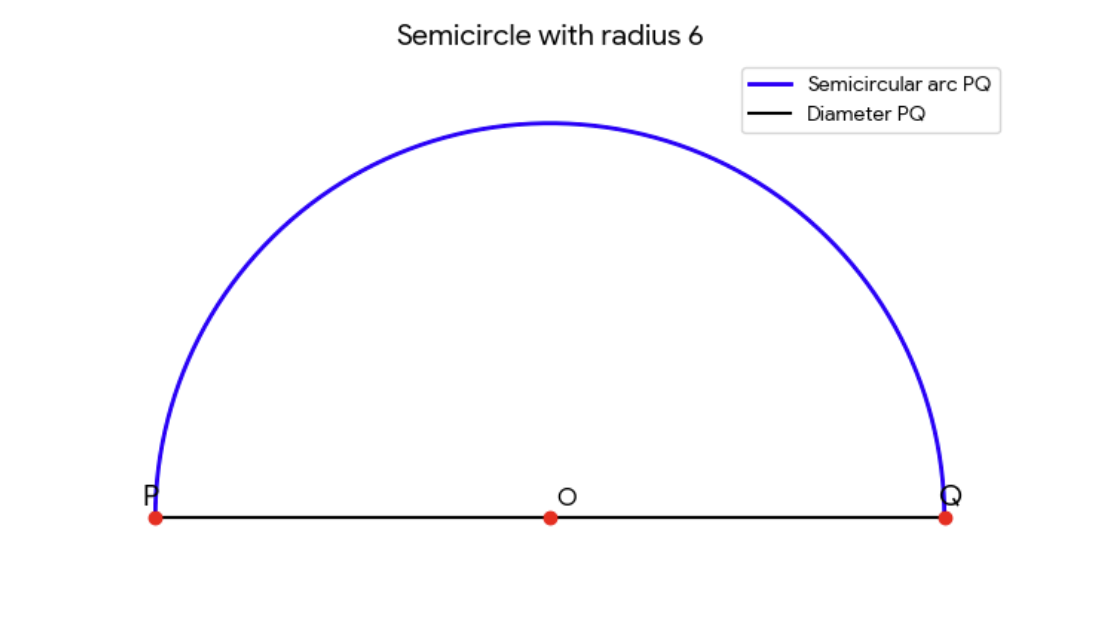
GRE In the figure, P R is.png [ 58.56 KiB | Viewed 3003 times ]
In the figure, PQ is the diameter of a semicircle with center O and radius 6. Point R lies on the semicircular arc such that the length of arc PR is twice the length of arc RQ. Point S lies on arc PR such that the measure of central angle ∠POS = 80°.
A. Quantity A is greater.
B. Quantity B is greater.
C. The two quantities are equal.
D. The relationship cannot be determined from the information given.
Question #2
The sum of the measures of the interior angles of a heptagon is \(p\) degrees. The sum of the measures of the interior angles of a nonagon is \(q\) degrees.
A. Quantity A is greater.
B. Quantity B is greater.
C. The two quantities are equal.
D. The relationship cannot be determined from the information given.
Question #3
Let \(n\) be a positive even integer.
A. Quantity A is greater.
B. Quantity B is greater.
C. The two quantities are equal.
D. The relationship cannot be determined from the information given.
Question #4
\(y^2-6 y+8<0 \)
A. Quantity A is greater.
B. Quantity B is greater.
C. The two quantities are equal.
D. The relationship cannot be determined from the information given.
Question #5
A hospital records 120 patients, each tested for three conditions: hypertension, diabetes, and anemia. The total number of positive test results across all patients and conditions is 175. No patient tested positive for all three conditions.
A. Quantity A is greater.
B. Quantity B is greater.
C. The two quantities are equal.
D. The relationship cannot be determined from the information given.
\(\begin{aligned}
&\text { Answer: Quantity A is greater. }\\
&n_1+n_2=120, n_1+2 n_2=175, n_3=0 \rightarrow n_2=55 \rightarrow \text { Quantity } \mathrm{A}=\mathbf{5 5}>50 .
\end{aligned}\)
Question #6
In a bakery, three ingredients - flour, sugar, and butter - are used in a recipe.
- The weight of flour is \(\frac{2}{3}\) kilogram.
- The weight of sugar is \(\frac{4}{5}\) kilogram.
- The ratio of flour to sugar is the same as the ratio of butter to a fourth ingredient, vanilla.
- The weight of butter is \(\frac{8}{15}\) kilogram.
What is the weight of vanilla, in kilograms?
Give your answer as a fraction.
Question #7
A quadratic function is defined by \(g(z)=z^2-4 z+3\) for all real numbers z.
What is the median of all possible values of g(z) where z is an integer and \(4 \leq z \leq 12\) ?
A. 15
B. 24
C. 35
D. 48
E. 63
Question #8
A sphere has a ratio of volume to surface area equal to \(\frac{5}{2}\).
(Note: Surface area \(=4 \pi r^2\), Volume \(=\frac{4}{3} \pi r^3\) )
What is the radius of the sphere?
A. \(\frac{5}{6}\)
B. \(\frac{3}{2}\)
C. \(\frac{5}{2}\)
D. \(\frac{15}{4}\)
E. \(\frac{15}{2}\)
Question #9
A researcher tracks the intensity of a radio signal over 8 time intervals.
At interval 0, the intensity is S watts.
- At the end of each odd-numbered interval (1st, 3rd, 5th, 7th), the intensity decreases by 20%.
- At the end of each even-numbered interval (2nd, 4th, 6th, 8th), the intensity increases by 20 %.
- Exception: At the end of interval 8 , the intensity increases by an additional \(\mathbf{1 0} \boldsymbol{\%}\) on top of the usual 20 % increase.
Which of the following represents the intensity, in watts, at the end of interval 8?
A. \(\left(0.96^3\right)(1.32) S\)
B. \(\left(0.96^4\right) S\)
C. \(\left(0.96^3\right)(1.056) S\)
D. \((0.8)(1.1)\left(0.96^3\right) S\)
E. \(\left(0.96^4\right)(1.1) S\)
Question #10
A patient has Q milligrams of a medication in the bloodstream. Beginning at 9:00 AM, the medication is administered at a constant rate of r milligrams per minute and eliminated at a constant rate of s milligrams per minute. If r<s, after how many minutes will the amount of medication in the bloodstream be \(\frac{5}{8} Q\) milligrams?
A. \(\frac{Q}{8(s-r)}\)
B. \(\frac{Q}{4(s-r)}\)
C. \(\frac{3 Q}{8(s-r)}\)
D. \(\frac{5 Q}{8(s-r)}\)
E. \(\frac{Q}{s-r}\)
Question #11
For all integers p and q, the operation \(\bigstar\) is defined as:
- \(p \bigstar q=p+q\) if \(p q\) is a multiple of 5 .
- \(p \bigstar q=p-q\) if \(p q\) is even and not a multiple of 5 .
- \(p \bigstar q=-(p+q)\) if \(p q\) is odd and not a multiple of 5 .
What is the value of \((6 \bigstar 4) \bigstar(3 \bigstar 5)\) ?
A. -18
B. -6
C. 6
D. 18
E. 22
Question #12
Let \(R=(7,234)^3 \times(1,987)^4+(5,619)^5\). What is the units digit of R ?
A. 1
B. 2
C. 3
D. 7
E. 9
Question #13
In the x y -plane, the points (1,3) and (5,-5) lie on line L . Which of the following points also lie on line L ?
Indicate all such points.
A. (-3,11)
B. (0,5)
C. (2,1)
D. (4,-3)
E. (6,-6)
Question #14
A landscape architect is designing a straight walkway divided into 4 sequential rectangular plots. Each plot will be planted with one of 6 available varieties of flowers. The architect may repeat flower varieties, but no two adjacent plots can contain the same variety. How many unique walkway designs are possible?
A. 150
B. 360
C. 480
D. 750
E. 1296
Question #15
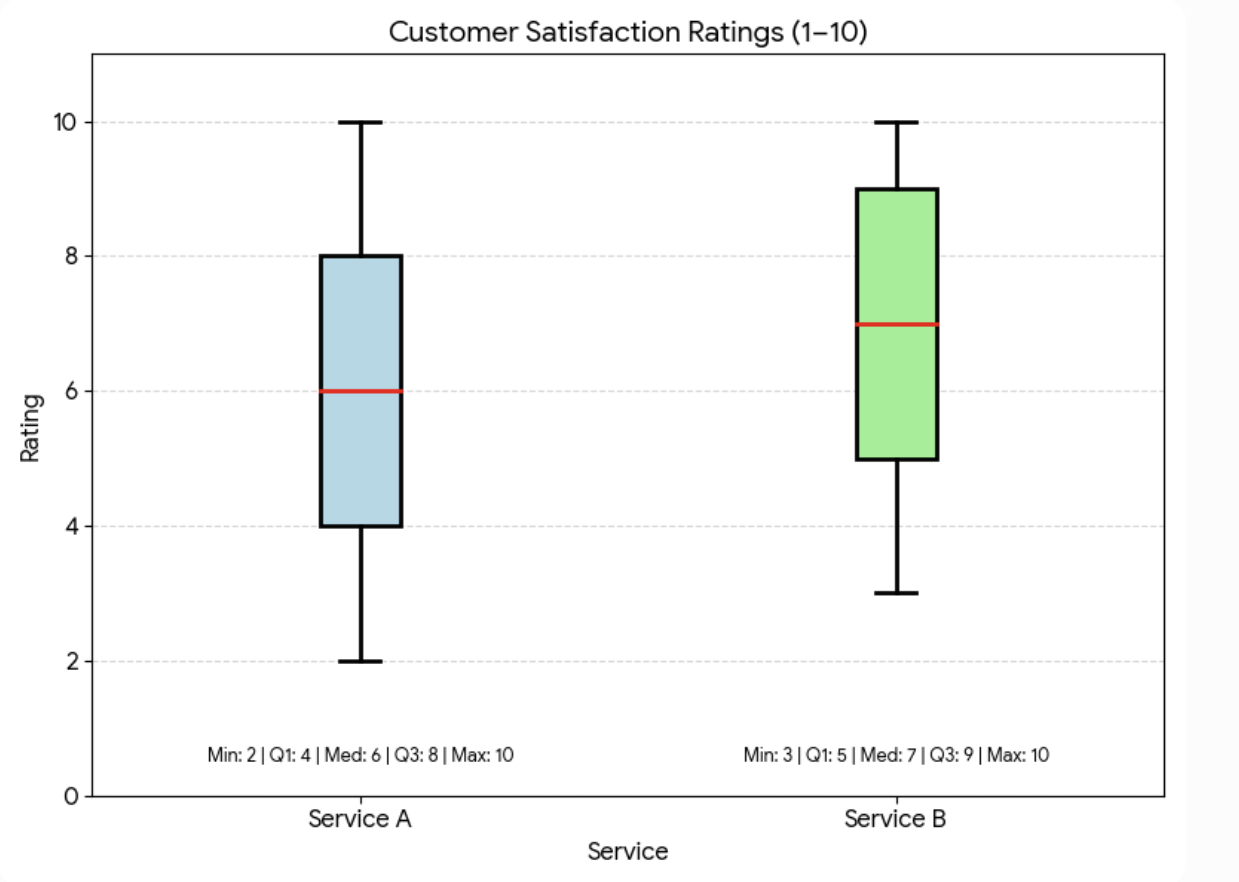
GRE box plot.png [ 91.92 KiB | Viewed 2966 times ]
The box plots above summarize customer satisfaction ratings for two services. Each rating is an integer from 1 to 10.
Service A five-number summary: \(\operatorname{Min}=2, \mathrm{Q} 1=4\), \(\operatorname{Median}= 6, Q3 = 8\),\( \operatorname{Max}=10\)
Service B five-number summary: \(\operatorname{Min}=3, \mathrm{Q} 1=5, \operatorname{Median}=7, \mathrm{Q} 3=9, \operatorname{Max}=10\)
Which of the following statements must be true?
Indicate all such statements.
- A. The interquartile range for Service A is equal to the interquartile range for Service B.
- B. More than 50 % of the ratings for Service A are less than 6 .
- C. Service B received more ratings of 10 than Service A did.
- D. At least 25 % of the ratings for Service B are greater than or equal to 9 .
---------------------------------------------------------------------------------------------
Verbal
Question #1
To hear that the novelist’s latest work radiates such an unflaggingly __________ mood is a genuine surprise to readers accustomed to her barbed essays and relentless mockery of social pretension."
Question #2
The envoy's refusal to address the assembly in straightforward terms sorely taxed the delegates' forbearance, as his remarks grew ever more ________ with each passing hour.
Question #3
That the snow leopard has persistently eluded systematic field observation is hardly surprising, given that the near-inaccessibility of its high-altitude terrain and its notoriously elusive nature have together (i) ________ any rigorous attempt at study outside the (ii) ________ confines of zoological institutions.
Question #4
Why, ask a growing number of geophysicists, should the puzzling luminous displays occasionally reported above active fault lines be ascribed to esoteric tectonic mechanisms, when the far more (i) ________ account - one that the field's mainstream finds considerably more (ii) ________ — points to such (iii) ________ sources as pockets of escaping gas ignited by friction, or the piezoelectric discharge of stressed quartz?
Question #5/6
Question #7/8/9
Which of the following most accurately captures the overall concern of the passage?
A. Enumerating the obstacles that prevent scholars from locating evidentiary materials pertinent to women's historical lives
B. Tracing the genesis and proliferation of a specific historical mythology during the middle decades of the nineteenth century
C. Delineating a spectrum of scholarly postures toward the evidentiary value of a particular category of sources for investigating a given era
D. Chronicling the efforts undertaken by an individual researcher to recover the meaning embedded in a specific set of handcrafted artifacts
E. Recounting a dispute among academic practitioners regarding the lived experience of a particular demographic during a circumscribed historical interval
According to the passage, which of the following constitutes an impediment for scholars seeking to draw inferences from the ceremonial masks discussed in the passage?
A. The relative scarcity of such masks when set against the abundance of other surviving ritual artifacts from the same period
B. An insufficiently developed scholarly understanding of the mask-carving workshop system that produced these ritual objects
C. A lack of consensus among researchers concerning the reasons that such masks became objects of particular fascination during the nineteenth century
D. A framework of interpretation imposed upon these masks during the nineteenth century
E. A deficiency of written documentation that could contextualize and elucidate such masks
With respect to the "colonial antiquarianism" identified in the passage, it can be inferred that Kamara would most likely part company with the majority of scholars over
A. the degree to which this antiquarianism obstructs the effort to deploy certain artifacts as vehicles for historical understanding
B. the degree to which this antiquarianism developed as a reaction to conditions set in motion by European industrialization
C. whether this antiquarianism inadvertently preserves traces of the original significance of the ritual masks dating from the medieval period
D. whether this antiquarianism achieved particularly broad cultural currency during the nineteenth century
E. whether this antiquarianism served to adequately rationalize the political project of colonial administration
Question #10
Because direct observation of the Yellowstone magma chamber is impossible, scientists have __________ its presence from patterns of ground deformation and hydrothermal activity at the surface.
Question #11
Given how outlandish their plots and how remote their settings from present-day concerns, the remarkable ________ of the ancient Greek tragedies in the modern repertory strikes many observers as deeply perplexing.
Question #12
The director's public image as a vacillating and ineffectual leader is, by all accounts from those who have served under her, utterly ________: colleagues describe a decisive, analytically rigorous, and unyielding figure behind closed doors.
Question #13
The argument depends on which of the following being true?
A. Water lost to residential leakage represents a larger share of the municipal authority's total potable water deliveries now than it did four years ago.
B. The average volume of water lost per leaking household in Trevania has not risen markedly over the past four years.
C. Total potable water deliveries account for a larger proportion of the city's overall water output now than they did four years ago.
D. Trevania's total annual water output is not substantially smaller now than it was four years ago.
E. Plumbing deterioration severe enough to cause significant leakage typically progresses even after a household has taken advantage of the subsidy program.
Question #14/15
The passage indicates that the deployment of high-relief artificial reefs in areas where they never historically occurred requires ongoing institutional management. What is the reason offered for this necessity?
A. Such installations are prone to becoming economically unfeasible when evaluated over sufficiently long time spans.
B. Mariculture production entails a degree of technical intricacy that can only be sustained through vigilant supervision.
C. The pursuit of intensive mariculture is fundamentally at odds with the preservation of maximal benthic biodiversity.
D. The hydrodynamic changes induced by these structures can open pathways for organisms that disrupt benthic community stability.
E. Introducing artificial reefs into regions where they are no longer present constitutes an intrinsically undesirable ecological intervention.
In the passage, the word “intensive” as it appears in the phrase “intensive mariculture output” most nearly means
A. severe
B. rigorous
C. concentrated
D. scrupulous
E. resolute
Quantitative
Question #1
Attachment:
GRE In the figure, P R is.png [ 58.56 KiB | Viewed 3003 times ]
In the figure, PQ is the diameter of a semicircle with center O and radius 6. Point R lies on the semicircular arc such that the length of arc PR is twice the length of arc RQ. Point S lies on arc PR such that the measure of central angle ∠POS = 80°.
Quantity A |
Quantity B |
The length of arc RS |
The length of arc SQ minus \(2 \pi\) |
A. Quantity A is greater.
B. Quantity B is greater.
C. The two quantities are equal.
D. The relationship cannot be determined from the information given.
Show: ::
Step 1: Find the total arc length of the semicircle.
A full circle with radius 6 has circumference $2 \pi(6)=12 \pi$, so the semicircular $\operatorname{arc} \mathrm{PQ}$ has length $6 \pi$. In degrees, this entire arc spans $180^{\circ}$.
Step 2: Use the $\mathbf{P R} / \mathbf{R Q}$ relationship to split that arc.
Since $\operatorname{arc} \mathrm{PR}=2 \times \operatorname{arc} \mathrm{RQ}$, and $\operatorname{arc} \mathrm{PR}+\operatorname{arc} \mathrm{RQ}=6 \pi$, you get $\operatorname{arc} \mathrm{RQ}=2 \pi \operatorname{and} \operatorname{arc} \mathrm{PR}=4 \pi$. Converting to degrees (where $6 \pi$ corresponds to $180^{\circ}$ ), $\operatorname{arc} \mathrm{RQ}=60^{\circ}$ and $\operatorname{arc} \mathrm{PR}=120^{\circ}$. So going around the semicircle, the order is P , then $\mathrm{R}\left(120^{\circ}\right.$ later $)$, then Q (another $60^{\circ}$ later).
Step 3: Locate $S$ using the central angle.
$\angle \mathrm{POS}=80^{\circ}$ is a central angle (vertex at the actual center O ), so it directly tells you the arc measure: $\operatorname{arc} P S=80^{\circ}$. Since $S$ is specified to lie on arc $P R$, and arc $P R$ is $120^{\circ}$ total, $S$ sits $80^{\circ}$ of the way from $P$ toward $R$, leaving $120^{\circ}-80^{\circ}=40^{\circ}$ remaining between $S$ and $R$.
Step 4: Compute arc RS (Quantity A).
$\operatorname{ArcRS}=40^{\circ}$. Converting to length using the formula $($ degrees $/ 180) \times 6 \pi$ : $\operatorname{arc} \operatorname{RS}=(40 / 180) \times 6 \pi=4 \pi / 3$.
Step 5: Compute arc SQ, then Quantity B.
Arc SQ is everything left over from S to Q: $180^{\circ}$ (total) $-80^{\circ}(\operatorname{arc} P S)=100^{\circ}$. $\operatorname{arcSQ}=(100 / 180) \times 6 \pi=10 \pi / 3$.
Quantity $\mathrm{B}=\operatorname{arc} \mathrm{SQ}-2 \pi=10 \pi / 3-6 \pi / 3=4 \pi / 3$.
Step 6: Compare.
Quantity $\mathrm{A}=4 \pi / 3$ and Quantity $\mathrm{B}=4 \pi / 3$ - they're identical.
Answer: (C) The two quantities are equal.
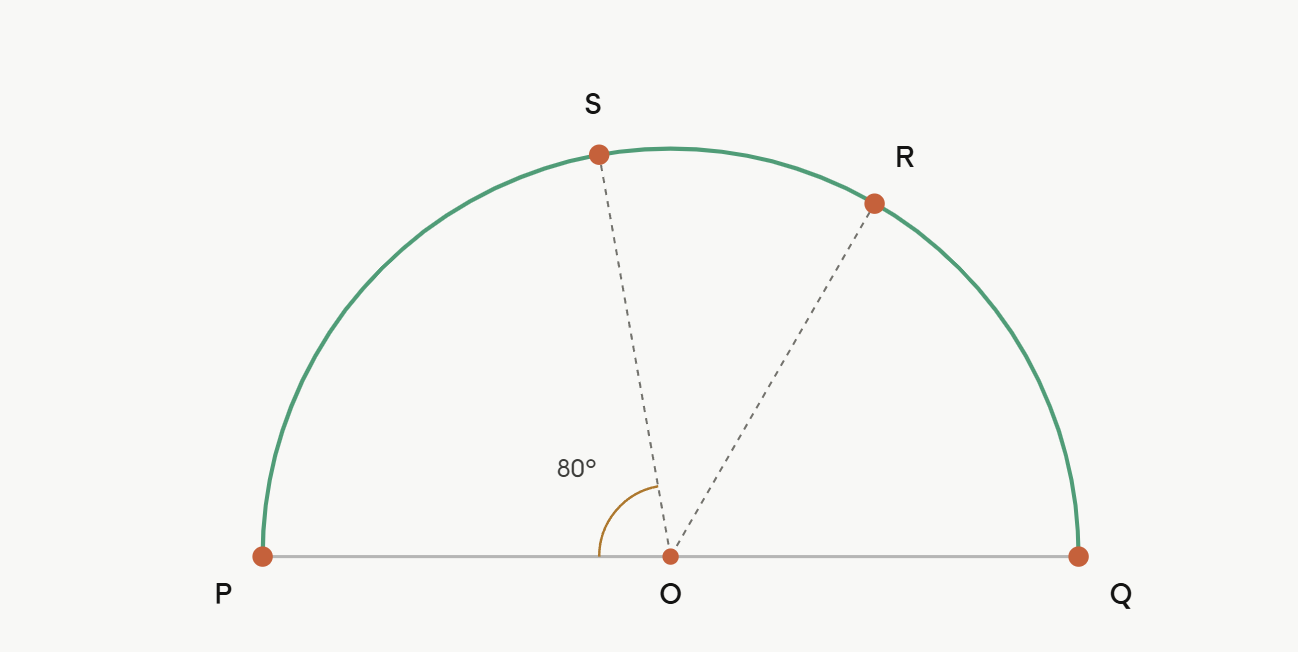
GRE In the figure, PQ.png [ 35.19 KiB | Viewed 2078 times ]
The teal arc is the semicircle (diameter PQ, center O), the dashed lines mark the radii OR and OS, and the small amber arc near O highlights the 80° central angle ∠POS. From this you can read off the same structure used in the solution: R sits 60° from Q, S sits 80° from P along arc PR, leaving exactly 40° between R and S.
A full circle with radius 6 has circumference $2 \pi(6)=12 \pi$, so the semicircular $\operatorname{arc} \mathrm{PQ}$ has length $6 \pi$. In degrees, this entire arc spans $180^{\circ}$.
Step 2: Use the $\mathbf{P R} / \mathbf{R Q}$ relationship to split that arc.
Since $\operatorname{arc} \mathrm{PR}=2 \times \operatorname{arc} \mathrm{RQ}$, and $\operatorname{arc} \mathrm{PR}+\operatorname{arc} \mathrm{RQ}=6 \pi$, you get $\operatorname{arc} \mathrm{RQ}=2 \pi \operatorname{and} \operatorname{arc} \mathrm{PR}=4 \pi$. Converting to degrees (where $6 \pi$ corresponds to $180^{\circ}$ ), $\operatorname{arc} \mathrm{RQ}=60^{\circ}$ and $\operatorname{arc} \mathrm{PR}=120^{\circ}$. So going around the semicircle, the order is P , then $\mathrm{R}\left(120^{\circ}\right.$ later $)$, then Q (another $60^{\circ}$ later).
Step 3: Locate $S$ using the central angle.
$\angle \mathrm{POS}=80^{\circ}$ is a central angle (vertex at the actual center O ), so it directly tells you the arc measure: $\operatorname{arc} P S=80^{\circ}$. Since $S$ is specified to lie on arc $P R$, and arc $P R$ is $120^{\circ}$ total, $S$ sits $80^{\circ}$ of the way from $P$ toward $R$, leaving $120^{\circ}-80^{\circ}=40^{\circ}$ remaining between $S$ and $R$.
Step 4: Compute arc RS (Quantity A).
$\operatorname{ArcRS}=40^{\circ}$. Converting to length using the formula $($ degrees $/ 180) \times 6 \pi$ : $\operatorname{arc} \operatorname{RS}=(40 / 180) \times 6 \pi=4 \pi / 3$.
Step 5: Compute arc SQ, then Quantity B.
Arc SQ is everything left over from S to Q: $180^{\circ}$ (total) $-80^{\circ}(\operatorname{arc} P S)=100^{\circ}$. $\operatorname{arcSQ}=(100 / 180) \times 6 \pi=10 \pi / 3$.
Quantity $\mathrm{B}=\operatorname{arc} \mathrm{SQ}-2 \pi=10 \pi / 3-6 \pi / 3=4 \pi / 3$.
Step 6: Compare.
Quantity $\mathrm{A}=4 \pi / 3$ and Quantity $\mathrm{B}=4 \pi / 3$ - they're identical.
Answer: (C) The two quantities are equal.
Attachment:
GRE In the figure, PQ.png [ 35.19 KiB | Viewed 2078 times ]
The teal arc is the semicircle (diameter PQ, center O), the dashed lines mark the radii OR and OS, and the small amber arc near O highlights the 80° central angle ∠POS. From this you can read off the same structure used in the solution: R sits 60° from Q, S sits 80° from P along arc PR, leaving exactly 40° between R and S.
Question #2
The sum of the measures of the interior angles of a heptagon is \(p\) degrees. The sum of the measures of the interior angles of a nonagon is \(q\) degrees.
Quantity A |
Quantity B |
\(p+180\) |
\(q-180\) |
A. Quantity A is greater.
B. Quantity B is greater.
C. The two quantities are equal.
D. The relationship cannot be determined from the information given.
Show: ::
Solution
Step 1 - Interior angle sum formula
For an \(n\)-sided polygon:
\(\text { Sum }=(n-2) \times 180\)
Step 2 - Calculate \(p\) (heptagon, \(n=7\) )
\(p=(7-2) \times 180=5 \times 180=900\)
Step 3 - Calculate \(q\) (nonagon, \(n=9\) )
\(q=(9-2) \times 180=7 \times 180=1260\)
Step 4 - Quantity A
\(p+180=900+180=1080\)
Step 5 - Quantity B
\(q-180=1260-180=1080\)
Step 6 - Compare
\(1080=1080\)
C - The two quantities are equal
Step 1 - Interior angle sum formula
For an \(n\)-sided polygon:
\(\text { Sum }=(n-2) \times 180\)
Step 2 - Calculate \(p\) (heptagon, \(n=7\) )
\(p=(7-2) \times 180=5 \times 180=900\)
Step 3 - Calculate \(q\) (nonagon, \(n=9\) )
\(q=(9-2) \times 180=7 \times 180=1260\)
Step 4 - Quantity A
\(p+180=900+180=1080\)
Step 5 - Quantity B
\(q-180=1260-180=1080\)
Step 6 - Compare
\(1080=1080\)
C - The two quantities are equal
Question #3
Let \(n\) be a positive even integer.
Quantity A |
Quantity B |
The units digit of \(n^2+2 n+1\) |
5 |
A. Quantity A is greater.
B. Quantity B is greater.
C. The two quantities are equal.
D. The relationship cannot be determined from the information given.
Show: ::
Solution
Step 1 - Simplify the expression
\(n^2+2 n+1=(n+1)^2\)
Step 2 - Use the fact that n is even
If n is even, then n+1 is odd.
An odd number squared is odd.
So \((n+1)^2\) is odd.
Step 3 - Units digit possibilities for an odd number
Odd numbers have units digits: 1,3,5,7, or 9 .
Step 4 - Compare to Quantity B = 5
- If units digit \(=5 \rightarrow \mathrm{~A}=\mathrm{B}\)
- If units digit =1,3,7$, or 9 \(\rightarrow \mathrm{~A}<\mathrm{B}\)
Check:
\(\begin{tabular}{|l|l|}
\hline Units digit & Comparison to 5 \\
\hline 1 & \mathrm{A}<\mathrm{B} \\
\hline 3 & \mathrm{A}<\mathrm{B} \\
\hline 5 & \mathrm{A}=\mathrm{B} \\
\hline 7 & \mathrm{A}>\mathrm{B} \\
\hline 9 & A>B \\
\hline
\end{tabular}
\)
Since the units digit can be 1,3,5,7, or 9 depending on n :
- \(n=2 \rightarrow(3)^2=9 \rightarrow\) units digit 9 \(\rightarrow \mathrm{~A}>\mathrm{B}\)
- \(n=4 \rightarrow(5)^2=25 \rightarrow\) units digit 5 \(\rightarrow \mathrm{~A}=\mathrm{B}\)
- \(n=6 \rightarrow(7)^2=49 \rightarrow\) units digit 9 \(\rightarrow \mathrm{~A}>\mathrm{B}\)
- \(n=8 \rightarrow(9)^2=81 \rightarrow\) units digit 1 \(\rightarrow \mathrm{~A}<\mathrm{B}\)
Different n give different relationships.
Step 5 - Conclusion
The relationship cannot be determined from the information given.
Step 1 - Simplify the expression
\(n^2+2 n+1=(n+1)^2\)
Step 2 - Use the fact that n is even
If n is even, then n+1 is odd.
An odd number squared is odd.
So \((n+1)^2\) is odd.
Step 3 - Units digit possibilities for an odd number
Odd numbers have units digits: 1,3,5,7, or 9 .
Step 4 - Compare to Quantity B = 5
- If units digit \(=5 \rightarrow \mathrm{~A}=\mathrm{B}\)
- If units digit =1,3,7$, or 9 \(\rightarrow \mathrm{~A}<\mathrm{B}\)
Check:
\(\begin{tabular}{|l|l|}
\hline Units digit & Comparison to 5 \\
\hline 1 & \mathrm{A}<\mathrm{B} \\
\hline 3 & \mathrm{A}<\mathrm{B} \\
\hline 5 & \mathrm{A}=\mathrm{B} \\
\hline 7 & \mathrm{A}>\mathrm{B} \\
\hline 9 & A>B \\
\hline
\end{tabular}
\)
Since the units digit can be 1,3,5,7, or 9 depending on n :
- \(n=2 \rightarrow(3)^2=9 \rightarrow\) units digit 9 \(\rightarrow \mathrm{~A}>\mathrm{B}\)
- \(n=4 \rightarrow(5)^2=25 \rightarrow\) units digit 5 \(\rightarrow \mathrm{~A}=\mathrm{B}\)
- \(n=6 \rightarrow(7)^2=49 \rightarrow\) units digit 9 \(\rightarrow \mathrm{~A}>\mathrm{B}\)
- \(n=8 \rightarrow(9)^2=81 \rightarrow\) units digit 1 \(\rightarrow \mathrm{~A}<\mathrm{B}\)
Different n give different relationships.
Step 5 - Conclusion
The relationship cannot be determined from the information given.
Question #4
\(y^2-6 y+8<0 \)
Quantity A |
Quantity B |
\(y-2\) |
\(2\) |
A. Quantity A is greater.
B. Quantity B is greater.
C. The two quantities are equal.
D. The relationship cannot be determined from the information given.
Show: ::
Step 1 - Solve the inequality
\(y^2-6 y+8<0\)
Factor:
\((y-2)(y-4)<0\)
Step 2 - Determine the interval
A quadratic opening upward is negative between the roots:
\(2<y<4\)
Step 3 - Analyze Quantity A = $y-2$ within the interval
- At \(y=2.1: y-2=0.1 \rightarrow \mathrm{~A}<\mathrm{B}(2)\)
- At \(y=3: y-2=1 \rightarrow \mathrm{~A}<\mathrm{B}(2)\)
- At \(y=3.9: y-2=1.9 \rightarrow \mathrm{~A}<\mathrm{B}(2)\)
All values in \(2<y<4\) give \(0<y-2<2\), so A is always less than 2 .
That means Quantity B is always greater.
Step 4 - Test boundary values
- y approaches 2 from above: y-2 approaches \(0 \rightarrow \mathrm{~A}<\mathrm{B}\)
- y=3: \(y-2=1 \rightarrow \mathrm{~A}<\mathrm{B}\)
- y approaches 4 from below: y-2 approaches \(2 \rightarrow \mathrm{~A}<\mathrm{B}\) (since strictly less than 2 )
So indeed, for all y satisfying 2<y<4 :
\(0<y-2<2\)
Thus A is always less than 2 .
Step 5 - Conclusion
Quantity B is greater
\(y^2-6 y+8<0\)
Factor:
\((y-2)(y-4)<0\)
Step 2 - Determine the interval
A quadratic opening upward is negative between the roots:
\(2<y<4\)
Step 3 - Analyze Quantity A = $y-2$ within the interval
- At \(y=2.1: y-2=0.1 \rightarrow \mathrm{~A}<\mathrm{B}(2)\)
- At \(y=3: y-2=1 \rightarrow \mathrm{~A}<\mathrm{B}(2)\)
- At \(y=3.9: y-2=1.9 \rightarrow \mathrm{~A}<\mathrm{B}(2)\)
All values in \(2<y<4\) give \(0<y-2<2\), so A is always less than 2 .
That means Quantity B is always greater.
Step 4 - Test boundary values
- y approaches 2 from above: y-2 approaches \(0 \rightarrow \mathrm{~A}<\mathrm{B}\)
- y=3: \(y-2=1 \rightarrow \mathrm{~A}<\mathrm{B}\)
- y approaches 4 from below: y-2 approaches \(2 \rightarrow \mathrm{~A}<\mathrm{B}\) (since strictly less than 2 )
So indeed, for all y satisfying 2<y<4 :
\(0<y-2<2\)
Thus A is always less than 2 .
Step 5 - Conclusion
Quantity B is greater
Question #5
A hospital records 120 patients, each tested for three conditions: hypertension, diabetes, and anemia. The total number of positive test results across all patients and conditions is 175. No patient tested positive for all three conditions.
Quantity A |
Quantity B |
Patients with at least two positive results |
50 |
A. Quantity A is greater.
B. Quantity B is greater.
C. The two quantities are equal.
D. The relationship cannot be determined from the information given.
Show: ::
\(\begin{aligned}
&\text { Answer: Quantity A is greater. }\\
&n_1+n_2=120, n_1+2 n_2=175, n_3=0 \rightarrow n_2=55 \rightarrow \text { Quantity } \mathrm{A}=\mathbf{5 5}>50 .
\end{aligned}\)
Question #6
In a bakery, three ingredients - flour, sugar, and butter - are used in a recipe.
- The weight of flour is \(\frac{2}{3}\) kilogram.
- The weight of sugar is \(\frac{4}{5}\) kilogram.
- The ratio of flour to sugar is the same as the ratio of butter to a fourth ingredient, vanilla.
- The weight of butter is \(\frac{8}{15}\) kilogram.
What is the weight of vanilla, in kilograms?
Give your answer as a fraction.
Show: ::
We have:
\(\frac{\text { flour }}{\text { sugar }}=\frac{\text { butter }}{\text { vanilla }}\)
Let \(F=\frac{2}{3}, S=\frac{4}{5}, B=\frac{8}{15}, V=\) ?
\(\frac{F}{S}=\frac{2 / 3}{4 / 5}=\frac{2}{3} \times \frac{5}{4}=\frac{10}{12}=\frac{5}{6}\)
Set equal to \(\frac{B}{V}\) :
\(\begin{aligned}
\frac{5}{6} & =\frac{8 / 15}{V} \\
\frac{5}{6} & =\frac{8}{15} \times \frac{1}{V} \\
\frac{5}{6} & =\frac{8}{15 V}
\end{aligned}\)
Cross-multiply:
\(\begin{gathered}
5 \times 15 V=8 \times 6 \\
75 V=48 \\
V=\frac{48}{75}=\frac{16}{25} \\
\end{gathered}\)
\(\frac{\text { flour }}{\text { sugar }}=\frac{\text { butter }}{\text { vanilla }}\)
Let \(F=\frac{2}{3}, S=\frac{4}{5}, B=\frac{8}{15}, V=\) ?
\(\frac{F}{S}=\frac{2 / 3}{4 / 5}=\frac{2}{3} \times \frac{5}{4}=\frac{10}{12}=\frac{5}{6}\)
Set equal to \(\frac{B}{V}\) :
\(\begin{aligned}
\frac{5}{6} & =\frac{8 / 15}{V} \\
\frac{5}{6} & =\frac{8}{15} \times \frac{1}{V} \\
\frac{5}{6} & =\frac{8}{15 V}
\end{aligned}\)
Cross-multiply:
\(\begin{gathered}
5 \times 15 V=8 \times 6 \\
75 V=48 \\
V=\frac{48}{75}=\frac{16}{25} \\
\end{gathered}\)
Question #7
A quadratic function is defined by \(g(z)=z^2-4 z+3\) for all real numbers z.
What is the median of all possible values of g(z) where z is an integer and \(4 \leq z \leq 12\) ?
A. 15
B. 24
C. 35
D. 48
E. 63
Show: ::
Step 1 - List integer values of z from 4 to 12 inclusive
\(z=4,5,6,7,8,9,10,11,12\)
Step 2 - Compute \(g(z)=z^2-4 z+3\) for each
\(\begin{aligned}
z=4: & 16-16+3=3 \\
z=5: & 25-20+3=8 \\
z=6: & 36-24+3=15 \\
z=7: & 49-28+3=24 \\
z=8: & 64-32+3=35 \\
z=9: & 81-36+3=48 \\
z=10: & 100-40+3=63 \\
z=11: & 121-44+3=80 \\
z=12: & 144-48+3=99
\end{aligned}\)
Step 3 - Ordered values
\(3,8,15,24,35,48,63,80,99\)
Step 4 - Find the median
There are 9 values (odd count). The median is the 5th value in the ordered list.
\(\text { Median }=35\)
Step 5 - Match to answer choices
35
\(z=4,5,6,7,8,9,10,11,12\)
Step 2 - Compute \(g(z)=z^2-4 z+3\) for each
\(\begin{aligned}
z=4: & 16-16+3=3 \\
z=5: & 25-20+3=8 \\
z=6: & 36-24+3=15 \\
z=7: & 49-28+3=24 \\
z=8: & 64-32+3=35 \\
z=9: & 81-36+3=48 \\
z=10: & 100-40+3=63 \\
z=11: & 121-44+3=80 \\
z=12: & 144-48+3=99
\end{aligned}\)
Step 3 - Ordered values
\(3,8,15,24,35,48,63,80,99\)
Step 4 - Find the median
There are 9 values (odd count). The median is the 5th value in the ordered list.
\(\text { Median }=35\)
Step 5 - Match to answer choices
35
Question #8
A sphere has a ratio of volume to surface area equal to \(\frac{5}{2}\).
(Note: Surface area \(=4 \pi r^2\), Volume \(=\frac{4}{3} \pi r^3\) )
What is the radius of the sphere?
A. \(\frac{5}{6}\)
B. \(\frac{3}{2}\)
C. \(\frac{5}{2}\)
D. \(\frac{15}{4}\)
E. \(\frac{15}{2}\)
Show: ::
Step 1-Set up the equation.
You're given that \(\frac{\text { Volume }}{\text { Surface Area }}=\frac{5}{2}\). Substitute the formulas:
\(\frac{\frac{4}{3} \pi r^3}{4 \pi r^2}=\frac{5}{2}\)
Step 2 - Simplify the left side.
The \(4 \pi r^2\) cancels:
\(\frac{\frac{4}{3} \pi r^3}{4 \pi r^2}=\frac{4 \pi r^3}{3} \times \frac{1}{4 \pi r^2}=\frac{r}{3}\)
So the equation becomes:
\(\frac{r}{3}=\frac{5}{2}\)
Step 3 - Solve for r.
\(r=3 \times \frac{5}{2}=\frac{15}{2}\)
Answer: \(\frac{15}{2} \)
You're given that \(\frac{\text { Volume }}{\text { Surface Area }}=\frac{5}{2}\). Substitute the formulas:
\(\frac{\frac{4}{3} \pi r^3}{4 \pi r^2}=\frac{5}{2}\)
Step 2 - Simplify the left side.
The \(4 \pi r^2\) cancels:
\(\frac{\frac{4}{3} \pi r^3}{4 \pi r^2}=\frac{4 \pi r^3}{3} \times \frac{1}{4 \pi r^2}=\frac{r}{3}\)
So the equation becomes:
\(\frac{r}{3}=\frac{5}{2}\)
Step 3 - Solve for r.
\(r=3 \times \frac{5}{2}=\frac{15}{2}\)
Answer: \(\frac{15}{2} \)
Question #9
A researcher tracks the intensity of a radio signal over 8 time intervals.
At interval 0, the intensity is S watts.
- At the end of each odd-numbered interval (1st, 3rd, 5th, 7th), the intensity decreases by 20%.
- At the end of each even-numbered interval (2nd, 4th, 6th, 8th), the intensity increases by 20 %.
- Exception: At the end of interval 8 , the intensity increases by an additional \(\mathbf{1 0} \boldsymbol{\%}\) on top of the usual 20 % increase.
Which of the following represents the intensity, in watts, at the end of interval 8?
A. \(\left(0.96^3\right)(1.32) S\)
B. \(\left(0.96^4\right) S\)
C. \(\left(0.96^3\right)(1.056) S\)
D. \((0.8)(1.1)\left(0.96^3\right) S\)
E. \(\left(0.96^4\right)(1.1) S\)
Show: ::
1. Set up the multipliers:
- Decrease by 20 % : Multiply by 0.8
- Increase by 20 % : Multiply by 1.2
- The "pair" (one odd interval followed by one even interval) results in a multiplier of (0.8)(1.2)=0.96 .
2. Track the intervals:
- There are 4 full pairs (1 & 2,3 & 4,5 & 6,7 & 8) .
- Normally, the intensity after 8 intervals would be \(S \times(0.96)^4\) .
3. Apply the exception:
- The exception states that at the end of interval 8, there is an additional 10 % increase on top of the usual 20 % increase.
- The "usual" increase at interval 8 (an even interval) is already included in the \(0.96^4\) term (which uses 1.2).
- An additional 10 % increase means we must multiply the result by 1.1.
4. Formulate the final expression:
- \(\quad\) Starting intensity =S
- \(\quad\) Result \(=S \times(0.96)^3 \times(0.8 \times 1.2 \times 1.1)\)
- Wait, let's look at the final step specifically:
- Intervals \(1-6=S(0.96)^3 \)
- Interval 7 (decrease 20 % ) \(=\times 0.8\)
- Interval 8 (increase 20 %+ extra 10 %)\(=\times(1.2 \times 1.1)=\times 1.32\)
- Combined for last pair: \(0.8 \times 1.32=1.056\)
- Therefore, the intensity is \(S(0.96)^3(1.056)\) .
Correct Answer: C
- Decrease by 20 % : Multiply by 0.8
- Increase by 20 % : Multiply by 1.2
- The "pair" (one odd interval followed by one even interval) results in a multiplier of (0.8)(1.2)=0.96 .
2. Track the intervals:
- There are 4 full pairs (1 & 2,3 & 4,5 & 6,7 & 8) .
- Normally, the intensity after 8 intervals would be \(S \times(0.96)^4\) .
3. Apply the exception:
- The exception states that at the end of interval 8, there is an additional 10 % increase on top of the usual 20 % increase.
- The "usual" increase at interval 8 (an even interval) is already included in the \(0.96^4\) term (which uses 1.2).
- An additional 10 % increase means we must multiply the result by 1.1.
4. Formulate the final expression:
- \(\quad\) Starting intensity =S
- \(\quad\) Result \(=S \times(0.96)^3 \times(0.8 \times 1.2 \times 1.1)\)
- Wait, let's look at the final step specifically:
- Intervals \(1-6=S(0.96)^3 \)
- Interval 7 (decrease 20 % ) \(=\times 0.8\)
- Interval 8 (increase 20 %+ extra 10 %)\(=\times(1.2 \times 1.1)=\times 1.32\)
- Combined for last pair: \(0.8 \times 1.32=1.056\)
- Therefore, the intensity is \(S(0.96)^3(1.056)\) .
Correct Answer: C
Question #10
A patient has Q milligrams of a medication in the bloodstream. Beginning at 9:00 AM, the medication is administered at a constant rate of r milligrams per minute and eliminated at a constant rate of s milligrams per minute. If r<s, after how many minutes will the amount of medication in the bloodstream be \(\frac{5}{8} Q\) milligrams?
A. \(\frac{Q}{8(s-r)}\)
B. \(\frac{Q}{4(s-r)}\)
C. \(\frac{3 Q}{8(s-r)}\)
D. \(\frac{5 Q}{8(s-r)}\)
E. \(\frac{Q}{s-r}\)
Show: ::
Let $t$ be the number of minutes after 9:00 AM.
The account starts with Q milligrams. Each minute, $r$ milligrams are added and s milligrams are removed, so the net change per minute is r-s. Since r<s, the amount is decreasing.
So after t minutes, the amount is
\(Q+r t-s t=Q-(s-r) t\)
We want this to equal \(\frac{5}{8} Q\), so set up:
\(Q-(s-r) t=\frac{5}{8} Q\)
Subtract \(\frac{5}{8} Q\) from both sides:
\(\frac{3}{8} Q=(s-r) t\)
Now solve for t :
\(
t=\frac{3 Q}{8(s-r)}\)
So the correct answer is:
\(\frac{3 Q}{8(s-r)}\)
A quick way to see it: the amount has to drop by \(\frac{3}{8} Q\), and it drops at a rate of s-r per minute, so time \(= change \div rate\).
The account starts with Q milligrams. Each minute, $r$ milligrams are added and s milligrams are removed, so the net change per minute is r-s. Since r<s, the amount is decreasing.
So after t minutes, the amount is
\(Q+r t-s t=Q-(s-r) t\)
We want this to equal \(\frac{5}{8} Q\), so set up:
\(Q-(s-r) t=\frac{5}{8} Q\)
Subtract \(\frac{5}{8} Q\) from both sides:
\(\frac{3}{8} Q=(s-r) t\)
Now solve for t :
\(
t=\frac{3 Q}{8(s-r)}\)
So the correct answer is:
\(\frac{3 Q}{8(s-r)}\)
A quick way to see it: the amount has to drop by \(\frac{3}{8} Q\), and it drops at a rate of s-r per minute, so time \(= change \div rate\).
Question #11
For all integers p and q, the operation \(\bigstar\) is defined as:
- \(p \bigstar q=p+q\) if \(p q\) is a multiple of 5 .
- \(p \bigstar q=p-q\) if \(p q\) is even and not a multiple of 5 .
- \(p \bigstar q=-(p+q)\) if \(p q\) is odd and not a multiple of 5 .
What is the value of \((6 \bigstar 4) \bigstar(3 \bigstar 5)\) ?
A. -18
B. -6
C. 6
D. 18
E. 22
Show: ::
Explanation
To find the value of \((6 \bigstar 4) \bigstar(3 \bigstar 5)\), the expression must be evaluated sequentially following the order of operations, starting with the inner parentheses.
Step 1: Evaluate \((6 \bigstar 4)\)
- Identify the values: p=6 and q=4.
- Calculate the product: \(p q=6 \times 4=24\).
- Determine the applicable condition: The product 24 is even and is not a multiple of 5 .
Therefore, the second rule applies: \(p \bigstar q=p-q\).
- Calculate the result: 6-4=2.
- Substitute this back into the original expression: \(2 \bigstar(3 \bigstar 5)\).
Step 2: Evaluate \((3 \bigstar 5)\)
- Identify the values: p=3 and q=5.
- Calculate the product: \(p q=3 \times 5=15\).
- Determine the applicable condition: The product 15 is a multiple of 5 . Therefore, the first rule applies: \(p \bigstar q=p+q\).
- Calculate the result: 3+5=8.
- Substitute this back into the expression: \(2 \bigstar 8\).
Step 3: Evaluate the final operation \((2 \bigstar 8)\)
- Identify the values: p=2 and q=8.
- Calculate the product: \(p q=2 \times 8=16\).
- Determine the applicable condition: The product 16 is even and is not a multiple of 5 . Therefore, the second rule applies: \(p \bigstar q=p-q\).
- Calculate the final result: 2-8=-6.
The correct answer is B.
To find the value of \((6 \bigstar 4) \bigstar(3 \bigstar 5)\), the expression must be evaluated sequentially following the order of operations, starting with the inner parentheses.
Step 1: Evaluate \((6 \bigstar 4)\)
- Identify the values: p=6 and q=4.
- Calculate the product: \(p q=6 \times 4=24\).
- Determine the applicable condition: The product 24 is even and is not a multiple of 5 .
Therefore, the second rule applies: \(p \bigstar q=p-q\).
- Calculate the result: 6-4=2.
- Substitute this back into the original expression: \(2 \bigstar(3 \bigstar 5)\).
Step 2: Evaluate \((3 \bigstar 5)\)
- Identify the values: p=3 and q=5.
- Calculate the product: \(p q=3 \times 5=15\).
- Determine the applicable condition: The product 15 is a multiple of 5 . Therefore, the first rule applies: \(p \bigstar q=p+q\).
- Calculate the result: 3+5=8.
- Substitute this back into the expression: \(2 \bigstar 8\).
Step 3: Evaluate the final operation \((2 \bigstar 8)\)
- Identify the values: p=2 and q=8.
- Calculate the product: \(p q=2 \times 8=16\).
- Determine the applicable condition: The product 16 is even and is not a multiple of 5 . Therefore, the second rule applies: \(p \bigstar q=p-q\).
- Calculate the final result: 2-8=-6.
The correct answer is B.
Question #12
Let \(R=(7,234)^3 \times(1,987)^4+(5,619)^5\). What is the units digit of R ?
A. 1
B. 2
C. 3
D. 7
E. 9
Show: ::
Explanation
To find the units digit of the expression \(R=(7,234)^3 \times(1,987)^4+(5,619)^5\), we do not need to calculate the full values. The units digit of any large number raised to a power is determined entirely by the units digit of its base. We can evaluate each term by finding the repeating pattern (cyclicity) of its units digit.
Step 1: Find the units digit of \((7,234)^3\)
- The base ends in 4. The units digits of the powers of 4 repeat in a cycle of two:
- 4\(^1=4\)
- \(4^2=16\) (ends in 6)
- \(4^3=64\) (ends in 4 )
- The pattern is \(\mathbf{4 , 6 , 4 , 6 \ldots}\) * Because the exponent (3) is an odd number, the units digit for this term is 4.
Step 2: Find the units digit of \((1,987)^4\)
- The base ends in 7. The units digits of the powers of 7 repeat in a cycle of four:
- \(\quad 7^1=7\)
- \(7^2=49\) (ends in 9)
- \(7^3=343\) (ends in 3)
- \(7^4=2,401\) (ends in 1)
- The pattern is \(\mathbf{7 , 9 , 3 , 1 . . .}\) * Because the exponent (4) is a multiple of the 4 -step cycle, it lands perfectly on the end of the pattern. The units digit for this term is 1.
Step 3: Find the units digit of \((5,619)^5\)
- The base ends in 9 . The units digits of the powers of 9 repeat in a cycle of two:
- \(9^1=9\)
- \(9^2=81\) (ends in 1)
- \(9^3=729\) (ends in 9)
- The pattern is 9, 1, 9, 1...
- Because the exponent ( 5 ) is an odd number, the units digit for this term is 9 .
Step 4: Combine the units digits
Substitute the derived units digits back into the original algebraic structure of the problem:
(Units digit of 1st term) × (Units digit of 2nd term) + (Units digit of 3rd term)
\(4 \times 1+9\)
Following the order of operations (PEMDAS), multiplication must be performed before addition:
\(4+9=13\)
The units digit of 13 is 3 .
The correct answer is 3 .
To find the units digit of the expression \(R=(7,234)^3 \times(1,987)^4+(5,619)^5\), we do not need to calculate the full values. The units digit of any large number raised to a power is determined entirely by the units digit of its base. We can evaluate each term by finding the repeating pattern (cyclicity) of its units digit.
Step 1: Find the units digit of \((7,234)^3\)
- The base ends in 4. The units digits of the powers of 4 repeat in a cycle of two:
- 4\(^1=4\)
- \(4^2=16\) (ends in 6)
- \(4^3=64\) (ends in 4 )
- The pattern is \(\mathbf{4 , 6 , 4 , 6 \ldots}\) * Because the exponent (3) is an odd number, the units digit for this term is 4.
Step 2: Find the units digit of \((1,987)^4\)
- The base ends in 7. The units digits of the powers of 7 repeat in a cycle of four:
- \(\quad 7^1=7\)
- \(7^2=49\) (ends in 9)
- \(7^3=343\) (ends in 3)
- \(7^4=2,401\) (ends in 1)
- The pattern is \(\mathbf{7 , 9 , 3 , 1 . . .}\) * Because the exponent (4) is a multiple of the 4 -step cycle, it lands perfectly on the end of the pattern. The units digit for this term is 1.
Step 3: Find the units digit of \((5,619)^5\)
- The base ends in 9 . The units digits of the powers of 9 repeat in a cycle of two:
- \(9^1=9\)
- \(9^2=81\) (ends in 1)
- \(9^3=729\) (ends in 9)
- The pattern is 9, 1, 9, 1...
- Because the exponent ( 5 ) is an odd number, the units digit for this term is 9 .
Step 4: Combine the units digits
Substitute the derived units digits back into the original algebraic structure of the problem:
(Units digit of 1st term) × (Units digit of 2nd term) + (Units digit of 3rd term)
\(4 \times 1+9\)
Following the order of operations (PEMDAS), multiplication must be performed before addition:
\(4+9=13\)
The units digit of 13 is 3 .
The correct answer is 3 .
Question #13
In the x y -plane, the points (1,3) and (5,-5) lie on line L . Which of the following points also lie on line L ?
Indicate all such points.
A. (-3,11)
B. (0,5)
C. (2,1)
D. (4,-3)
E. (6,-6)
Show: ::
Solution
Step 1 - Find the slope
\(m=\frac{-5-3}{5-1}=\frac{-8}{4}=-2\)
Step 2 - Find line equation
Using (1,3) :
\(\begin{gathered}
y-3=-2(x-1) \\
y-3=-2 x+2 \\
y=-2 x+5
\end{gathered}\)
Step 3 - Check each point
- \((-3,11):-2(-3)+5=6+5=11\)
- \((0,5):-2(0)+5=5\)
- \((2,1):-2(2)+5=-4+5=1\)
- \((4,-3):-2(4)+5=-8+5=-3\)
- \((6,-6):-2(6)+5=-12+5=-7 \neq-6\)
Step 4 - Conclusion
\((-3,11),(0,5),(2,1),(4,-3)\)
Step 1 - Find the slope
\(m=\frac{-5-3}{5-1}=\frac{-8}{4}=-2\)
Step 2 - Find line equation
Using (1,3) :
\(\begin{gathered}
y-3=-2(x-1) \\
y-3=-2 x+2 \\
y=-2 x+5
\end{gathered}\)
Step 3 - Check each point
- \((-3,11):-2(-3)+5=6+5=11\)
- \((0,5):-2(0)+5=5\)
- \((2,1):-2(2)+5=-4+5=1\)
- \((4,-3):-2(4)+5=-8+5=-3\)
- \((6,-6):-2(6)+5=-12+5=-7 \neq-6\)
Step 4 - Conclusion
\((-3,11),(0,5),(2,1),(4,-3)\)
Question #14
A landscape architect is designing a straight walkway divided into 4 sequential rectangular plots. Each plot will be planted with one of 6 available varieties of flowers. The architect may repeat flower varieties, but no two adjacent plots can contain the same variety. How many unique walkway designs are possible?
A. 150
B. 360
C. 480
D. 750
E. 1296
Show: ::
Explanation
To find the total number of unique walkway designs, evaluate the number of choices available for each of the 4 plots sequentially.
Step 1: The First Plot
The architect can choose any of the available flower varieties.
- Choices for Plot 1=6
Step 2: The Second Plot
This plot is adjacent to the first, so it cannot use the variety just planted in Plot 1. However, all other varieties are available.
- Choices for Plot 2=5
Step 3: The Third Plot
This plot is adjacent to the second plot, so it cannot use the variety planted in Plot 2. It can, however, use the variety planted in Plot 1. Therefore, the pool of choices resets.
- Choices for Plot 3=5
Step 4: The Fourth Plot
Following the same logic as the third plot, this plot cannot match Plot 3, but can be anything else.
- Choices for Plot 4=5
Step 5: Calculate the Total
Multiply the independent choices together to find the total number of combinations:
\(\text { Total }=6 \times 5 \times 5 \times 5=750\)
The correct answer is D.
To find the total number of unique walkway designs, evaluate the number of choices available for each of the 4 plots sequentially.
Step 1: The First Plot
The architect can choose any of the available flower varieties.
- Choices for Plot 1=6
Step 2: The Second Plot
This plot is adjacent to the first, so it cannot use the variety just planted in Plot 1. However, all other varieties are available.
- Choices for Plot 2=5
Step 3: The Third Plot
This plot is adjacent to the second plot, so it cannot use the variety planted in Plot 2. It can, however, use the variety planted in Plot 1. Therefore, the pool of choices resets.
- Choices for Plot 3=5
Step 4: The Fourth Plot
Following the same logic as the third plot, this plot cannot match Plot 3, but can be anything else.
- Choices for Plot 4=5
Step 5: Calculate the Total
Multiply the independent choices together to find the total number of combinations:
\(\text { Total }=6 \times 5 \times 5 \times 5=750\)
The correct answer is D.
Question #15
Attachment:
GRE box plot.png [ 91.92 KiB | Viewed 2966 times ]
The box plots above summarize customer satisfaction ratings for two services. Each rating is an integer from 1 to 10.
Service A five-number summary: \(\operatorname{Min}=2, \mathrm{Q} 1=4\), \(\operatorname{Median}= 6, Q3 = 8\),\( \operatorname{Max}=10\)
Service B five-number summary: \(\operatorname{Min}=3, \mathrm{Q} 1=5, \operatorname{Median}=7, \mathrm{Q} 3=9, \operatorname{Max}=10\)
Which of the following statements must be true?
Indicate all such statements.
- A. The interquartile range for Service A is equal to the interquartile range for Service B.
- B. More than 50 % of the ratings for Service A are less than 6 .
- C. Service B received more ratings of 10 than Service A did.
- D. At least 25 % of the ratings for Service B are greater than or equal to 9 .
Show: ::
A box plot shows the minimum, Q1, median, Q3, and maximum, so it tells you about spread and center, but not exact counts of each score.
- A is true because both IQRs are Q 3-Q 1=4 .
- D is true because if Q 3=9 , then at least 25 % of ratings are 9 or higher.
- B is not guaranteed because a median of 6 does not mean more than half the ratings are below 6 .
- C is not guaranteed because the plot does not show how many 10 s there are.
So the correct choices are \(\mathbf{A}$ and $\mathbf{D} \).
------------------------------------------
- A. The interquartile range (IQR) for Service A is equal to the interquartile range for Service B.
- Logic: The IQR is the range of the middle 50 % of the data, calculated as Q 3-Q 1 .
- Service A: 8-4=4.
- Service B: 9-5=4 .
- Conclusion: This statement is True because 4=4 . It is a sound, verifiable mathematical fact based on the provided five-number summary.
- B. More than 50 % of the ratings for Service A are less than 6.
- Logic: The median is defined as the 50 th percentile. By definition, 50 % of the data points are less than or equal to the median.
- Conclusion: This statement is False. Because the median is 6 , we know 50 % are \(\leq 6\) , but we cannot guarantee that strictly more than 50 % are less than 6 , as we do not know the frequency of the value "6." This is a sound, logical "trap" common in high-level testing.
- C. Service B received more ratings of 10 than Service A did.
- Logic: A box plot summarizes the distribution and spread of data, not the absolute number (frequency) of specific data points.
- Conclusion: This statement is False. This is soundly excluded because the data does not provide the total number of survey respondents.
- D. At least 25 % of the ratings for Service B are greater than or equal to 9 .
- Logic: The third quartile ( Q 3 ) is the 75th percentile, meaning 25 % of the data lies above it.
- Service B: Since Q 3=9 and the Maximum =10 , the top 25 % of all ratings must fall within the range of 9 to 10.
- Conclusion: This statement is True. This is a sound inference based on the definition of quartiles.
- A is true because both IQRs are Q 3-Q 1=4 .
- D is true because if Q 3=9 , then at least 25 % of ratings are 9 or higher.
- B is not guaranteed because a median of 6 does not mean more than half the ratings are below 6 .
- C is not guaranteed because the plot does not show how many 10 s there are.
So the correct choices are \(\mathbf{A}$ and $\mathbf{D} \).
------------------------------------------
- A. The interquartile range (IQR) for Service A is equal to the interquartile range for Service B.
- Logic: The IQR is the range of the middle 50 % of the data, calculated as Q 3-Q 1 .
- Service A: 8-4=4.
- Service B: 9-5=4 .
- Conclusion: This statement is True because 4=4 . It is a sound, verifiable mathematical fact based on the provided five-number summary.
- B. More than 50 % of the ratings for Service A are less than 6.
- Logic: The median is defined as the 50 th percentile. By definition, 50 % of the data points are less than or equal to the median.
- Conclusion: This statement is False. Because the median is 6 , we know 50 % are \(\leq 6\) , but we cannot guarantee that strictly more than 50 % are less than 6 , as we do not know the frequency of the value "6." This is a sound, logical "trap" common in high-level testing.
- C. Service B received more ratings of 10 than Service A did.
- Logic: A box plot summarizes the distribution and spread of data, not the absolute number (frequency) of specific data points.
- Conclusion: This statement is False. This is soundly excluded because the data does not provide the total number of survey respondents.
- D. At least 25 % of the ratings for Service B are greater than or equal to 9 .
- Logic: The third quartile ( Q 3 ) is the 75th percentile, meaning 25 % of the data lies above it.
- Service B: Since Q 3=9 and the Maximum =10 , the top 25 % of all ratings must fall within the range of 9 to 10.
- Conclusion: This statement is True. This is a sound inference based on the definition of quartiles.
---------------------------------------------------------------------------------------------
Verbal
Question #1
To hear that the novelist’s latest work radiates such an unflaggingly __________ mood is a genuine surprise to readers accustomed to her barbed essays and relentless mockery of social pretension."
| Blank (i) |
|---|
| A. genial |
| B. caustic |
| C. waggish | D. impious | E. punctilious |
Show: ::
Why A is the correct choice:
- Genial means friendly, affable, and cheerful. This creates the necessary contrast with the "barbed" and "mocking" tone mentioned in the sentence.
Why the other choices are incorrect:
- B. Caustic: This means biting or sarcastic. This is a "thematic trap" because it describes the author's usual style rather than the surprising new one.
- C. Waggish: This means humorous in a playful or mischievous way. While it isn't "barbed," it is too specific and does not offer the same broad, warm contrast that "genial" provides to "mockery".
- D. Impious: This means lacking respect. This is too close to "mockery" and does not create the surprise contrast required.
- E. Punctilious: This means showing great attention to detail or correct behavior. This is irrelevant to the tone of her writing and does not contrast with her previous "barbed" style.
- Genial means friendly, affable, and cheerful. This creates the necessary contrast with the "barbed" and "mocking" tone mentioned in the sentence.
Why the other choices are incorrect:
- B. Caustic: This means biting or sarcastic. This is a "thematic trap" because it describes the author's usual style rather than the surprising new one.
- C. Waggish: This means humorous in a playful or mischievous way. While it isn't "barbed," it is too specific and does not offer the same broad, warm contrast that "genial" provides to "mockery".
- D. Impious: This means lacking respect. This is too close to "mockery" and does not create the surprise contrast required.
- E. Punctilious: This means showing great attention to detail or correct behavior. This is irrelevant to the tone of her writing and does not contrast with her previous "barbed" style.
Question #2
The envoy's refusal to address the assembly in straightforward terms sorely taxed the delegates' forbearance, as his remarks grew ever more ________ with each passing hour.
| Blank (i) |
|---|
| A. unequivocal |
| B. bombastic |
| C. limpid | D. glib | E. pellucid |
Show: ::
Explanation
The sentence states that the envoy refused to address the assembly "in straightforward terms," and this "sorely taxed the delegates' forbearance." The subordinate clause explains the consequence: "his remarks grew ever more _______ with each passing hour." Since the envoy deliberately avoided plain speech, his remarks must have become increasingly pompous, inflated, or grandiloquent - the opposite of straightforward. The blank must mean pretentiously verbose, high-flown, or bombastic.
- A. unequivocal - Leaving no doubt; unambiguous; perfectly clear. This is the opposite of what the sentence requires. If the remarks were unequivocal, they would be straightforward - and the delegates would not be taxed. Incorrect.
- B. bombastic - High-sounding but with little meaning; inflated, pompous, pretentious. "His remarks grew ever more bombastic" perfectly captures the consequence of refusing to speak plainly: the language becomes increasingly puffed up and irritating. Correct.
- C. limpid - Clear, transparent, easily understood. Like "unequivocal," this means the opposite of what is required. Limpid remarks would be a relief, not a tax on forbearance. Incorrect.
- D. glib - Fluent but insincere and shallow; superficially smooth. While "glib" describes speech that lacks substance, it emphasizes superficial ease rather than pompous inflation. A glib speaker is slick and effortless; the envoy's speech is described as increasingly irritating and overblown. Incorrect.
- E. pellucid - Translucently clear; easily understood. Like "limpid" and "unequivocal," this means the opposite of the required meaning. Incorrect.
The sentence states that the envoy refused to address the assembly "in straightforward terms," and this "sorely taxed the delegates' forbearance." The subordinate clause explains the consequence: "his remarks grew ever more _______ with each passing hour." Since the envoy deliberately avoided plain speech, his remarks must have become increasingly pompous, inflated, or grandiloquent - the opposite of straightforward. The blank must mean pretentiously verbose, high-flown, or bombastic.
- A. unequivocal - Leaving no doubt; unambiguous; perfectly clear. This is the opposite of what the sentence requires. If the remarks were unequivocal, they would be straightforward - and the delegates would not be taxed. Incorrect.
- B. bombastic - High-sounding but with little meaning; inflated, pompous, pretentious. "His remarks grew ever more bombastic" perfectly captures the consequence of refusing to speak plainly: the language becomes increasingly puffed up and irritating. Correct.
- C. limpid - Clear, transparent, easily understood. Like "unequivocal," this means the opposite of what is required. Limpid remarks would be a relief, not a tax on forbearance. Incorrect.
- D. glib - Fluent but insincere and shallow; superficially smooth. While "glib" describes speech that lacks substance, it emphasizes superficial ease rather than pompous inflation. A glib speaker is slick and effortless; the envoy's speech is described as increasingly irritating and overblown. Incorrect.
- E. pellucid - Translucently clear; easily understood. Like "limpid" and "unequivocal," this means the opposite of the required meaning. Incorrect.
Question #3
That the snow leopard has persistently eluded systematic field observation is hardly surprising, given that the near-inaccessibility of its high-altitude terrain and its notoriously elusive nature have together (i) ________ any rigorous attempt at study outside the (ii) ________ confines of zoological institutions.
| Blank (i) | Blank (ii) |
|---|---|
| A. encompassed | D. simulated |
| B. facilitated | E. pristine |
| C. foreclosed | F. contrived |
Show: ::
Blank (i)
The sentence first establishes a fact: the snow leopard has "persistently eluded systematic field observation." This is "hardly surprising," given two factors: "the near-inaccessibility of its highaltitude terrain" and "its notoriously elusive nature." Together, these factors have done something to "any rigorous attempt at study outside the ______ confines of zoological institutions." The "outside" phrase implies that study within zoological institutions is possible, but study outside them is not. The blank must therefore mean prevented, ruled out, or made impossible.
- A. encompassed - Included, contained, embraced. If the factors encompassed rigorous study, they would include or enable it - the opposite of what the sentence describes. Incorrect.
- B. facilitated - Made easier, assisted, promoted. If the factors facilitated study, field observation would be easier, not elusive. Incorrect.
- C. foreclosed - Prevented, precluded, ruled out in advance. "Have together foreclosed any rigorous attempt at study outside the contrived confines" perfectly captures the idea that natural conditions make field research impossible. Correct.
Blank (ii)
The sentence contrasts study "outside" zoological institutions (in the wild, where it is foreclosed) with study within them. The word "confines" suggests limitation and enclosure. The blank must describe the artificial, human-constructed, or unnatural character of zoo environments, especially in contrast to the natural high-altitude terrain.
- D. simulated - Imitated, reproduced artificially. While zoo environments may simulate natural habitats, "simulated" does not carry the slightly pejorative connotation of "unnatural" that "confines" suggests. Incorrect.
- E. pristine - Original, unspoiled, in its natural state. This is the opposite of what the blank requires. Zoological institutions are not pristine; they are artificial. Incorrect.
- F. contrived - Artificially created; deliberately arranged rather than natural; forced. "The contrived confines of zoological institutions" perfectly captures the artificial, human-constructed nature of captivity, directly contrasting with the natural high-altitude terrain. Correct.
The sentence first establishes a fact: the snow leopard has "persistently eluded systematic field observation." This is "hardly surprising," given two factors: "the near-inaccessibility of its highaltitude terrain" and "its notoriously elusive nature." Together, these factors have done something to "any rigorous attempt at study outside the ______ confines of zoological institutions." The "outside" phrase implies that study within zoological institutions is possible, but study outside them is not. The blank must therefore mean prevented, ruled out, or made impossible.
- A. encompassed - Included, contained, embraced. If the factors encompassed rigorous study, they would include or enable it - the opposite of what the sentence describes. Incorrect.
- B. facilitated - Made easier, assisted, promoted. If the factors facilitated study, field observation would be easier, not elusive. Incorrect.
- C. foreclosed - Prevented, precluded, ruled out in advance. "Have together foreclosed any rigorous attempt at study outside the contrived confines" perfectly captures the idea that natural conditions make field research impossible. Correct.
Blank (ii)
The sentence contrasts study "outside" zoological institutions (in the wild, where it is foreclosed) with study within them. The word "confines" suggests limitation and enclosure. The blank must describe the artificial, human-constructed, or unnatural character of zoo environments, especially in contrast to the natural high-altitude terrain.
- D. simulated - Imitated, reproduced artificially. While zoo environments may simulate natural habitats, "simulated" does not carry the slightly pejorative connotation of "unnatural" that "confines" suggests. Incorrect.
- E. pristine - Original, unspoiled, in its natural state. This is the opposite of what the blank requires. Zoological institutions are not pristine; they are artificial. Incorrect.
- F. contrived - Artificially created; deliberately arranged rather than natural; forced. "The contrived confines of zoological institutions" perfectly captures the artificial, human-constructed nature of captivity, directly contrasting with the natural high-altitude terrain. Correct.
Question #4
Why, ask a growing number of geophysicists, should the puzzling luminous displays occasionally reported above active fault lines be ascribed to esoteric tectonic mechanisms, when the far more (i) ________ account - one that the field's mainstream finds considerably more (ii) ________ — points to such (iii) ________ sources as pockets of escaping gas ignited by friction, or the piezoelectric discharge of stressed quartz?
| Blank (i) | Blank (ii) | Blank (iii) |
|---|---|---|
| A. overwrought | D. seductive | G. recherche |
| B. prosaic | E. compelling | H. commonplace |
| C. intricate | F. divisive | I. imperceptible |
Show: ::
Step-by-Step Breakdown
- Blank (i): The sentence asks why we should use "esoteric" explanations when a "far more ________ account" exists. Since the alternative is based on common, tangible phenomena (gas/friction/quartz), the word must be the antonym of "esoteric."
- Selection: (B) Prosaic. "Prosaic" means commonplace, unromantic, or matter-of-factthe perfect contrast to "esoteric."
- Why not (A) or (C)? "Overwrought" (too complex) and "intricate" (complex) would be synonyms for "esoteric," which fails the contrast logic.
- Blank (ii): This blank describes how the "field's mainstream" views this "prosaic" account. In scientific arguments, if the mainstream accepts an explanation over an esoteric one, they find it more convincing.
- Selection: (E) Compelling. "Compelling" implies a strong, believable, and persuasive argument.
- Why not (D) or (F)? "Seductive" is often used for arguments that are appealing but potentially misleading. "Divisive" would imply that the mainstream disagrees, but the context of the sentence suggests they do agree with the simpler explanation.
- Blank (iii): This blank describes the nature of the sources: "pockets of escaping gas ignited by friction, or the piezoelectric discharge of stressed quartz." These are well-known physical phenomena.
- Selection: (H) Commonplace. This ties back to "prosaic" in Blank (i); it confirms that these are ordinary, well-understood occurrences.
- Why not (G) or (I)? "Recherché" (esoteric/rare) is a synonym for the "esoteric" side of the argument, not the "mainstream" side. "Imperceptible" makes no sense in this context, as these phenomena must be perceptible enough for scientists to study them.
- Blank (i): The sentence asks why we should use "esoteric" explanations when a "far more ________ account" exists. Since the alternative is based on common, tangible phenomena (gas/friction/quartz), the word must be the antonym of "esoteric."
- Selection: (B) Prosaic. "Prosaic" means commonplace, unromantic, or matter-of-factthe perfect contrast to "esoteric."
- Why not (A) or (C)? "Overwrought" (too complex) and "intricate" (complex) would be synonyms for "esoteric," which fails the contrast logic.
- Blank (ii): This blank describes how the "field's mainstream" views this "prosaic" account. In scientific arguments, if the mainstream accepts an explanation over an esoteric one, they find it more convincing.
- Selection: (E) Compelling. "Compelling" implies a strong, believable, and persuasive argument.
- Why not (D) or (F)? "Seductive" is often used for arguments that are appealing but potentially misleading. "Divisive" would imply that the mainstream disagrees, but the context of the sentence suggests they do agree with the simpler explanation.
- Blank (iii): This blank describes the nature of the sources: "pockets of escaping gas ignited by friction, or the piezoelectric discharge of stressed quartz." These are well-known physical phenomena.
- Selection: (H) Commonplace. This ties back to "prosaic" in Blank (i); it confirms that these are ordinary, well-understood occurrences.
- Why not (G) or (I)? "Recherché" (esoteric/rare) is a synonym for the "esoteric" side of the argument, not the "mainstream" side. "Imperceptible" makes no sense in this context, as these phenomena must be perceptible enough for scientists to study them.
Question #5/6
In his popular treatise on linguistic etymology, Marcus Ridley contends that when Roman sculptors adopted the term sincerus to describe unblemished marble, they drew upon a workshop convention: supposedly, unscrupulous artisans would conceal flaws in low-grade stone with beeswax, and the phrase sine cera (“without wax”) came to guarantee authenticity. In fact, Romance-language philology reveals that sincerus predates any attested wax-related workshop terminology in Latin epigraphy by at least three centuries. Ridley’s sole cited authority for this anecdote is Etymological Curiosities, whose compiler, Helena Vance, provides no primary-source documentation but who likely garbled a speculative aside offered in 1927—nearly two millennia after the Roman era—by the classicist Alistair Fowles and mentioned in a monograph Vance lists among her references. Fowles had mused that sincerus might derive from an unattested Etruscan commercial term relating to unadulterated goods, not from any Latin workshop jargon; Vance appears to have conflated this with the unrelated wax-filling practice, which is documented only in medieval guild records.
The author of the passage would be most likely to concur with which of the following claims regarding the relationship between Fowles’s conjecture and Ridley’s account?
Consider each of the choices separately and select all that apply.
A. Ridley’s claim can be traced, through a chain of intermediary distortions, to an ultimately garbled interpretation of Fowles’s conjecture.
B. The monograph that Ridley includes in his bibliography indicates that he had direct acquaintance with Fowles’s original speculation.
C. Ridley composed his treatise almost two millennia after the period during which Fowles situated his conjecture.
The author draws attention to the chronological span separating Fowles’s conjecture from the Roman era primarily in order to
A. establish that Fowles published his conjecture well before Ridley produced his etymological treatise.
B. underscore the intrinsically conjectural character of Fowles’s proposed derivation.
C. account for the dearth of any credible explanation for the origin of sincerus in the centuries immediately following the Roman period.
D. illustrate the remarkable durability of certain commercial terminology across vast stretches of time.
E. intimate that the lexical frequency patterns Fowles relied upon may have shifted in the intervening centuries.
Consider each of the choices separately and select all that apply.
A. Ridley’s claim can be traced, through a chain of intermediary distortions, to an ultimately garbled interpretation of Fowles’s conjecture.
B. The monograph that Ridley includes in his bibliography indicates that he had direct acquaintance with Fowles’s original speculation.
C. Ridley composed his treatise almost two millennia after the period during which Fowles situated his conjecture.
The author draws attention to the chronological span separating Fowles’s conjecture from the Roman era primarily in order to
A. establish that Fowles published his conjecture well before Ridley produced his etymological treatise.
B. underscore the intrinsically conjectural character of Fowles’s proposed derivation.
C. account for the dearth of any credible explanation for the origin of sincerus in the centuries immediately following the Roman period.
D. illustrate the remarkable durability of certain commercial terminology across vast stretches of time.
E. intimate that the lexical frequency patterns Fowles relied upon may have shifted in the intervening centuries.
Show: ::
Question 1
The passage says Ridley’s claim about sincerus comes from a chain of indirect sources, and that chain likely distorted an earlier guess by Fowles. That makes A correct, because Ridley’s account can indeed be traced back through intermediary distortion to Fowles’s conjecture. B is wrong because merely listing a monograph in the bibliography does not prove Ridley personally knew Fowles’s original idea. C is correct in substance because the passage emphasizes that Fowles’s conjecture was made nearly two millennia after the Roman era, which is the same kind of “much later” timing contrast shown in the original screen question.
Question 2
The highlighted phrase “nearly two millennia after the Roman era” is there to emphasize a huge time gap between the ancient Roman period and Fowles’s later speculation. Its main purpose is not to prove that Fowles published before Ridley, nor to comment on word-frequency patterns, nor to celebrate the survival of terminology. The best answer is C, because the date gap helps explain why Fowles’s conjecture is not a credible direct source for the ancient origin of sincerus.
The passage says Ridley’s claim about sincerus comes from a chain of indirect sources, and that chain likely distorted an earlier guess by Fowles. That makes A correct, because Ridley’s account can indeed be traced back through intermediary distortion to Fowles’s conjecture. B is wrong because merely listing a monograph in the bibliography does not prove Ridley personally knew Fowles’s original idea. C is correct in substance because the passage emphasizes that Fowles’s conjecture was made nearly two millennia after the Roman era, which is the same kind of “much later” timing contrast shown in the original screen question.
Question 2
The highlighted phrase “nearly two millennia after the Roman era” is there to emphasize a huge time gap between the ancient Roman period and Fowles’s later speculation. Its main purpose is not to prove that Fowles published before Ridley, nor to comment on word-frequency patterns, nor to celebrate the survival of terminology. The best answer is C, because the date gap helps explain why Fowles’s conjecture is not a credible direct source for the ancient origin of sincerus.
Question #7/8/9
Confronted with the near-total absence of written records produced by inhabitants of the medieval Mali Empire, scholars of pre-colonial West African social organization have demonstrated considerable ingenuity in exploiting non-documentary evidence. In recent years, Mariam Kamara has directed her attention to the ceremonial masks preserved by Mande descendant communities, arguing that artifacts such as the ntomo face mask and the ci-wara antelope headdress encode the "rhythm of communal obligation" even as they furnish an implicit framework for understanding dynastic transitions. Extracting dependable historical insight from these ritual objects is fraught with difficulty, however. Between contemporary researchers and fourteenth-century Mali there intervenes a potent nineteenth-century colonial antiquarianism that sentimentalized the pre-colonial Sahel as a realm of static, hierarchical harmony governed by immutable custom. This idealized construct arose in part to justify the colonial civilizing mission by presenting indigenous societies as simultaneously noble and irredeemably frozen in time. As traditional mask-carving workshops dwindled under the pressure of imported European manufactures, colonial administrators and ethnographers assiduously collected, catalogued, and displayed these ritual objects as emblems of a supposedly vanishing authenticity. Acutely sensitive to the ideological contaminations introduced by colonial-era curation, most scholars remain deeply skeptical that the original social significance of Malian masks can ever be recovered, maintaining that such artifacts now testify more faithfully to the preoccupations of nineteenth-century European collectors than to the lived realities of fourteenth-century Mande society. Kamara, in a striking departure from this consensus, declines to dismiss the colonial collectors, crediting them instead with preserving objects that would otherwise have been lost to the communities whose history she seeks to reconstruct.
Which of the following most accurately captures the overall concern of the passage?
A. Enumerating the obstacles that prevent scholars from locating evidentiary materials pertinent to women's historical lives
B. Tracing the genesis and proliferation of a specific historical mythology during the middle decades of the nineteenth century
C. Delineating a spectrum of scholarly postures toward the evidentiary value of a particular category of sources for investigating a given era
D. Chronicling the efforts undertaken by an individual researcher to recover the meaning embedded in a specific set of handcrafted artifacts
E. Recounting a dispute among academic practitioners regarding the lived experience of a particular demographic during a circumscribed historical interval
According to the passage, which of the following constitutes an impediment for scholars seeking to draw inferences from the ceremonial masks discussed in the passage?
A. The relative scarcity of such masks when set against the abundance of other surviving ritual artifacts from the same period
B. An insufficiently developed scholarly understanding of the mask-carving workshop system that produced these ritual objects
C. A lack of consensus among researchers concerning the reasons that such masks became objects of particular fascination during the nineteenth century
D. A framework of interpretation imposed upon these masks during the nineteenth century
E. A deficiency of written documentation that could contextualize and elucidate such masks
With respect to the "colonial antiquarianism" identified in the passage, it can be inferred that Kamara would most likely part company with the majority of scholars over
A. the degree to which this antiquarianism obstructs the effort to deploy certain artifacts as vehicles for historical understanding
B. the degree to which this antiquarianism developed as a reaction to conditions set in motion by European industrialization
C. whether this antiquarianism inadvertently preserves traces of the original significance of the ritual masks dating from the medieval period
D. whether this antiquarianism achieved particularly broad cultural currency during the nineteenth century
E. whether this antiquarianism served to adequately rationalize the political project of colonial administration
Show: ::
Explanation:
Step 1 - Map the passage structure.
- Paragraph 1: Problem (no texts) → solution (Kamara turns to masks) → complication (colonial antiquarianism intervenes)
- Paragraph 2: Colonial myth described → masks collected → scholarly consensus (masks reveal more about collectors than about Mali) → Kamara's dissent (credits collectors)
Step 2 - Identify the central thread.
The passage is not only about Kamara, nor only about the colonial myth, nor only about the difficulty. It is fundamentally about how scholars relate to these objects as historical sources - the range of attitudes from the skeptical majority to Kamara's appreciative counter-stance. This is a spectrum of scholarly postures toward the evidentiary value of a category of sources (ceremonial masks) for a particular period (medieval Mali).
Step 3 - Eliminate wrong answers.
- A: The passage concerns the interpretive difficulty of existing sources, not the scarcity of sources. The problem is the intervening myth, not a shortage of material. Also, the passage is not about "women's historical lives" - that belongs to the original.
- B: The colonial myth is a complicating factor in the discussion, not the primary subject. The passage's focus is on how historians respond to the myth's effect on source interpretation.
- C (Correct): "A spectrum of scholarly postures" captures the range from the skeptical majority ("most scholars remain deeply skeptical") to Kamara's dissent ("striking departure from this consensus"). The "particular category of sources" is ceremonial masks; the "given era" is medieval Mali.
- D: Kamara's work is a central example, but the passage is not a chronicle of her efforts. It embeds her approach within a broader methodological debate. The primary concern is that debate, not the individual researcher.
- E: The passage does not recount a debate about "the lived experience of a particular demographic." The disagreement is methodological - about how to interpret sources - not about the nature of women's (or Mande) experience itself.
Explanation:
Step 1 - Locate the difficulty in the passage.
The passage states: "Between contemporary researchers and fourteenth-century Mali there intervenes a potent nineteenth-century colonial antiquarianism that sentimentalized the precolonial Sahel..." It later elaborates: "most scholars remain deeply skeptical that the original social significance of Malian masks can ever be recovered, maintaining that such artifacts now testify more faithfully to the preoccupations of nineteenth-century European collectors than to the lived realities of fourteenth-century Mande society."
Step 2 - Identify the nature of the impediment.
The difficulty is not the absence of material but the distorting lens applied by nineteenth-century collectors and ethnographers. Their "sentimentalized" and "idealized" framework of interpretation has contaminated the objects, making it difficult to see past the colonial-era overlay to the original Mande meanings. This is an interpretive context imposed during the nineteenth century.
Step 3 - Eliminate wrong answers.
- A: No relative shortage is discussed. The passage concerns the masks that were collected and preserved, not a scarcity compared to other artifacts.
- B: The passage does not suggest that scholars don't understand the production system. The problem is the colonial interpretive overlay, not ignorance of craft techniques.
- C: The passage does not present a "lack of consensus" about why the masks became prized. The colonial motivations are described with authorial confidence ("arose in part to justify..."), not as a matter of scholarly dispute. The consensus that is discussed concerns whether the masks can be interpreted, not why they were collected.
- D (Correct): The "potent nineteenth-century colonial antiquarianism" and its sentimentalizing, idealizing framework constitute precisely an "interpretive context applied during the nineteenth century" that now obstructs scholars.
- E: While the passage opens by noting an "absence of written records," this is the background condition that motivates turning to masks in the first place - not the impediment to interpretir the masks. The impediment is the colonial myth, not the pre-existing lack of texts.
Explanation:
Step 1 - Identify the consensus view.
Most scholars "remain deeply skeptical that the original social significance of Malian masks can ever be recovered" and believe the masks "now testify more faithfully to the preoccupations of nineteenth-century European collectors than to the lived realities of fourteenth-century Mande society." For the majority, the colonial myth is a near-fatal obstruction to historical interpretation.
Step 2 -Identify Kamara's dissent.
"Kamara, in a striking departure from this consensus, declines to dismiss the colonial collectors, crediting them instead with preserving objects that would otherwise have been lost to the communities whose history she seeks to reconstruct." Kamara views the collectors positively they saved the objects, enabling her historical project. This implies she believes the myth does not fatally obstruct interpretation; the objects can still yield historical insight despite their colonial provenance.
Step 3 - Pinpoint the locus of disagreement.
The disagreement is fundamentally about how much the colonial antiquarianism interferes with historical use of the masks. Most say: too much - original meaning is irrecoverable. Kamara says: not so much - the objects were preserved, and I can work with them.
Step 4 - Eliminate wrong answers.
- A (Correct): Kamara disagrees with most historians over "the degree to which this antiquarianism obstructs" the use of masks as historical sources. The majority sees severe obstruction; Kamara sees the preservation as enabling.
- B: The passage attributes the myth's emergence to justifying colonialism, not to industrialization. But even if industrialization were mentioned, there is no evidence Kamara disagrees about the cause of the myth - only about its effect on source usability.
- C: The passage does not suggest Kamara believes the myth "contains clues to the original meaning." She values the mythmakers for preserving the objects, not for providing interpretive clues embedded in the myth itself.
- D: The passage provides no basis to infer a disagreement about how "widespread" the myth was. Both Kamara and the majority would likely agree it was pervasive.
- E: Whether the myth "adequately rationalized" colonial administration is a political judgment not addressed in the passage. The disagreement is methodological, not political.
Step 1 - Map the passage structure.
- Paragraph 1: Problem (no texts) → solution (Kamara turns to masks) → complication (colonial antiquarianism intervenes)
- Paragraph 2: Colonial myth described → masks collected → scholarly consensus (masks reveal more about collectors than about Mali) → Kamara's dissent (credits collectors)
Step 2 - Identify the central thread.
The passage is not only about Kamara, nor only about the colonial myth, nor only about the difficulty. It is fundamentally about how scholars relate to these objects as historical sources - the range of attitudes from the skeptical majority to Kamara's appreciative counter-stance. This is a spectrum of scholarly postures toward the evidentiary value of a category of sources (ceremonial masks) for a particular period (medieval Mali).
Step 3 - Eliminate wrong answers.
- A: The passage concerns the interpretive difficulty of existing sources, not the scarcity of sources. The problem is the intervening myth, not a shortage of material. Also, the passage is not about "women's historical lives" - that belongs to the original.
- B: The colonial myth is a complicating factor in the discussion, not the primary subject. The passage's focus is on how historians respond to the myth's effect on source interpretation.
- C (Correct): "A spectrum of scholarly postures" captures the range from the skeptical majority ("most scholars remain deeply skeptical") to Kamara's dissent ("striking departure from this consensus"). The "particular category of sources" is ceremonial masks; the "given era" is medieval Mali.
- D: Kamara's work is a central example, but the passage is not a chronicle of her efforts. It embeds her approach within a broader methodological debate. The primary concern is that debate, not the individual researcher.
- E: The passage does not recount a debate about "the lived experience of a particular demographic." The disagreement is methodological - about how to interpret sources - not about the nature of women's (or Mande) experience itself.
Explanation:
Step 1 - Locate the difficulty in the passage.
The passage states: "Between contemporary researchers and fourteenth-century Mali there intervenes a potent nineteenth-century colonial antiquarianism that sentimentalized the precolonial Sahel..." It later elaborates: "most scholars remain deeply skeptical that the original social significance of Malian masks can ever be recovered, maintaining that such artifacts now testify more faithfully to the preoccupations of nineteenth-century European collectors than to the lived realities of fourteenth-century Mande society."
Step 2 - Identify the nature of the impediment.
The difficulty is not the absence of material but the distorting lens applied by nineteenth-century collectors and ethnographers. Their "sentimentalized" and "idealized" framework of interpretation has contaminated the objects, making it difficult to see past the colonial-era overlay to the original Mande meanings. This is an interpretive context imposed during the nineteenth century.
Step 3 - Eliminate wrong answers.
- A: No relative shortage is discussed. The passage concerns the masks that were collected and preserved, not a scarcity compared to other artifacts.
- B: The passage does not suggest that scholars don't understand the production system. The problem is the colonial interpretive overlay, not ignorance of craft techniques.
- C: The passage does not present a "lack of consensus" about why the masks became prized. The colonial motivations are described with authorial confidence ("arose in part to justify..."), not as a matter of scholarly dispute. The consensus that is discussed concerns whether the masks can be interpreted, not why they were collected.
- D (Correct): The "potent nineteenth-century colonial antiquarianism" and its sentimentalizing, idealizing framework constitute precisely an "interpretive context applied during the nineteenth century" that now obstructs scholars.
- E: While the passage opens by noting an "absence of written records," this is the background condition that motivates turning to masks in the first place - not the impediment to interpretir the masks. The impediment is the colonial myth, not the pre-existing lack of texts.
Explanation:
Step 1 - Identify the consensus view.
Most scholars "remain deeply skeptical that the original social significance of Malian masks can ever be recovered" and believe the masks "now testify more faithfully to the preoccupations of nineteenth-century European collectors than to the lived realities of fourteenth-century Mande society." For the majority, the colonial myth is a near-fatal obstruction to historical interpretation.
Step 2 -Identify Kamara's dissent.
"Kamara, in a striking departure from this consensus, declines to dismiss the colonial collectors, crediting them instead with preserving objects that would otherwise have been lost to the communities whose history she seeks to reconstruct." Kamara views the collectors positively they saved the objects, enabling her historical project. This implies she believes the myth does not fatally obstruct interpretation; the objects can still yield historical insight despite their colonial provenance.
Step 3 - Pinpoint the locus of disagreement.
The disagreement is fundamentally about how much the colonial antiquarianism interferes with historical use of the masks. Most say: too much - original meaning is irrecoverable. Kamara says: not so much - the objects were preserved, and I can work with them.
Step 4 - Eliminate wrong answers.
- A (Correct): Kamara disagrees with most historians over "the degree to which this antiquarianism obstructs" the use of masks as historical sources. The majority sees severe obstruction; Kamara sees the preservation as enabling.
- B: The passage attributes the myth's emergence to justifying colonialism, not to industrialization. But even if industrialization were mentioned, there is no evidence Kamara disagrees about the cause of the myth - only about its effect on source usability.
- C: The passage does not suggest Kamara believes the myth "contains clues to the original meaning." She values the mythmakers for preserving the objects, not for providing interpretive clues embedded in the myth itself.
- D: The passage provides no basis to infer a disagreement about how "widespread" the myth was. Both Kamara and the majority would likely agree it was pervasive.
- E: Whether the myth "adequately rationalized" colonial administration is a political judgment not addressed in the passage. The disagreement is methodological, not political.
Question #10
Because direct observation of the Yellowstone magma chamber is impossible, scientists have __________ its presence from patterns of ground deformation and hydrothermal activity at the surface.
| Two Answers |
|---|
| A. corroborated |
| B. conjectured |
| C. inferred | D. documented | E. predicted |
| F. extrapolated |
Show: ::
In Sentence Equivalence, the two correct choices must result in sentences that have the same meaning.
- Inferred: This means to reach a conclusion based on evidence and reasoning rather than explicit statement. It fits perfectly: we are "inferring" the existence of the magma chamber from the ground deformation.
- Extrapolated: This means to extend the application of (a method or conclusion) to an unknown situation by assuming that existing trends will continue. In this scientific context, it implies "extending" our knowledge from surface observations to the hidden interior.
Why the Other Choices Fail
- Corroborated (A) \& Documented (D): These are "Evidence Traps." They imply that scientists have found hard, physical proof or direct records. The sentence explicitly tells us direct observation is "impossible," so these are logical contradictions.
- Conjectured (B): While scientists are "guessing" (conjecturing), this word implies a lack of evidence or a mere hunch. In a scientific context, "inferring" or "extrapolating" sounds more professional and methodological, which is what the GRE favors.
- Predicted (E): This refers to the future. The scientists are not predicting that a magma chamber will exist; they are concluding that it currently exists.
- Inferred: This means to reach a conclusion based on evidence and reasoning rather than explicit statement. It fits perfectly: we are "inferring" the existence of the magma chamber from the ground deformation.
- Extrapolated: This means to extend the application of (a method or conclusion) to an unknown situation by assuming that existing trends will continue. In this scientific context, it implies "extending" our knowledge from surface observations to the hidden interior.
Why the Other Choices Fail
- Corroborated (A) \& Documented (D): These are "Evidence Traps." They imply that scientists have found hard, physical proof or direct records. The sentence explicitly tells us direct observation is "impossible," so these are logical contradictions.
- Conjectured (B): While scientists are "guessing" (conjecturing), this word implies a lack of evidence or a mere hunch. In a scientific context, "inferring" or "extrapolating" sounds more professional and methodological, which is what the GRE favors.
- Predicted (E): This refers to the future. The scientists are not predicting that a magma chamber will exist; they are concluding that it currently exists.
Question #11
Given how outlandish their plots and how remote their settings from present-day concerns, the remarkable ________ of the ancient Greek tragedies in the modern repertory strikes many observers as deeply perplexing.
| Two Answers |
|---|
| A. ubiquity |
| B. endurance |
| C. allure | D. transience | E. durability |
| F. evanescence |
Show: ::
Explanation
The sentence opens with a "Given how..." phrase that establishes two negative qualities: the plays have "outlandish" plots and "remote" settings from present-day concerns. The main clause then states that "the remarkable ______ of the ancient Greek tragedies in the modern repertory strikes many observers as deeply perplexing." The word "remarkable" signals that the blank must be a positive, surprising quality given the negative framing. Despite being outlandish and remote, the tragedies are still performed. The puzzle is their continued existence, lasting power, or sustained presence. The blank must mean lasting quality, ability to endure, or sustained survival.
The correct pair must be tight synonyms that both describe the capacity to continue existing over a long period despite adverse conditions.
- A. ubiquity - The state of being everywhere; widespread presence. While Greek tragedies might be widely performed, the sentence emphasizes their survival over time ("in the modern repertory," despite being "remote"), not their geographical spread. Incorrect.
- B. endurance - The capacity to last or withstand hardship; lasting quality; persistence. "The remarkable endurance of the ancient Greek tragedies" perfectly captures their puzzling ability to survive into the modern age despite outlandishness and remoteness. Correct.
- C. allure - Appeal, attraction, charm. While the tragedies certainly have allure, the puzzle is not their attractiveness but their survival despite being implausible and remote. Something can have allure yet not endure; something can endure without allure. Incorrect.
- D. transience - Short-livedness, fleetingness, ephemerality. This is the opposite of what the sentence requires. If the tragedies were transient, their presence in the modern repertory would not be remarkable - it would be non-existent. Incorrect.
- E. durability - The ability to withstand wear or damage; lasting quality; resilience. "The remarkable durability of the ancient Greek tragedies" produces a sentence virtually identical in meaning to the one with "endurance." Both describe their puzzling capacity to survive. Correct.
- F. evanescence - The quality of vanishing quickly; fleetingness. Like "transience," this is the opposite of the required meaning. Incorrect.
The sentence opens with a "Given how..." phrase that establishes two negative qualities: the plays have "outlandish" plots and "remote" settings from present-day concerns. The main clause then states that "the remarkable ______ of the ancient Greek tragedies in the modern repertory strikes many observers as deeply perplexing." The word "remarkable" signals that the blank must be a positive, surprising quality given the negative framing. Despite being outlandish and remote, the tragedies are still performed. The puzzle is their continued existence, lasting power, or sustained presence. The blank must mean lasting quality, ability to endure, or sustained survival.
The correct pair must be tight synonyms that both describe the capacity to continue existing over a long period despite adverse conditions.
- A. ubiquity - The state of being everywhere; widespread presence. While Greek tragedies might be widely performed, the sentence emphasizes their survival over time ("in the modern repertory," despite being "remote"), not their geographical spread. Incorrect.
- B. endurance - The capacity to last or withstand hardship; lasting quality; persistence. "The remarkable endurance of the ancient Greek tragedies" perfectly captures their puzzling ability to survive into the modern age despite outlandishness and remoteness. Correct.
- C. allure - Appeal, attraction, charm. While the tragedies certainly have allure, the puzzle is not their attractiveness but their survival despite being implausible and remote. Something can have allure yet not endure; something can endure without allure. Incorrect.
- D. transience - Short-livedness, fleetingness, ephemerality. This is the opposite of what the sentence requires. If the tragedies were transient, their presence in the modern repertory would not be remarkable - it would be non-existent. Incorrect.
- E. durability - The ability to withstand wear or damage; lasting quality; resilience. "The remarkable durability of the ancient Greek tragedies" produces a sentence virtually identical in meaning to the one with "endurance." Both describe their puzzling capacity to survive. Correct.
- F. evanescence - The quality of vanishing quickly; fleetingness. Like "transience," this is the opposite of the required meaning. Incorrect.
Question #12
The director's public image as a vacillating and ineffectual leader is, by all accounts from those who have served under her, utterly ________: colleagues describe a decisive, analytically rigorous, and unyielding figure behind closed doors.
| Two Answers |
|---|
| A. irrevocable |
| B. ubiquitous |
| C. spurious | D. rampant | E. unfounded |
| F. overblown |
Show: ::
Explanation
The sentence presents a contrast between public image and private reality. The director's "public image" is that of a "vacillating and ineffectual leader." The colon introduces the reality: colleagues describe her as "decisive, analytically rigorous, and unyielding." The phrase "by all accounts from those who have served under her" signals that firsthand testimony contradicts the public perception. The blank, modified by "utterly," must therefore mean false, baseless, or without foundation.
The correct pair must be tight synonyms that both describe something that is not true, lacks evidence, or is deceptive.
- A. irrevocable - Impossible to retract or undo; irreversible. This describes something that cannot be changed, not something that is false. A reputation can be irrevocable (fixed) yet accurate. Incorrect.
- B. ubiquitous - Present everywhere; pervasive. The sentence is about the truth-value of the reputation, not its prevalence. A reputation can be ubiquitous yet well-founded. Incorrect.
- C. spurious - Not genuine, authentic, or true; false; based on erroneous reasoning. "Utterly spurious" perfectly captures the idea that the public image is a complete falsehood, contradicted by firsthand evidence. Correct.
- D. rampant - Spreading unchecked; rife. Like "ubiquitous," this describes prevalence, not truthvalue. A reputation can be rampant yet deserved. Incorrect.
- E. unfounded - Having no foundation in fact; baseless. "Utterly unfounded" produces a sentence virtually identical in meaning to the one with "spurious." Both convey that the reputation is entirely without evidence or truth. Correct.
- F. overblown - Exaggerated; overstated. This is a strong distractor. "Overblown" means there is some truth that has been exaggerated. But the colon reveals a complete contradiction: the director is not somewhat stronger than her reputation suggests; she is its opposite - decisive where she is thought vacillating, unyielding where she is thought ineffectual. The contrast is absolute, not a matter of degree. "Spurious" and "unfounded" capture this totality; "overblown" implies partial truth. Incorrect.
The sentence presents a contrast between public image and private reality. The director's "public image" is that of a "vacillating and ineffectual leader." The colon introduces the reality: colleagues describe her as "decisive, analytically rigorous, and unyielding." The phrase "by all accounts from those who have served under her" signals that firsthand testimony contradicts the public perception. The blank, modified by "utterly," must therefore mean false, baseless, or without foundation.
The correct pair must be tight synonyms that both describe something that is not true, lacks evidence, or is deceptive.
- A. irrevocable - Impossible to retract or undo; irreversible. This describes something that cannot be changed, not something that is false. A reputation can be irrevocable (fixed) yet accurate. Incorrect.
- B. ubiquitous - Present everywhere; pervasive. The sentence is about the truth-value of the reputation, not its prevalence. A reputation can be ubiquitous yet well-founded. Incorrect.
- C. spurious - Not genuine, authentic, or true; false; based on erroneous reasoning. "Utterly spurious" perfectly captures the idea that the public image is a complete falsehood, contradicted by firsthand evidence. Correct.
- D. rampant - Spreading unchecked; rife. Like "ubiquitous," this describes prevalence, not truthvalue. A reputation can be rampant yet deserved. Incorrect.
- E. unfounded - Having no foundation in fact; baseless. "Utterly unfounded" produces a sentence virtually identical in meaning to the one with "spurious." Both convey that the reputation is entirely without evidence or truth. Correct.
- F. overblown - Exaggerated; overstated. This is a strong distractor. "Overblown" means there is some truth that has been exaggerated. But the colon reveals a complete contradiction: the director is not somewhat stronger than her reputation suggests; she is its opposite - decisive where she is thought vacillating, unyielding where she is thought ineffectual. The contrast is absolute, not a matter of degree. "Spurious" and "unfounded" capture this totality; "overblown" implies partial truth. Incorrect.
Question #13
The municipal authority of Trevania supplies potable water to all registered households within the city limits. Four years ago, with leakage from aging residential plumbing accounting for 8 percent of the city's total annual water output, the authority launched a comprehensive pipe-replacement subsidy program. Although the program demonstrably succeeded in reducing the number of households with substandard plumbing by a wide margin, it manifestly failed to curtail the annual volume of water lost to residential leakage, given that such leakage now constitutes 10 percent of the city's total annual water output.
The argument depends on which of the following being true?
A. Water lost to residential leakage represents a larger share of the municipal authority's total potable water deliveries now than it did four years ago.
B. The average volume of water lost per leaking household in Trevania has not risen markedly over the past four years.
C. Total potable water deliveries account for a larger proportion of the city's overall water output now than they did four years ago.
D. Trevania's total annual water output is not substantially smaller now than it was four years ago.
E. Plumbing deterioration severe enough to cause significant leakage typically progresses even after a household has taken advantage of the subsidy program.
Show: ::
Explanation
Step 1 - Identify the argument's logical structure.
- Goal: Reduce water lost to residential leakage ( $8 \%$ of total output).
- Action: Pipe-replacement subsidy program.
- Result: Number of households with bad plumbing dropped substantially.
- Conclusion: Program failed to reduce leakage volume.
- Evidence for conclusion: Leakage now $=10 \%$ of total water output.
Step 2 - Locate the logical gap.
The evidence is a percentage of total output. The conclusion is about absolute volume lost. A percentage can increase even while the absolute quantity decreases - if the denominator (total water output) shrinks enough. For example:
- Four years ago: Total output =1,000 million liters; Leakage =8 %=80 million liters.
- Now: Total output = 600 million liters; Leakage = 10 % = 60 million liters.
In this scenario, leakage dropped from 80 to 60 million liters (a real reduction), yet the percentage rose from 8 % to 10 % . The argument's inference - that the campaign "manifestly failed" - is invalid if total output declined.
Step 3 - Identify the necessary assumption.
For the percentage increase to validly signal a failure to reduce absolute leakage, we must assume the denominator (total annual water output) has not decreased significantly. This is choice D.
Step 4 - Eliminate wrong answers.
- A: This compares leakage as a share of potable water deliveries, not total water output. The argument's percentages are about total water output. This introduces a new category not mentioned in the argument. Even if true, it doesn't address the percentage-vs-absolute gap.
- B: The argument concerns total leakage volume, not leakage per household. Even if perhousehold leakage remained constant, total leakage could still drop if the number of leaking households dropped (which the program achieved). This is not a necessary assumption; in fact, the argument could work without it.
- C: This shifts the denominator to total water deliveries as a share of overall water output. The argument's percentages are about leakage as a share of total output, not deliveries as a share of output. Irrelevant shift of categories.
- D (Correct): If total water output shrank substantially, 10 % of a smaller total could represent less absolute leakage than 8 % of a larger total. The argument must assume this didn't happen.
- E: This suggests the program might be counteracted by ongoing deterioration. But the argument's logic is: percentage increased, therefore volume didn't decrease. This assumption about ongoing deterioration is not required for that logical move. The argument depends on the percentage meaning what the author thinks it means, not on why leakage might persist.
Step 1 - Identify the argument's logical structure.
- Goal: Reduce water lost to residential leakage ( $8 \%$ of total output).
- Action: Pipe-replacement subsidy program.
- Result: Number of households with bad plumbing dropped substantially.
- Conclusion: Program failed to reduce leakage volume.
- Evidence for conclusion: Leakage now $=10 \%$ of total water output.
Step 2 - Locate the logical gap.
The evidence is a percentage of total output. The conclusion is about absolute volume lost. A percentage can increase even while the absolute quantity decreases - if the denominator (total water output) shrinks enough. For example:
- Four years ago: Total output =1,000 million liters; Leakage =8 %=80 million liters.
- Now: Total output = 600 million liters; Leakage = 10 % = 60 million liters.
In this scenario, leakage dropped from 80 to 60 million liters (a real reduction), yet the percentage rose from 8 % to 10 % . The argument's inference - that the campaign "manifestly failed" - is invalid if total output declined.
Step 3 - Identify the necessary assumption.
For the percentage increase to validly signal a failure to reduce absolute leakage, we must assume the denominator (total annual water output) has not decreased significantly. This is choice D.
Step 4 - Eliminate wrong answers.
- A: This compares leakage as a share of potable water deliveries, not total water output. The argument's percentages are about total water output. This introduces a new category not mentioned in the argument. Even if true, it doesn't address the percentage-vs-absolute gap.
- B: The argument concerns total leakage volume, not leakage per household. Even if perhousehold leakage remained constant, total leakage could still drop if the number of leaking households dropped (which the program achieved). This is not a necessary assumption; in fact, the argument could work without it.
- C: This shifts the denominator to total water deliveries as a share of overall water output. The argument's percentages are about leakage as a share of total output, not deliveries as a share of output. Irrelevant shift of categories.
- D (Correct): If total water output shrank substantially, 10 % of a smaller total could represent less absolute leakage than 8 % of a larger total. The argument must assume this didn't happen.
- E: This suggests the program might be counteracted by ongoing deterioration. But the argument's logic is: percentage increased, therefore volume didn't decrease. This assumption about ongoing deterioration is not required for that logical move. The argument depends on the percentage meaning what the author thinks it means, not on why leakage might persist.
Question #14/15
Deploying artificial reef structures to replace lost marine habitat after seabed destruction by trawling is frequently justifiable in settings where commercial aquaculture is the overriding objective and where structurally complex benthic assemblages are historically prevalent. Yet the case for installing high-relief artificial formations in locations that never naturally supported them rests on far shakier ground. The difficulty is that such interventions reconfigure local current dynamics, and this hydrodynamic alteration in turn creates entry points for invasive sessile organisms that can destabilize the entire benthic community. These intrinsically unstable ecological configurations are defensible solely where there exist perpetual institutional commitments to actively curating the sites for intensive mariculture output. Where such commitments are absent — and they are unwarranted in any context where intensive mariculture neither aligns with conservation mandates nor proves economically viable over multi-decadal time horizons — the deployment of artificial reefs becomes ecologically reckless.
The introduction of artificial structures to establish complex habitat on trawl-damaged substrates may also prove counterproductive in light of alternative conservation priorities. Expansive, slowly recuperating, undisturbed tracts of seafloor frequently harbor considerable cryptic biodiversity. In the aftermath of submarine lava flows, for instance, certain unsalvaged and unreconstructed benthic zones have been documented to support remarkably diverse assemblages of endemic macroinvertebrates — a finding that underscores the wisdom of restraint.
The introduction of artificial structures to establish complex habitat on trawl-damaged substrates may also prove counterproductive in light of alternative conservation priorities. Expansive, slowly recuperating, undisturbed tracts of seafloor frequently harbor considerable cryptic biodiversity. In the aftermath of submarine lava flows, for instance, certain unsalvaged and unreconstructed benthic zones have been documented to support remarkably diverse assemblages of endemic macroinvertebrates — a finding that underscores the wisdom of restraint.
The passage indicates that the deployment of high-relief artificial reefs in areas where they never historically occurred requires ongoing institutional management. What is the reason offered for this necessity?
A. Such installations are prone to becoming economically unfeasible when evaluated over sufficiently long time spans.
B. Mariculture production entails a degree of technical intricacy that can only be sustained through vigilant supervision.
C. The pursuit of intensive mariculture is fundamentally at odds with the preservation of maximal benthic biodiversity.
D. The hydrodynamic changes induced by these structures can open pathways for organisms that disrupt benthic community stability.
E. Introducing artificial reefs into regions where they are no longer present constitutes an intrinsically undesirable ecological intervention.
In the passage, the word “intensive” as it appears in the phrase “intensive mariculture output” most nearly means
A. severe
B. rigorous
C. concentrated
D. scrupulous
E. resolute
Show: ::
Explanation
Step 1 — Understand what the question is asking.
The question asks for the reason that ongoing institutional management is required for artificial reefs placed where they never naturally occurred. This is a causal question: what is it about these structures that necessitates perpetual management?
Step 2 — Locate the relevant causal chain in the passage.
The passage establishes this sequence:
Action: Installing high-relief artificial formations in locations that never naturally supported them.
Consequence: "such interventions reconfigure local current dynamics, and this hydrodynamic alteration in turn creates entry points for invasive sessile organisms that can destabilize the entire benthic community."
Conclusion: "These intrinsically unstable ecological configurations are defensible solely where there exist perpetual institutional commitments to actively curating the sites..."
The logic is: artificial reefs in unnatural locations cause hydrodynamic changes → those changes allow invasive species to enter → the ecosystem becomes unstable (intrinsically unstable) → therefore, constant management is required to keep the instability in check. The reason management is necessary is the invasive species risk created by the hydrodynamic alteration.
Step 3 — Match this reason to the correct answer.
Choice D states: "The hydrodynamic changes induced by these structures can open pathways for organisms that disrupt benthic community stability." This directly paraphrases the causal mechanism: hydrodynamic alteration → entry points for invasive sessile organisms → destabilization. "Open pathways" corresponds to "creates entry points"; "organisms that disrupt benthic community stability" corresponds to "invasive sessile organisms that can destabilize the entire benthic community."
Step 4 — Eliminate the wrong answers.
A (Incorrect): Economic unfeasibility is discussed in the passage, but it plays a different logical role. The passage states that a commitment to management is "unwarranted in any context where intensive mariculture neither aligns with conservation mandates nor proves economically viable." Economic unviability is a reason the management commitment may be unjustified (i.e., a reason not to deploy the reefs at all). It is not the reason the management is required once reefs are deployed. The question asks for the latter.
B (Incorrect): The passage never claims that mariculture production is technically intricate or that it demands vigilant supervision. The need for management arises from the ecological instability of the artificial reefs, not from any inherent complexity of mariculture as a practice. This is an out-of-scope distractor.
C (Incorrect): The passage notes in its second paragraph that undisturbed seafloor tracts "harbor considerable cryptic biodiversity," implying that intensive mariculture may reduce biodiversity in those areas. However, the passage does not frame this as the reason management is needed for artificial reefs. The biodiversity concern is a separate argument against deploying reefs in certain contexts (alternative conservation priorities), not the causal mechanism requiring perpetual curation.
D (Correct): As explained in Step 3.
E (Incorrect): This choice essentially restates the conclusion in different words — it is undesirable to introduce reefs where they don't belong. But the question asks for the reason management is required, not a restatement that management is required. The passage gives a specific causal mechanism (invasive species via hydrodynamic change); this answer offers only a circular judgment. It's the difference between saying "this is bad" and explaining why it's bad in a way that demands management.
Explanation
Step 1 — Identify how the word is used in context.
The phrase appears in this sentence: "These intrinsically unstable ecological configurations are defensible solely where there exist perpetual institutional commitments to actively curating the sites for intensive mariculture output."
"Intensive" here modifies "mariculture output" — it describes a mode of production. In agricultural and aquacultural terminology, "intensive" farming or mariculture refers to systems that aim for high productivity per unit area, typically through high stocking densities, substantial inputs (feed, energy, infrastructure), and active management. It contrasts with "extensive" aquaculture, which involves lower densities and relies more on natural productivity.
Step 2 — Test each answer choice in the phrase.
A — severe: "Severe mariculture output" is not idiomatic. Severe means harsh, strict, or extremely serious in a punitive or austere sense. One might speak of "severe consequences" or "severe weather," but not "severe output." The word does not fit the technical register of the passage.
B — rigorous: Rigorous means extremely thorough, meticulous, or demanding strict precision. One can have "rigorous standards" or "rigorous management," but "rigorous output" is an awkward collocation. The word describes how something is done (the process), not the density or concentration of production (the output). It misses the technical meaning.
C — concentrated: Concentrated means gathered closely together, dense, intense in a confined area. "Concentrated mariculture output" accurately captures the meaning of intensive aquaculture — high-density, high-yield production within a limited spatial footprint. This is the standard technical sense of "intensive" in agriculture and aquaculture. It fits the context precisely.
D — scrupulous: Scrupulous means having moral integrity, being extremely attentive to ethical standards, or being meticulously careful about avoiding wrongdoing. "Scrupulous mariculture output" would describe the ethical character of the production, not its productive density. This meaning is wholly absent from the passage.
E — resolute: Resolute means admirably purposeful, determined, and unwavering. "Resolute mariculture output" is nonsensical — output cannot be determined or purposeful. The word describes a human character trait, not a mode of production.
Step 1 — Understand what the question is asking.
The question asks for the reason that ongoing institutional management is required for artificial reefs placed where they never naturally occurred. This is a causal question: what is it about these structures that necessitates perpetual management?
Step 2 — Locate the relevant causal chain in the passage.
The passage establishes this sequence:
Action: Installing high-relief artificial formations in locations that never naturally supported them.
Consequence: "such interventions reconfigure local current dynamics, and this hydrodynamic alteration in turn creates entry points for invasive sessile organisms that can destabilize the entire benthic community."
Conclusion: "These intrinsically unstable ecological configurations are defensible solely where there exist perpetual institutional commitments to actively curating the sites..."
The logic is: artificial reefs in unnatural locations cause hydrodynamic changes → those changes allow invasive species to enter → the ecosystem becomes unstable (intrinsically unstable) → therefore, constant management is required to keep the instability in check. The reason management is necessary is the invasive species risk created by the hydrodynamic alteration.
Step 3 — Match this reason to the correct answer.
Choice D states: "The hydrodynamic changes induced by these structures can open pathways for organisms that disrupt benthic community stability." This directly paraphrases the causal mechanism: hydrodynamic alteration → entry points for invasive sessile organisms → destabilization. "Open pathways" corresponds to "creates entry points"; "organisms that disrupt benthic community stability" corresponds to "invasive sessile organisms that can destabilize the entire benthic community."
Step 4 — Eliminate the wrong answers.
A (Incorrect): Economic unfeasibility is discussed in the passage, but it plays a different logical role. The passage states that a commitment to management is "unwarranted in any context where intensive mariculture neither aligns with conservation mandates nor proves economically viable." Economic unviability is a reason the management commitment may be unjustified (i.e., a reason not to deploy the reefs at all). It is not the reason the management is required once reefs are deployed. The question asks for the latter.
B (Incorrect): The passage never claims that mariculture production is technically intricate or that it demands vigilant supervision. The need for management arises from the ecological instability of the artificial reefs, not from any inherent complexity of mariculture as a practice. This is an out-of-scope distractor.
C (Incorrect): The passage notes in its second paragraph that undisturbed seafloor tracts "harbor considerable cryptic biodiversity," implying that intensive mariculture may reduce biodiversity in those areas. However, the passage does not frame this as the reason management is needed for artificial reefs. The biodiversity concern is a separate argument against deploying reefs in certain contexts (alternative conservation priorities), not the causal mechanism requiring perpetual curation.
D (Correct): As explained in Step 3.
E (Incorrect): This choice essentially restates the conclusion in different words — it is undesirable to introduce reefs where they don't belong. But the question asks for the reason management is required, not a restatement that management is required. The passage gives a specific causal mechanism (invasive species via hydrodynamic change); this answer offers only a circular judgment. It's the difference between saying "this is bad" and explaining why it's bad in a way that demands management.
Explanation
Step 1 — Identify how the word is used in context.
The phrase appears in this sentence: "These intrinsically unstable ecological configurations are defensible solely where there exist perpetual institutional commitments to actively curating the sites for intensive mariculture output."
"Intensive" here modifies "mariculture output" — it describes a mode of production. In agricultural and aquacultural terminology, "intensive" farming or mariculture refers to systems that aim for high productivity per unit area, typically through high stocking densities, substantial inputs (feed, energy, infrastructure), and active management. It contrasts with "extensive" aquaculture, which involves lower densities and relies more on natural productivity.
Step 2 — Test each answer choice in the phrase.
A — severe: "Severe mariculture output" is not idiomatic. Severe means harsh, strict, or extremely serious in a punitive or austere sense. One might speak of "severe consequences" or "severe weather," but not "severe output." The word does not fit the technical register of the passage.
B — rigorous: Rigorous means extremely thorough, meticulous, or demanding strict precision. One can have "rigorous standards" or "rigorous management," but "rigorous output" is an awkward collocation. The word describes how something is done (the process), not the density or concentration of production (the output). It misses the technical meaning.
C — concentrated: Concentrated means gathered closely together, dense, intense in a confined area. "Concentrated mariculture output" accurately captures the meaning of intensive aquaculture — high-density, high-yield production within a limited spatial footprint. This is the standard technical sense of "intensive" in agriculture and aquaculture. It fits the context precisely.
D — scrupulous: Scrupulous means having moral integrity, being extremely attentive to ethical standards, or being meticulously careful about avoiding wrongdoing. "Scrupulous mariculture output" would describe the ethical character of the production, not its productive density. This meaning is wholly absent from the passage.
E — resolute: Resolute means admirably purposeful, determined, and unwavering. "Resolute mariculture output" is nonsensical — output cannot be determined or purposeful. The word describes a human character trait, not a mode of production.