

GRE Prep Club Daily Prep
Thank you for using the timer - this advanced tool can estimate your performance and suggest more practice questions. We have subscribed you to Daily Prep Questions via email.
Customized
for You
Track
Your Progress
Practice
Pays
Not interested in getting valuable practice questions and articles delivered to your email? No problem, unsubscribe here.
 Sep 28
Live Online Class with Top GRE Expert Mike Butville
08:00 PM EDT
-10:00 PM EDT
Top scores are possible when you enroll in a powerful GRE course, taught live online + 6 months access to TTP GRE OnDemand video courses included! Class starts Mon/Wed Sept. 28, 2026 - Dec. 9, 2026, 8:00pm-10:00pm EST

If A C=B C and C D=D E
[#permalink]
 02 Jun 2026, 10:19
02 Jun 2026, 10:19
Expert Reply


00:00
Question Stats:
 41% (01:42) correct
58% (01:22) wrong based on 12 sessions
41% (01:42) correct
58% (01:22) wrong based on 12 sessions
Hide Show timer Statistics
If \(A C=B C\) and \(C D=D E\) then, in terms of x, the value of y is
Note: Figure not drawn to scale
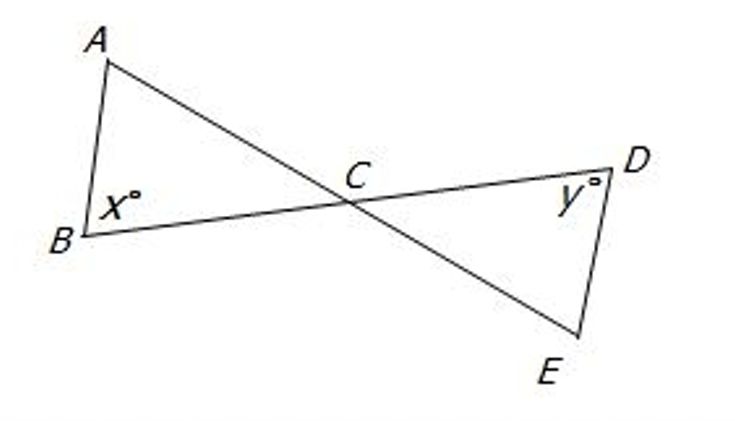
GRE If A C=B C and C D=D E.png [ 84.01 KiB | Viewed 392 times ]
\(\begin{aligned}
&\text A. { x }\\
& B. 180-2 x\\
& C. 90-2 x\\
& D. 4 x-180\\
& E. 45+\frac{x }{ 4}
\end{aligned}\)
Note: Figure not drawn to scale
Attachment:
GRE If A C=B C and C D=D E.png [ 84.01 KiB | Viewed 392 times ]
\(\begin{aligned}
&\text A. { x }\\
& B. 180-2 x\\
& C. 90-2 x\\
& D. 4 x-180\\
& E. 45+\frac{x }{ 4}
\end{aligned}\)
If A C=B C and C D=D E
[#permalink]
30 Jun 2026, 12:26
30 Jun 2026, 12:26
Expert Reply
1. Analyze Triangle A B C
- We are given that A C=B C , making \(\triangle A B C\) an isosceles triangle.
- In an isosceles triangle, the angles opposite the equal sides are equal. Since the angle opposite side A C is \(\angle A B C=x^{\circ}\) , the angle opposite side B C must also be equal:
\(\angle B A C=x^{\circ}\)
- The sum of the interior angles in any triangle is \(180^{\circ}\) . Therefore, we can find the vertical vertex angle \(\angle A C B\) :
\(\begin{gathered}
\angle A C B=180^{\circ}-(\angle A B C+\angle B A C) \\
\angle A C B=180-2 x
\end{gathered}\)
2. Move Across the Intersection Point C
- Lines B D and A E intersect at point C , meaning \(\angle A C B\) and \( \angle D C E\) are vertical angles and are equal to each other:
\(\angle D C E=\angle A C B=180-2 x\)
2. Move Across the Intersection Point C
- Lines B D and A E $ intersect at point C , meaning \(\angle A C B\) and \(\angle D C E \) are vertical angles and are equal to each other:
\(\angle D C E=\angle A C B=180-2 x\)
3. Analyze Triangle C D E
- We are given that C D=D E , making \(\triangle C D E\) another isosceles triangle.
- The angles opposite these equal sides must be equal. Therefore, the angle opposite side $C D(\angle D E C)$ equals the angle opposite side \(D E(\angle D C E)\) :
\(\angle D E C=\angle D C E=180-2 x\)
- The sum of angles in \(\triangle C D E\) must also equal \(180^{\circ}\) :
\(\angle C D E+\angle D C E+\angle D E C=180^{\circ}\)
- Substitute the expressions we found into the equation:
\(\begin{gathered}
y+(180-2 x)+(180-2 x)=180 \\
y+360-4 x=180
\end{gathered}\)
4. Solve for y
\(\begin{gathered}
y=180-360+4 x \\
y=4 x-180
\end{gathered}\)
Correct Answer: D. \(4 x-180 \)
- We are given that A C=B C , making \(\triangle A B C\) an isosceles triangle.
- In an isosceles triangle, the angles opposite the equal sides are equal. Since the angle opposite side A C is \(\angle A B C=x^{\circ}\) , the angle opposite side B C must also be equal:
\(\angle B A C=x^{\circ}\)
- The sum of the interior angles in any triangle is \(180^{\circ}\) . Therefore, we can find the vertical vertex angle \(\angle A C B\) :
\(\begin{gathered}
\angle A C B=180^{\circ}-(\angle A B C+\angle B A C) \\
\angle A C B=180-2 x
\end{gathered}\)
2. Move Across the Intersection Point C
- Lines B D and A E intersect at point C , meaning \(\angle A C B\) and \( \angle D C E\) are vertical angles and are equal to each other:
\(\angle D C E=\angle A C B=180-2 x\)
2. Move Across the Intersection Point C
- Lines B D and A E $ intersect at point C , meaning \(\angle A C B\) and \(\angle D C E \) are vertical angles and are equal to each other:
\(\angle D C E=\angle A C B=180-2 x\)
3. Analyze Triangle C D E
- We are given that C D=D E , making \(\triangle C D E\) another isosceles triangle.
- The angles opposite these equal sides must be equal. Therefore, the angle opposite side $C D(\angle D E C)$ equals the angle opposite side \(D E(\angle D C E)\) :
\(\angle D E C=\angle D C E=180-2 x\)
- The sum of angles in \(\triangle C D E\) must also equal \(180^{\circ}\) :
\(\angle C D E+\angle D C E+\angle D E C=180^{\circ}\)
- Substitute the expressions we found into the equation:
\(\begin{gathered}
y+(180-2 x)+(180-2 x)=180 \\
y+360-4 x=180
\end{gathered}\)
4. Solve for y
\(\begin{gathered}
y=180-360+4 x \\
y=4 x-180
\end{gathered}\)
Correct Answer: D. \(4 x-180 \)

gmatclubot
If A C=B C and C D=D E [#permalink]
30 Jun 2026, 12:26
Moderators: