

GRE Prep Club Daily Prep
Thank you for using the timer - this advanced tool can estimate your performance and suggest more practice questions. We have subscribed you to Daily Prep Questions via email.
Customized
for You
Track
Your Progress
Practice
Pays
Not interested in getting valuable practice questions and articles delivered to your email? No problem, unsubscribe here.

If square A B C D has area 25 , and the area of the larger
[#permalink]
 31 May 2026, 06:51
31 May 2026, 06:51
Expert Reply


00:00
Question Stats:
 75% (02:20) correct
25% (01:21) wrong based on 12 sessions
75% (02:20) correct
25% (01:21) wrong based on 12 sessions
Hide Show timer Statistics
If square \(A B C D\) has area 25 , and the area of the larger shaded square is 9 times the area of the smaller shaded square, what is the length of one side of the smaller shaded square?
Note: Figure not drawn to scale
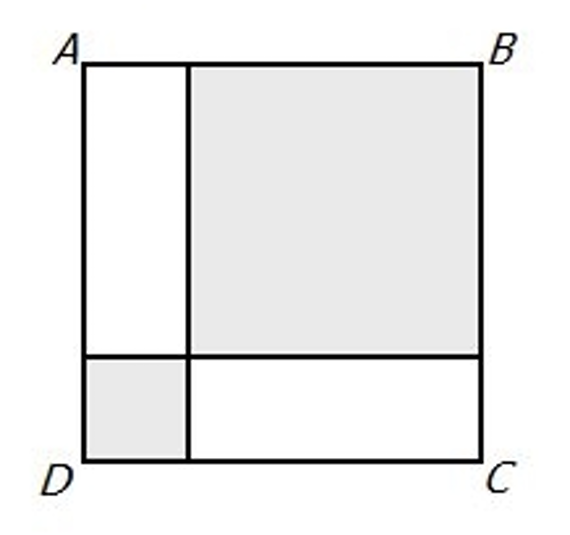
GRe If square A B C D has area 25 , and the area of the larger.png [ 32.42 KiB | Viewed 471 times ]
\(\begin{aligned}
& A. 3 / 4 \\
& B. 5 / 4 \\
& C. 6 / 5 \\
& D. 4 / 3 \\
& E. 5 / 3
\end{aligned}\)
Note: Figure not drawn to scale
Attachment:
GRe If square A B C D has area 25 , and the area of the larger.png [ 32.42 KiB | Viewed 471 times ]
\(\begin{aligned}
& A. 3 / 4 \\
& B. 5 / 4 \\
& C. 6 / 5 \\
& D. 4 / 3 \\
& E. 5 / 3
\end{aligned}\)
- Part of the project: GRE Daily Quant Challenge - Topic-Wise 2025!!!
- Also replying to the unanswered questions


If square A B C D has area 25 , and the area of the larger
[#permalink]
01 Jun 2026, 03:38
01 Jun 2026, 03:38
1
Carcass wrote:
If square \(A B C D\) has area 25 , and the area of the larger shaded square is 9 times the area of the smaller shaded square, what is the length of one side of the smaller shaded square?
Note: Figure not drawn to scale
\(\begin{aligned}
& A. 3 / 4 \\
& B. 5 / 4 \\
& C. 6 / 5 \\
& D. 4 / 3 \\
& E. 5 / 3
\end{aligned}\)
Note: Figure not drawn to scale
Attachment:
GRe If square A B C D has area 25 , and the area of the larger.png
\(\begin{aligned}
& A. 3 / 4 \\
& B. 5 / 4 \\
& C. 6 / 5 \\
& D. 4 / 3 \\
& E. 5 / 3
\end{aligned}\)
Square ABCD has side lengths of \(\sqrt{25}=5\).
Let the smaller shaded square have side length \(x\) and the larger shaded sqaure have side length \(5-x\), so we can set up the following equation:
\(9x^2=(5-x)^2\)
\(9x^2=25-10x+x^2\)
\(8x^2+10x-25=0\)
\((4x-5)(2x+5)=0\)
Since we are talking about positve lengths, \(x>0\), we get \(x=\frac{5}{4}\).
Answer: B) \(\frac{5}{4}\)

gmatclubot
If square A B C D has area 25 , and the area of the larger [#permalink]
01 Jun 2026, 03:38
Moderators: