

GRE Prep Club Daily Prep
Thank you for using the timer - this advanced tool can estimate your performance and suggest more practice questions. We have subscribed you to Daily Prep Questions via email.
Customized
for You
Track
Your Progress
Practice
Pays
Not interested in getting valuable practice questions and articles delivered to your email? No problem, unsubscribe here.

The tension between functional and ornamental imperatives has shaped b
[#permalink]
 05 May 2026, 23:56
05 May 2026, 23:56
Expert Reply
Question 1


00:00
Question Stats:
 32% (04:05) correct
68% (03:23) wrong based on 22 sessions
32% (04:05) correct
68% (03:23) wrong based on 22 sessions
Hide Show timer Statistics
Question 2
00:00
Question Stats:
71% (01:34) correct
29% (02:20) wrong based on 17 sessions
Hide Show timer Statistics
The tension between functional and ornamental imperatives has shaped both the practice of illustration and the scholarly study of its history. Nineteenth-century scientific illustrators, for instance, were divided: some prided themselves on purely observational precision, dismissing decorative elaboration as a corruption of scientific intent, while others drew freely on the conventions of landscape painting and ornamental engraving. This division came to organize the historiography of scientific illustration. Through most of the twentieth century, historians valorized pre-industrial illustration - celebrated for its visual richness - while treating postindustrial work as mere technical documentation devoid of aesthetic merit. Daston and Galison, however, have challenged this framing, arguing that the supposed boundary between the "artistic" and the "objective" was itself an achievement of the nineteenth century, constructed in part to distinguish the emerging professional scientist from the amateur naturalist. Prior to this construction, they contend, illustration was understood as a practice in which visual judgment and empirical accuracy were mutually constitutive, not opposed.
According to the passage, Daston and Galison would most likely argue that the historiographical tradition described was flawed because it
- A. projected onto earlier illustrators a distinction those illustrators would not have recognized
- B. underestimated the technical competence of pre-industrial scientific illustrators
- C. conflated the decorative conventions of landscape painting with genuine scientific observation
- D. ignored the role of amateur naturalists in developing standards of visual accuracy
- E. treated the nineteenth-century boundary between art and science as self-evident rather than as constructed
The passage implies that, prior to the nineteenth century, scientific illustrators most likely
- A. were evaluated primarily on the decorative quality of their work rather than its accuracy
- B. did not draw a sharp distinction between visual judgment and empirical observation
- C. were unaware of the conventions of landscape painting and ornamental engraving
- D. were considered less rigorous than their post-industrial counterparts
- E. deliberately avoided ornamental elaboration in order to preserve scientific credibility
- Part of the project: GRE Hard and Tricky Verbal Practice: NEW Questions Daily - Gain 20 Kudos & Get FREE Access to GRE Prep Club TESTS
- Also replying to the unanswered questions
Re: The tension between functional and ornamental imperatives has shaped b
[#permalink]
08 May 2026, 04:00
08 May 2026, 04:00
Expert Reply
EXPLANATION QUESTION #1
Q1 - Why E is correct and the others fail
The passage says Daston and Galison argue that the "boundary between the artistic and the objective was itself an achievement of the nineteenth century, constructed to distinguish the professional scientist from the amateur." This means the historiographical tradition took that boundary for granted as natural, when it was in fact historically made. E captures this precisely: the tradition treated the boundary as self-evident rather than constructed.
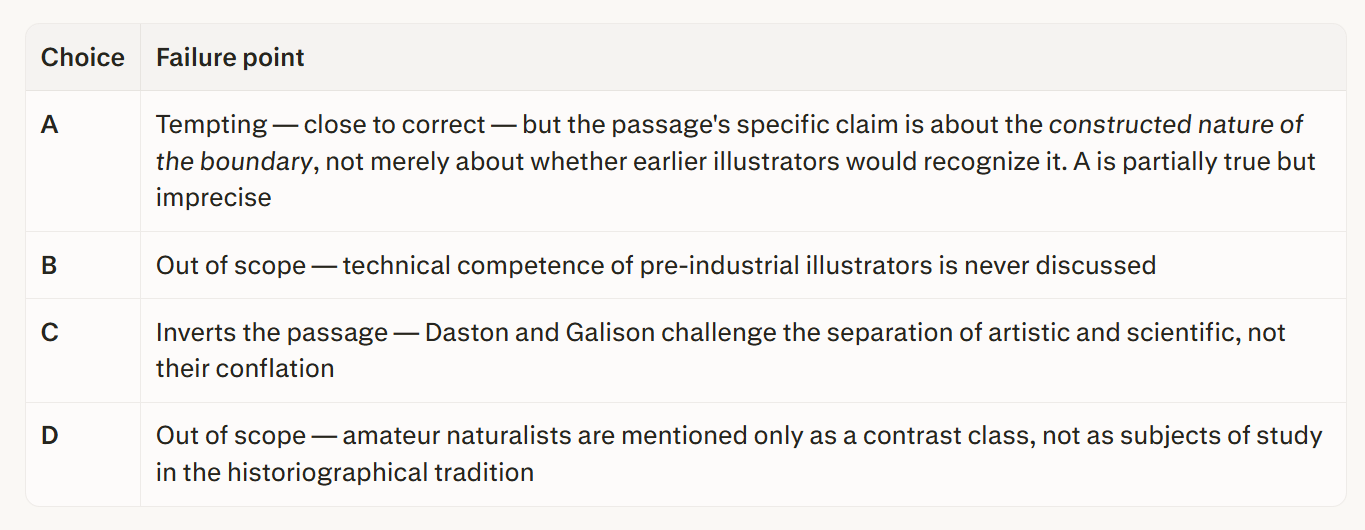
Q1.png [ 86.62 KiB | Viewed 780 times ]
Q1 - Why E is correct and the others fail
The passage says Daston and Galison argue that the "boundary between the artistic and the objective was itself an achievement of the nineteenth century, constructed to distinguish the professional scientist from the amateur." This means the historiographical tradition took that boundary for granted as natural, when it was in fact historically made. E captures this precisely: the tradition treated the boundary as self-evident rather than constructed.
Attachment:
Q1.png [ 86.62 KiB | Viewed 780 times ]
Re: The tension between functional and ornamental imperatives has shaped b
[#permalink]
08 May 2026, 04:00
08 May 2026, 04:00
Expert Reply
EXPLANATION QUESTION #2
Q2 - Why B is correct and the others fail
The passage states that prior to the nineteenth-century construction, "illustration was understood as a practice in which visual judgment and empirical accuracy were mutually constitutive, not opposed." This directly implies that earlier illustrators did not sharply separate visual judgment (aesthetic) from empirical observation (scientific). B states this precisely.
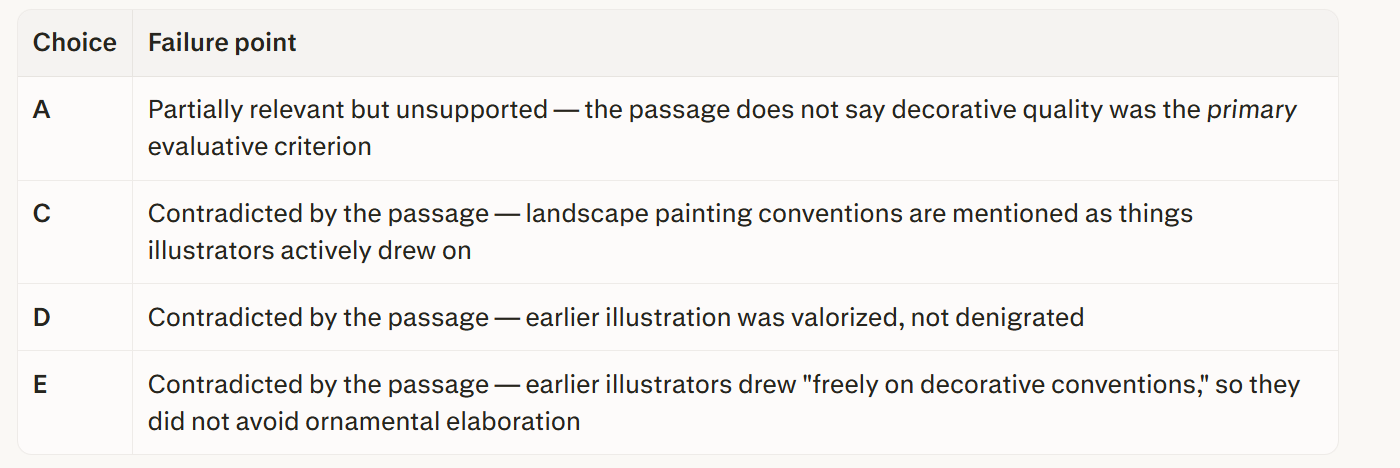
Q2.png [ 79.6 KiB | Viewed 776 times ]
Q2 - Why B is correct and the others fail
The passage states that prior to the nineteenth-century construction, "illustration was understood as a practice in which visual judgment and empirical accuracy were mutually constitutive, not opposed." This directly implies that earlier illustrators did not sharply separate visual judgment (aesthetic) from empirical observation (scientific). B states this precisely.
Attachment:
Q2.png [ 79.6 KiB | Viewed 776 times ]