

GRE Prep Club Daily Prep
Thank you for using the timer - this advanced tool can estimate your performance and suggest more practice questions. We have subscribed you to Daily Prep Questions via email.
Customized
for You
Track
Your Progress
Practice
Pays
Not interested in getting valuable practice questions and articles delivered to your email? No problem, unsubscribe here.
 Nov 17
Live Online Classes with Top GRE Expert Rich Zwelling
08:00 PM EST
-10:00 PM EST
Get live instruction from a top-scoring, industry-recognized GRE teachers + 6 months of access to TTP Self-Study included! Tues/Thur Sept 7, 2026---Feb. 2, 2027, 1:00pm-3:00pm EST Dec 14
Live Online Classes with Top GRE Expert Michael Butville
08:00 PM EST
-10:00 PM EST
Get live instruction from a top-scoring, industry-recognized GRE teachers + 6 months of access to TTP Self-Study included! Mon/Wed Dec. 14, 2026---Feb. 22, 2027, 8:00pm-10:00pm EST

What is the value of w in terms of x and y ?
[#permalink]
 19 May 2026, 13:03
19 May 2026, 13:03
Expert Reply


00:00
Question Stats:
 100% (02:27) correct
0% (00:00) wrong based on 4 sessions
100% (02:27) correct
0% (00:00) wrong based on 4 sessions
Hide Show timer Statistics
What is the value of w in terms of x and y ?
Note: Figure not drawn to scale
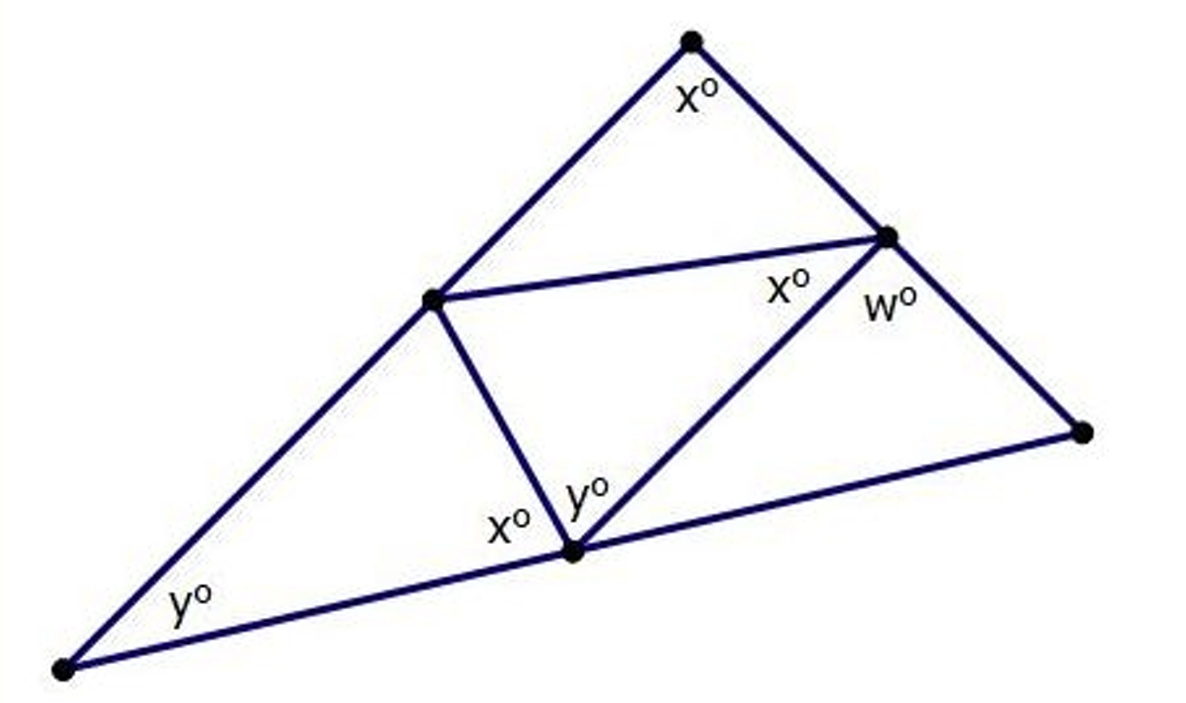
GRe what is the value of w.png [ 361.9 KiB | Viewed 445 times ]
\(\begin{aligned}
& A. 2 x+2 y-180 \\
& B. 180-x-y \\
& C. 360-2 x-2 y \\
& D. 360-2 x-3 y \\
& E. 180+x-2 y
\end{aligned}\)
Note: Figure not drawn to scale
Attachment:
GRe what is the value of w.png [ 361.9 KiB | Viewed 445 times ]
\(\begin{aligned}
& A. 2 x+2 y-180 \\
& B. 180-x-y \\
& C. 360-2 x-2 y \\
& D. 360-2 x-3 y \\
& E. 180+x-2 y
\end{aligned}\)
- Part of the project: GRE Hard and Tricky Verbal Practice: NEW Questions Daily
- Also replying to the unanswered questions
Re: What is the value of w in terms of x and y ?
[#permalink]
20 May 2026, 09:39
20 May 2026, 09:39
Expert Reply
1 Top Triangle:
The top triangle has interior angles of \(x^{\circ} \) and two others. Let the angle at the bottom-left vertex of this triangle be A and the angle at the bottom-right vertex be B.
The sum is x+A+B=180, so A+B=180-x.
2 Left Triangle:
The large triangle on the left has vertices with angles \(y^{\circ}, x^{\circ}\), and the sum of the angles at the base. Let's call the angle at the bottom-right vertex of this large triangle C.
By the triangle sum theorem, the angle at the top is $x$, and the angle at the bottom-left is y.
Therefore, the third angle C must be:
\(C=180-x-y\)
3 Middle Quadrilateral/Triangle setup:
Looking at the middle triangle, it has an interior angle \(x^{\circ}\) and an interior angle \(y^{\circ}\). Let the third angle be D.
\(D=180-x-y\)
4 The Bottom-Right Triangle:
We now have a triangle on the bottom right containing the angle \(w^{\circ}\), the angle \(y^{\circ}\), and an angle adjacent to the previous ones.
Based on the straight line at the right-hand intersection, the angles must sum to \(180^{\circ}\). If we sum the interior angles of the entire outer boundary and relate them to the inner triangles, we find:
- The angle inside the bottom-right triangle, adjacent to w, is calculated as 180-(180- x-y)-x=y. No, that's not right.
- Let's use the sum of all angles: The total sum of the two smaller bottom triangles equals the large triangle.
- By calculating the interior angles of the bottom-right triangle:
- One angle is y.
- One angle is determined by the intersection: 180-(x+C)=180-(x+ 180-x-y)=y.
- The sum of angles is w+y+(180-x-y)=180.
- Actually, following the correct geometric path: w=180-(180-x-y)- (180-x-y)=2 x+2 y-180.
The correct answer is \(2 x+2 y-180\).
The top triangle has interior angles of \(x^{\circ} \) and two others. Let the angle at the bottom-left vertex of this triangle be A and the angle at the bottom-right vertex be B.
The sum is x+A+B=180, so A+B=180-x.
2 Left Triangle:
The large triangle on the left has vertices with angles \(y^{\circ}, x^{\circ}\), and the sum of the angles at the base. Let's call the angle at the bottom-right vertex of this large triangle C.
By the triangle sum theorem, the angle at the top is $x$, and the angle at the bottom-left is y.
Therefore, the third angle C must be:
\(C=180-x-y\)
3 Middle Quadrilateral/Triangle setup:
Looking at the middle triangle, it has an interior angle \(x^{\circ}\) and an interior angle \(y^{\circ}\). Let the third angle be D.
\(D=180-x-y\)
4 The Bottom-Right Triangle:
We now have a triangle on the bottom right containing the angle \(w^{\circ}\), the angle \(y^{\circ}\), and an angle adjacent to the previous ones.
Based on the straight line at the right-hand intersection, the angles must sum to \(180^{\circ}\). If we sum the interior angles of the entire outer boundary and relate them to the inner triangles, we find:
- The angle inside the bottom-right triangle, adjacent to w, is calculated as 180-(180- x-y)-x=y. No, that's not right.
- Let's use the sum of all angles: The total sum of the two smaller bottom triangles equals the large triangle.
- By calculating the interior angles of the bottom-right triangle:
- One angle is y.
- One angle is determined by the intersection: 180-(x+C)=180-(x+ 180-x-y)=y.
- The sum of angles is w+y+(180-x-y)=180.
- Actually, following the correct geometric path: w=180-(180-x-y)- (180-x-y)=2 x+2 y-180.
The correct answer is \(2 x+2 y-180\).

gmatclubot
Re: What is the value of w in terms of x and y ? [#permalink]
20 May 2026, 09:39
Moderators: